

Published
Part 1
Name: Fractal Sextet
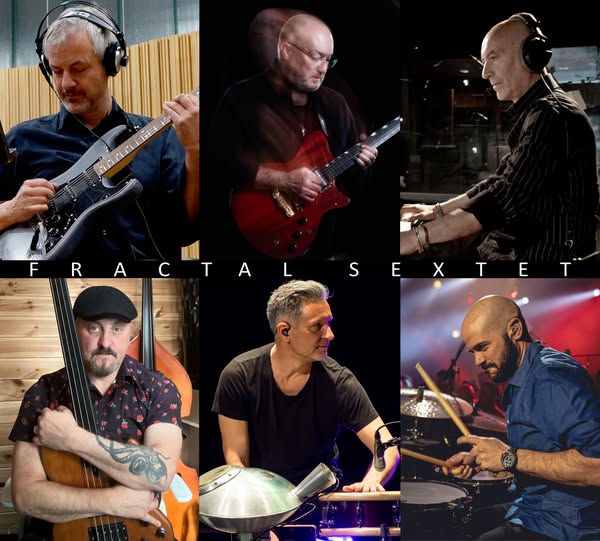
Members: Stephan Thelen (guitars, keyboards), Jon Durant (guitars, cloud guitar), Fabio Anile (piano, synths, samples), Colin Edwin (bass), Andi Pupato (percussion, udu and azzam bells), Yogev Gabay (drums)
Interviewee: Jon Durant
Nationality: American (Jon Durant), British (Colin Edwin), Israeli (Yogev Gabay), Italian (Fabio Anile), Swiss (Stephan Thelen, Andi Pupato)
Current release: The Fractal Sextet's sophomore album Sky full of Hope is out via RareNoise. Jon Durant has also collaborated with Stephan Thelen on the latter's series of Rothko Spaces albums.
[Read our Stephan Thelen interview]
[Read our Stephan Thelen interview about Rothko Spaces]
[Read our Colin Edin interview]
[Read our Andi Pupato interview]
If you enjoyed this Jon Durant interview and would like to know more about his music, visit his official website. He is also on Facebook, and bandcamp.
For a deeper dive, you can read the thoughts of some of his collaborators in our Robert Jürjendal interview and our Elif Yalvaç interview.
In the press release to Sky full of Hope, Mike Jacobs calls the term math rock “heinous.” On the other hand, Stephan Thelen is actually a mathematician and musicians from the time of Bach (and before) have often regarded music as a mathematical discipline. How do you see that yourself?
Oh, there is a huge mathematical component. I’m in no way a mathematician but I have long seen how math worked in understanding harmony, and of course, in Stephan’s case how rhythm works musically.
As for the term “math rock” … what I’ve heard from that genre didn’t interest me all that much, though some of it was definitely of more interest than straight up pop music.
But in general I’m not interested in anything that fits squarely into any genre. I’m far more interested in blending and mutating genres.
From some of the interviews with you that I've read I gathered that you also really like Nik Bärtsch's RONIN. Their approach shares a few similarities with the Fractal Sextet and Andi was even a member of RONIN for some time. Where do you personally see the overlaps and differences?
Yes, I really love Nik’s work and feel like there are definitely some parallels.
Andi’s work in both groups is, to me, absolutely central. I really miss his playing on the most recent couple Ronin albums. He has a really distinctive sound and approach that is what immediately grabbed me the first time I heard Ronin.
I’ve been really fortunate to work closely with him over the last few years and I think what he does here with Fractal Sextet and also on my most recent solo album (Momentarily) is really extraordinary.
And to me, his work on the Fractal Sextet albums is an absolute highlight—every time he hits something, it’s always just the right time and right place.
[Read our Nik Bärtsch interview]
[Read our Nik Bärtsch's RONIN band interview]
The biggest overlap between Ronin and Fractal Sextet is within the polyrhythmic nature of the music.
But one huge difference comes in within the improvisations: within Ronin there is a much larger focus on hypnotic rhythmic improv, whereas on Fractal Sextet there is much more emphasis on melody in the improvisation.
You've stated that the compositional approaches of Stephan and Fabio Anile are very different from your own. In which way?
Stephan and Fabio both tend to write from a rhythm first perspective. My own work, especially on Momentarily but also within Burnt Belief (with Colin Edwin), most often begins with texture, followed by melody, with rhythm coming third.
I’m really a fan of a lot of the early ECM work where the rhythm was often more implied than overtly stated, which is why I found it strange that Ronin were on ECM for so many years.
Since your cloud guitar work is not inherently rhythmical, I'm curious about what the effects of shifting the focus more towards a rhythmical focus feels like for you – both in your music in and outside of the Fractal Sextet.
It’s fascinating for me to spend time focusing on the rhythmic element, but what I really love is when I stop counting and just feel the rhythmic pulse. But also, the mixing my a-rhythmic clouds with the tightly played rhythms that are being laid down by Colin and Yogev helps to keep things from feeling too static.
In Burnt Belief, Colin came up with the idea to take my clouds and run them through a slicer pedal which chops up the drifting clouds into rhythmic pulses which then get sent through rhythmic delays to create really atmospheric rhythms which we could build tracks around. 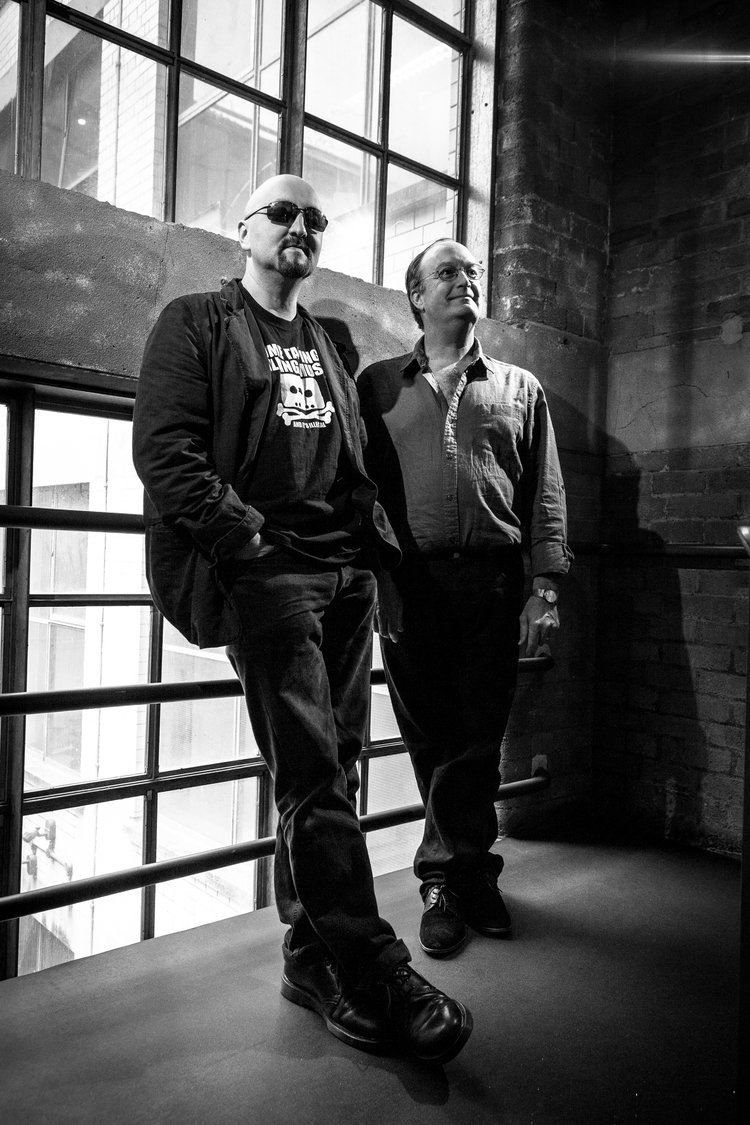
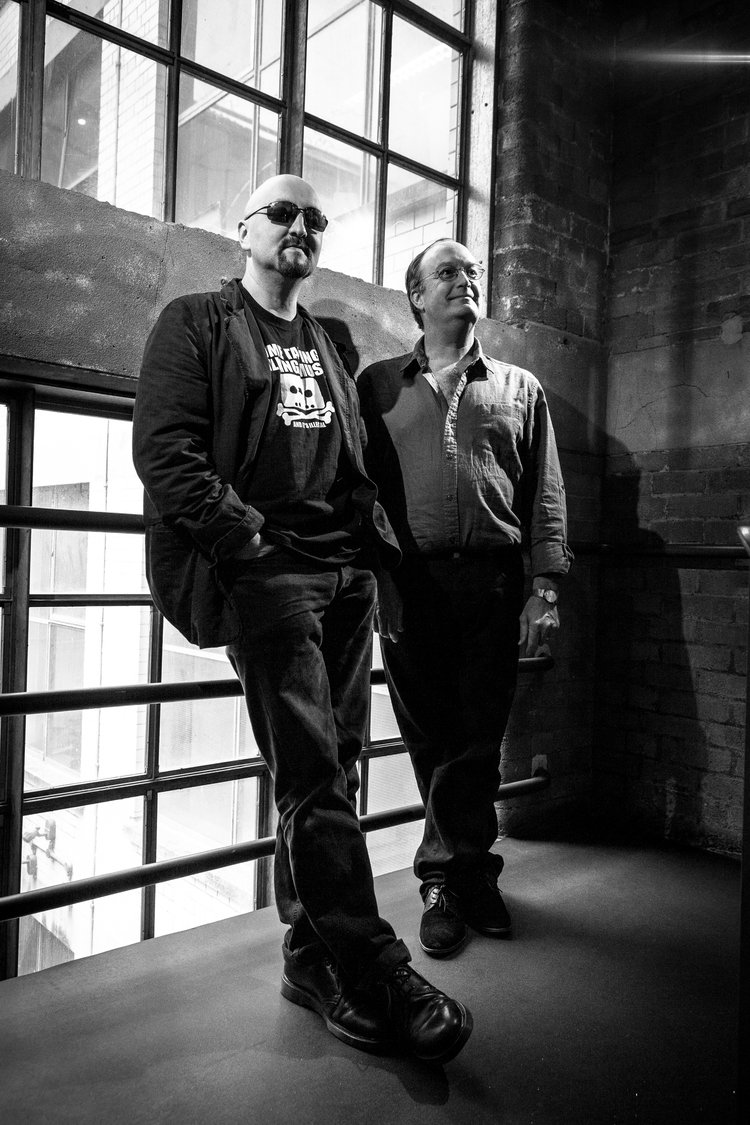
Burnt Belief Interview Image (c) Jon Durant & Colin Edwin
I used this technique in a few spots on the Fractal Sextet albums and I find it to be a really effective texture. Most listeners would imagine that it’s a synthesizer but it’s guitar generated.
Both of your albums as a group were recorded remotely – I'm still trying to wrap my head around that, as the music sounds incredibly cohesive and “in one space.”
It really is incredible how much it feels like everyone was together, despite the fact that we recorded everything remotely. This is evidence that Colin, Andi, Yogev all listen to everything that is played and respond to that.
When we were recording Yogev, it was instantly clear that he’d not only mapped out all the rhythmic elements that he need to play (an enormous task in and of itself!) but that he knew all the solos by heart and was responding to them.
On Sky Full of Hope, Colin was recorded after Yogev so he could respond to Yogev as well as to Fabio, Stephan and I. And Andi could then respond to everyone and everything.
What are you presented with from Stephan and Fabio and what does the process of interpretation, performance, and putting-the-pieces-together work like in practise?
My role comes early in the process. Stephan or Fabio will have a groove that they want me to play over. Some of the time the composition is pretty well fleshed out by the time it gets to me, but sometimes it’s very early and they will write things around what I’ve done.
In the case of the title track, the structure was there, but my solo ended with a really epic melodic statement which Stephan orchestrated to turn it into the final melody.
There is a rousing and truly ecstatic climax towards the end of “Four Hands.” What do you remember about how that came together?
This was very much a case of Stephan and Fabio having had a great picture of what they wanted from the beginning. So when I got it, I could already see the form that the piece was going to take and it was a matter of generating a really great build in the course of the solo.
By the end the guitar was screaming and it’s a great case of Yogev feeling it and really propelling us to that climax. 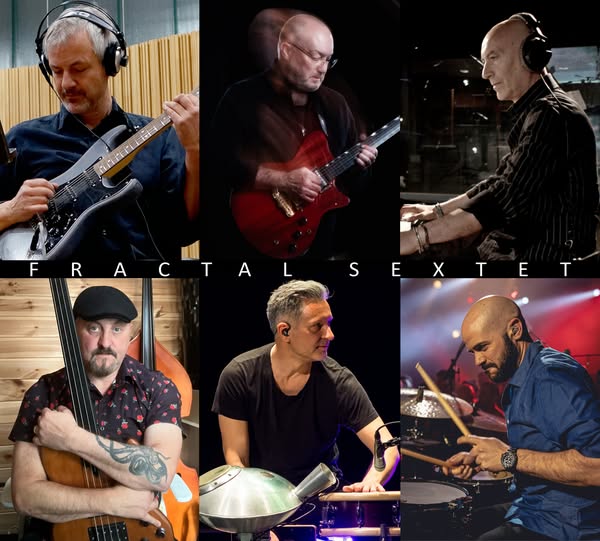
Fractal Sextet Interview Image (c) the artists
I know you're all eager to play this music live which is proving hard because of the dire realities of touring at the moment …
Man … just the cost of getting the six of us in the same room runs into several thousand dollars because of our remote locations.
But, that said, if we can find a way to mitigate that, we are all on board. The spirit between all of us both as people as well as musicians is really palpable.
Also, audience reaction can play a tremendous role in propelling the band forward when there is room for interpretation of a piece. It’s such a joy to know when the audience is responding to what you do and it pushes you to keep trying to explore and excite them.
Do you think that in some way the music benefits from the “discipline” (if that's the word) over spontaneity that recording it remotely imposes?
Stephan and I had a discussion about this while we were recording my parts for Rothko Spaces 3.
With the complexity of the Fractal Sextet compositions, there’s a lot to be said for taking the time to fix parts and be able to have Colin switch between upright and electric bass on “Four Hands” for instance. It makes for a nicer record to listen to in the end, in my opinion.
That said, there’s a ton of spontaneity that happens on our records, especially within my parts. I really don’t do much overdubbing within my solos (though I do overdub parts like the acoustic and electric chords on the title track). So while I might do a couple takes for Stephan to choose from, we don’t usually edit between them, we really try to keep it alive.
One thing we discussed, however, is that we really want to do the next one live in the studio with more room for group improvisation.
How different would this music sound like if you did play it live together, do you think?
If we were able to take the group live, there would likely be a lot of discussion about how we would pull together the different elements that make up the rhythm tracks.
Because of the precise nature of Stephan’s rhythmic delays that are central to his fractal guitar parts, we’d have to use a click, which we’re all accustomed to so that’s not a problem for us.
But hopefully we’d be able to stretch out forms a little bit and see where that leads us through group improvs.