

Part 2
You said that playing with the sextet gives you the freedom to be who you are as a guitarist and the opportunity to push beyond that at the same time. Can you expand on that a bit?
The reason Stephan first asked me to participate in the Fractal Guitar albums was because he appreciates that I’m first and foremost a really distinctive player. I might display elements of guitarists to whom I’ve listened but I really don’t sound just like any of them.
But the other element is that his music is really challenging and absolutely forces me to really try to push harder to make sure that what I do makes him sit up and take notice.
And after the many albums we’ve done together, he knows me and knows how to say “give me more” or “that’s not what I had in mind” and send me deeper into myself to get the best out of me.
Since the fractal philosophy seems so much about a rhythm, what are the considerations for a fractal solo?
For my solos, I really try to NOT focus on rhythm so much because the rhythms underneath me are really very structured. And I want to break that by maybe playing across bar lines or play slightly out (such as on “Uneven,” where I really wanted to feel like something is off).
But even while I’m in time, such as on the title track, I really want to add an emotional energy that feels apart from the rhythm and stands alone as a melody.
In relation to sound, one often reads words like “material”, “sculpting”, and “design”. Do these terms make sense for your understanding of music and your own creativity?
Indeed, yes. Especially texturally with my clouds,
I am always thinking about visuals and spatial ideas more than traditional rhythms and melodies. I was really inspired early on by Fripp and Eno, as well as early Tangerine Dream, and it was always the way they sculpted sound that drew me in.
[Read our feature on Fripp & Eno's No Pussyfooting]
[Read our Brian Eno interview about climate change]
[Read our Tangerine Dream interview]
For yourself, can you talk a bit about how you're working with the overtones and distortion signals from your guitar or other instruments/tools to shape the music you're playing?
One of the central things that I dove into back in 2016 was fretless guitar. I’d studied with Randy Roos back in 1981-82, and he’d been doing amazing things with a fretless guitar with infinite sustain since the late 70s and I was absolutely blown away by it.
But because of what Randy had done, I felt like there was no way I could approach it as he’d been so influential on me. But my brother Kingsley had gotten one and brought it to me to check out and the minute I put my hands on it, I knew it was my calling.
I had Saul Koll build me one with a sustainiac pickup and I was immediately taken over by it. The phrasing possibilities are amazing, I can add Indian or middle eastern inflections that I’ve always loved using via whammy bar, but now they are so much more immediate and instinctive for me.
As for distortion and other effects: I have always wanted to be able to make the guitar sustain much longer than they normally do. I’m much more interested in the phrasing that’s possible from breathing, like a trumpet or sax or voice, than a guitar can do on it’s own. So by using distortion and feedback and volume pedal swells I can keep notes going longer to create a much more breathy feel.
As for other effects, like delays and reverb and modulation kinds of things, that harkens back to the sound sculpting that I loved about early synthesis and my desire to do that with a guitar.
Stephan's other big project at the moment are his Rothko Spaces. Since you're also deeply interested in photography, how do you see the connection between the visual (and space) and sound?
The Rothko Spaces albums are very special and very close to my heart. I’ve always felt a deep connection between visual and aural mediums, and my interest in photography came out of a lull in my musical output. I feel like I need to have some creative outlet to flow from me and it really sparked a nice challenge to transfer from one to the other.
But specifically for Rothko, there is such a haunting space within his painting that absolutely demands, for me, a musically accompaniment. I have a Pacific Northwest based modern artist from whom I have purchased several pieces (Jeane Myers) and she and I have spoken at length about how this kind of art, and my more abstract ambient music work really well together.
And the Rothko Spaces albums really connect that way. I’m really happy with my work on the second and especially the third instalment.
[Read our Markus Reuter interview]
The music on Sky Full Of Hope really occupies a fascinating space between the usually clearly demarcated fields of composition, improvisation, production, and interpretation. What do these terms imply to you creatively and can you reflect a bit on their interaction within the Fractal Sextet?
Interesting question! Because each of them is different and yet somehow they all have to blend to create a uniform whole, at least in so far as the recorded medium of “an album” is concerned.
Composition involves the piecing together of the melodies, rhythms and textures into a cohesive structure. Improvisation is the spontaneous construction of music—which can really be compositional in itself. (My album Momentarily was a series of improvisations that I then composed around to create the pieces that resulted.) And improvisation within a composition, whether as “solos” or as group improvs, can add drama and excitement to a composition.
Production is how the whole thing is put together, both from a sonic perspective but also from a performance perspective. The producer’s job is to extract the best possible performance and sound for the final result. Interpretation is when a musician follows the composition but develops their own unique idea about how that composition might sound with a different approach.
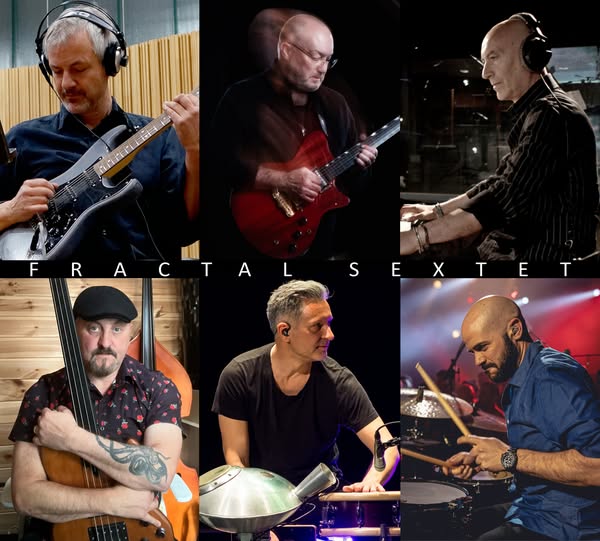
A great example of this within Fractal Sextet is how my improvisations can inspire Stephan to expand or enhance his composition. Or how Colin interprets the bass lines that Stephan or Fabio wrote and turns them into his own unique parts. Further as producer, Stephan will listen to my takes and chose ones that he feels are best.
You've described the second album as more “emotionally centred” than the first one. That's interesting, for me it's the other way around: the album feels a bit more drifting, inviting me to let go and float rather than hold on to my feelings.
It’s wonderful how everyone hears things in their own way.
To me, the fact that everyone was so much more prepared for how we would work on the second album allowed us all to play more from the heart. The first album was very exciting but to me we were all learning how it might work and that left me feeling like it was more cerebral than the new one.
There are moments on the first one, for sure, but overall tracks like “Flight of the Phoenix,” “Ladder to the Stars” and “Sky Full of Hope” really hit me emotionally.