

Part 2
Artists from all corner of the musical spectrum, not just “free jazz” have emphasised the importance of freedom in their creativity. What defines freedom for your improvisations?
K: Freedom comes from not needing to repeat — freedom is the chance to re-express and to re-imagine and to change.
M: I don’t really know how to meaningfully think about freedom in this context and it isn’t a word I feel comfortable thinking with, personally. Not to say that I think it shouldn’t be used here.
Artistically I think a lot about the distribution of control and relation, which encompasses power and awareness of positions.
But I don’t think in terms of freedom in my artistic practice because I’d prefer to keep its political importance around the ability for a subject to think or act separate from making art, which imports barriers or conditions of class & privilege.
Taking your recent projects, releases, and performances as examples, what, would you say, are the key ideas behind your approach to improvisation?
M: Relation, listening, indeterminacy, and materiality.
K: For me, key ideas behind the improvisation in all my recent work, including Ouroboros and solo projects, are balance, patience, and a willingness to go very deeply into sound.
I often think about horror vacui—a fear of empty space—and how to fight against that while leaning into sound completely. There’s a lot to channel through improvisation, it craves time.
In your best improvisations, do you feel a strong sense of personal presence or do you (or your ego) “disappear”?
K: During the best feeling improvisations (hopefully also the best sounding improvs!), I feel like I melt into sound and really disappear into the process. I like having this happen while playing alongside another person, and feel like Mitch and I reach that space through a lot of our work.
M: I find for myself if I go too far down the line of thinking about removing ego that I lose the ability to make artistic decisions. Presented with a set of options everything feels equally possible, like there’s a flattening of criteria to the point where I am so far removed, I might as well not be there and just listening to something interesting like the overtones and resonance of a bathroom fan.
That said, I am happiest when I’m playing, listening, & responding rather than controlling or pushing. I suppose there is throughline in my work to looking for forms of indeterminacy to circumnavigate ‘virtuosic’ tendencies from my earliest days of trying to shred.
Trying to let go of mastery and striving towards whatever thing.
What are some of your favourite collaborators and how do they enrich your improvisations?
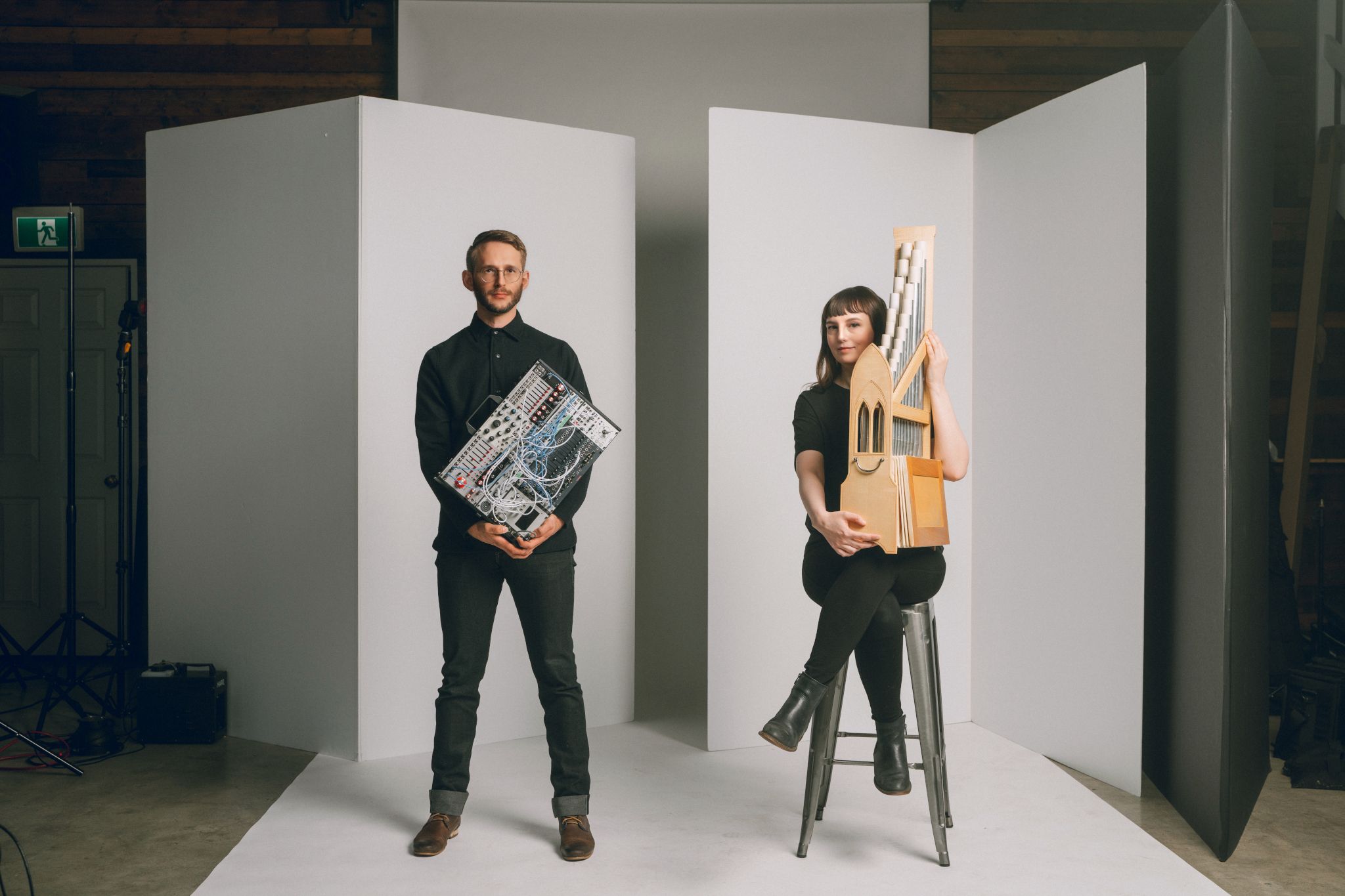
K: Mitch is definitely one of my favourite collaborators, and I enjoy how his attention to detail and his sensitive process enrich my own attention to sound.
Ben Grossman, an incredible hurdy gurdy player and sound artist, and Isaiah Ceccarelli, an amazing drummer and composer, are also favourite collaborators and friends — their ideas feel timeless and limitless to me.
You can hear some of my work with Ben on Cetus …
… and Isaiah on Landmarks.
M: Playing with Kate is obviously a joy and I’m constantly in awe of the clarity of her intent and how she brings that out in so many aspects of her playing.
Recent work with performance artist Peter Morin, along with Nora Wilson and Edie Skeard, was an insightful and powerful experience of holding and supporting one another in sounding.
Being able to collaborate with Dave Riedstra on the Sympath, a resonator and feedback instrument, has opened a number of new ways of working I’m carrying into new projects.
In a live situation, decisions between creatives often work without words. From your experience and current projects, what does this process feel like and how does it work?
K: This depends on the person I’m working with and on the situation. I actually have no problem talking to a collaborator while we’re playing live, if that feels like the right thing at the moment and they’re clearly comfortable playing and talking at the same time.
But yes, often there are no words and musical gestures become the way to communicate decisions. Sometimes gestures are planned out in advance, so if I hear something specific, it acts like a trigger for what’s about to happen or what should happen next.
Other times, everything is intuitive, and the creative experience is a series of chain reactions.
Stewart Copeland said: “Listening is where the cool stuff comes from. And that listening thing, magically, turns all of your chops into gold.” What do you listen for?
K: I always listen for opportunity and for space to communicate; I look for a way to have a musical conversation and for chances to step aside.
M: I listen for prompts from what’s happening that suggest direction.
I guess for me listening is the thing rather than chops. Pauline Oliveros or other forms of practices of attention come to mind where bodily conditioning (i.e. technique) facilitates interaction but that relation is at the fore rather than a product of gesture.
It’s the technique of mutually holding space for attention.
[Read our Pauline Oliveros interview]
There can be surprising moments during improvisations – from one of the performers not playing a single note to another shaking up a quiet section with an outburst of noise. Can you tell me about such situations from your own performances and how they impacted the performance?
M: Some of the most rewarding moments for me playing with Kate is when our sounds blend, and we lose hold of whose is whose. Suspending those moments and playing with the smallest details are some of my favourite musical situations.
I think the track “Turns” really shows these moments when what we’re doing respectively wouldn’t work without the other and we’re playing into each other’s sound.
In a way, we improvise all the time. In which way is your creative work feeding back and possibly supporting other areas of your life?
M: Improvisation for me relies on a specific quality of attention so I’d find it elsewhere most commonly in observation, whether that’s paying attention to food or drink, meditation, or just listening to whatever.
The difference here is I am not immediately active in these examples but they’re not significantly different for me.