

Part 1
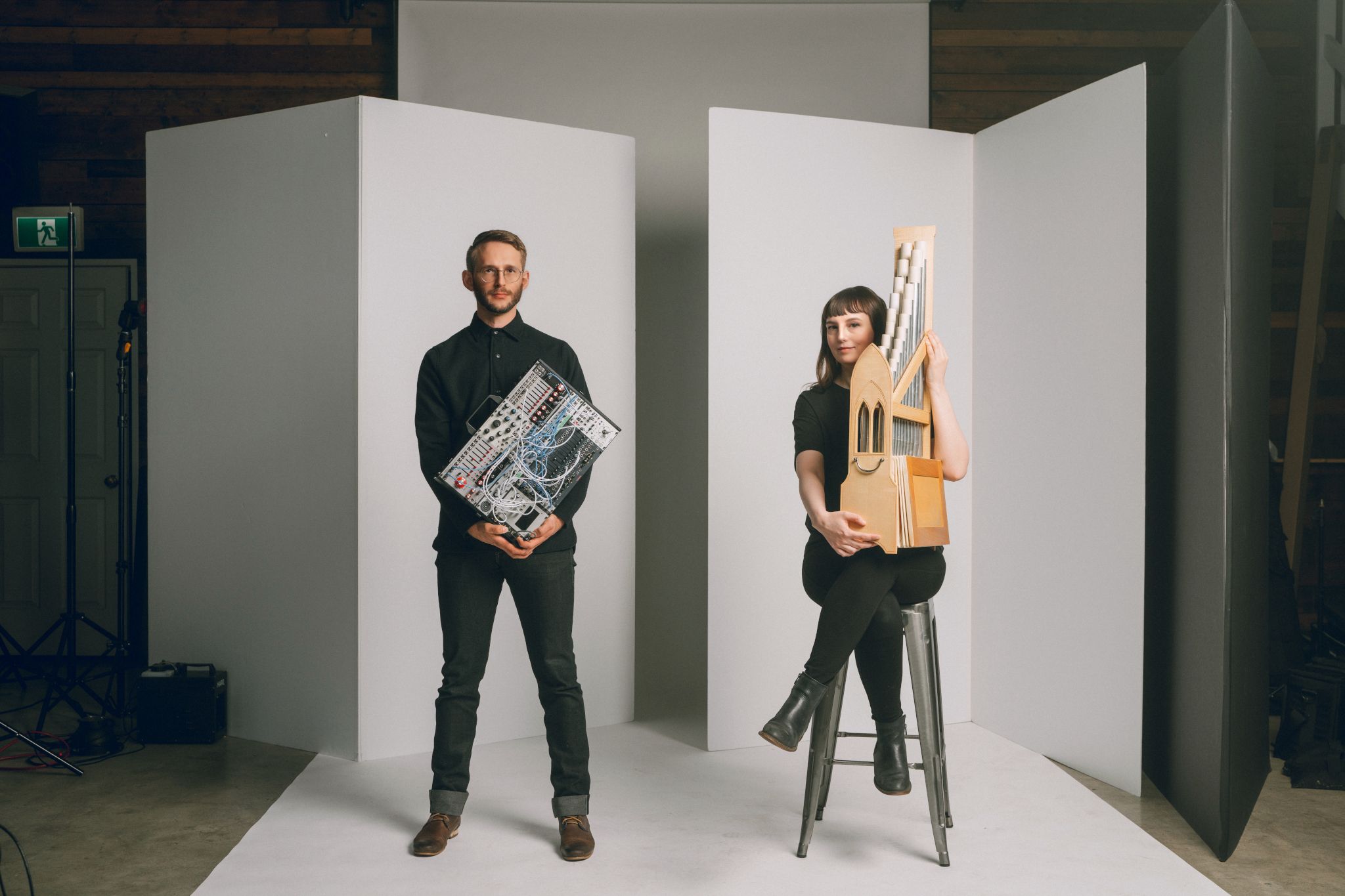
Names: Katelyn Clark, Mitch Renaud
Nationality: Canadian
Occupation: Composer, curator, sound artist (Mitch), keyboardist, performer, improviser (Katelyn)
Current release: Katelyn Clark and Mitch Renaud's album Ouroboros is out via Hallow Ground.
Global Recommendations:
K: In my hometown of Victoria, located on the traditional territory of the lək̓ʷəŋən speaking peoples in British Columbia, Canada, I’d recommend walking up Gonzales Hill to the observatory and watching the sky and the ocean.
M: In Victoria BC I would point folks to the reversing waterfall on the Gorge under the Tillicum Bridge, as seen from Saanich Gorge Park. It’s the site of the lək̓ʷəŋən story of Camossung and it’s been a grounding place for me when I first moved here and I have recently returned to that area.
Topic that I am passionate about but rarely get to talk about:
M: Ask me about pro-cycling, chess, or minimal intervention wine.
If you enjoyed this interview and would like to know more about the artists and their work, visit their respective homepages: Katelyn Clark; Mitch Renaud
When did you first consciously start getting interested in musical improvisation? What was your first improvisation on stage or in the studio and what was the experience like?
K: My early experiences with musical improvisation came from playing basso continuo on harpsichord, so within a classical/early music context. I found this type of improvising interesting but limiting, which led to freer musical improvisation.
I actually can’t remember my first improvisation on stage, but my first improvisation in studio was a solo, and the experience felt like opening a door. You can hear an early example of my improvising on portative organ on SoundCloud.
M: I grew up playing guitar in bands from metal to pop punk to jazz, so my earliest relation to improvisation was through the vernacular of guitar solos.
When I started studying jazz in high school, my teacher introduced me to a broader context for improvisation through folks like Francois Houle or John Zorn, but especially John Cage. That moment in New York encapsulated by Cage and others made me aware of an overlap between indeterminacy and improvisation that I’m still interested in today.
Tell me about your instrument and/or tools, please. What made you seek it out, what makes it “your” instrument, and what are some of the most important aspects of playing it?
K: I work with historical keyboard instruments, mainly on harpsichord and portative organ (organetto), sometimes with electronics/processing.
I originally sought out these instruments to experience really early keyboard sounds and repertoire, and important aspects of playing include touch/release, temperament, and sustain/lack of sustain.
With organetto, I especially like to play with harmonics and extended techniques, which you can hear in the track "Ballast (Returns)" on Ouroboros.
M: I designed my modular synth and the patch I play with around acoustic feedback with spring reverb. Over 5 years and several iterations, I’ve found different ways to interact with the feedback loop (bandpass filters, delays, shifting phase, and gain staging).
I also use a harmonic oscillator to extend key pitches from the feedback loop so there are two ‘voices’ that I can play with. I think "Ballast (Returns)" on the album, especially the closing thirty-five seconds, shows these voices of my instrument.
The tuning system Kate and I developed for this record extends from the frequencies of the feedback available with my instrument, so it has developed alongside the interests and ways of working that I brought to this project and really feels a part of my work with Kate.
But you could also say that refining this instrument and how I relate to it has shaped my practice elsewhere in my work.
K: The specific tuning system for our works on Ouroboros was really effective for improvising between organ and synth. You can hear this throughout the album, especially in moments like a few minutes into the track “Obliquity I” and in the second half of “Turns.”
How would you describe your own relationship with your instrument – is it an extension of your self/body, a partner and companion, a creative catalyst, a challenge to be overcome, something else entirely?
K: I have a deep relationship with my instruments. That relationship has taken different forms over time, sometimes more research driven or focussed on instrument maintenance/development, sometimes more exploratory in terms of creation.
My keyboards are definitely an extension of my creative self, requiring care to stay in a good playing condition and to adjust to new environments.
M: I think of my instrument as something to play with, something that has its own agency that affects what or how I play with it.
The key aspect of this instrument for me is the balance between control and indeterminacy. Gradually I’ve found different ways to interact with it so I can play it with a level of repeatability, but control still isn’t linear. If I want to shift the frequency of the feedback, different ways of influencing it will bias it towards different changes.
Even with areas with lots of energy that it’s quick to move to there is a delay between my input and its response, so the instrument really plays an active role, blocking traditional virtuosity and shifting my focus to listening and attending to how I’m relating in that improvisation.
Derek Bailey defined improvising as the search for material which is endlessly transformable. What kind of materials have turned to be particularly transformable and stimulating for you?
M: Materiality itself, when I can respond to what’s given and play with that, is especially stimulating for me - whether playing with temperament in an embodied relation or listening to how our instruments are responding on the day.
K: Manipulating temperament or tuning systems, and building ostinati or repeated patterns often come back to me when improvising. I feel like these things offer endless material that can be drawn out in different directions and in different contexts.
Do you feel as though there are at least elements of composition and improvisation which are entirely unique to each? Based on your own work or maybe performances or recordings by other artists, do you feel that there are results which could only have happened through one of them?
M: Yes, I suppose so. There are polar examples of improvisation or composition that couldn’t exist in the other. But it’s the fuzzy middle area between improvisation and composition that I’m interested in, spaces we can think about being co-compositional.
I can think of groups like Kneebody, Fond of Tigers, and Wayne Shorter’s band around 2009 (with Brian Blade, Danilo Perez, and John Patitucci) as really opening different ways of improvising.
Recent releases by Judith Hamann or Lucy Railton have been really alluring in the way they play out relations between their instruments, their embodiment as players, and small details of their materials.
[Read our Judith Hamann interview]
K: I feel as though composition allows planned moments/elements to happen quickly, but also feel that when improvisors play together frequently enough this can happen in non-composed contexts.
Maybe composition is like reading letters back and forth with a friend, while improvisation is finishing each other’s sentences.
For my own work, tracks like “Obliquity II” from Ouroboros and most of my work with Isaiah Ceccarelli on the album Landmarks (Another Timbre) could only have happened with elements of co-composition.
When listening to others’ work, I love being unsure about how much of the music is purely improvised or composed in advance.
When you're improvising, does it actually feel like you're inventing something on the spot – or are you inventively re-arranging patterns from preparations, practise or previous performances? What balance is there between forgetting and remembering in your work?
K: It depends on the situation. With our work in Ouroboros, we’re executing material that is semi-composed, so a lot of the improvisation is within practised material.
There’s still a balance of forgetting and remembering because most of the material isn’t notated, and I love remembering alongside Mitch and hearing how we react to each other’s micro changes. Listening to tracks “Obliquity I” and “Obliquity II” gives a sense of this.
M: The body of work on this record for me feels more like tapping into and iterating on an absent form: not so much a score, but a shape with shared understanding of vertical & horizontal points. I want to retain an openness so listening can shift how we approach that shape.
We are creating versions of whatever it is that takes into account what’s going on in our bodies, attention, instruments, and in the room. The goal for me is really relational rather than some form of top down realizing a thing.