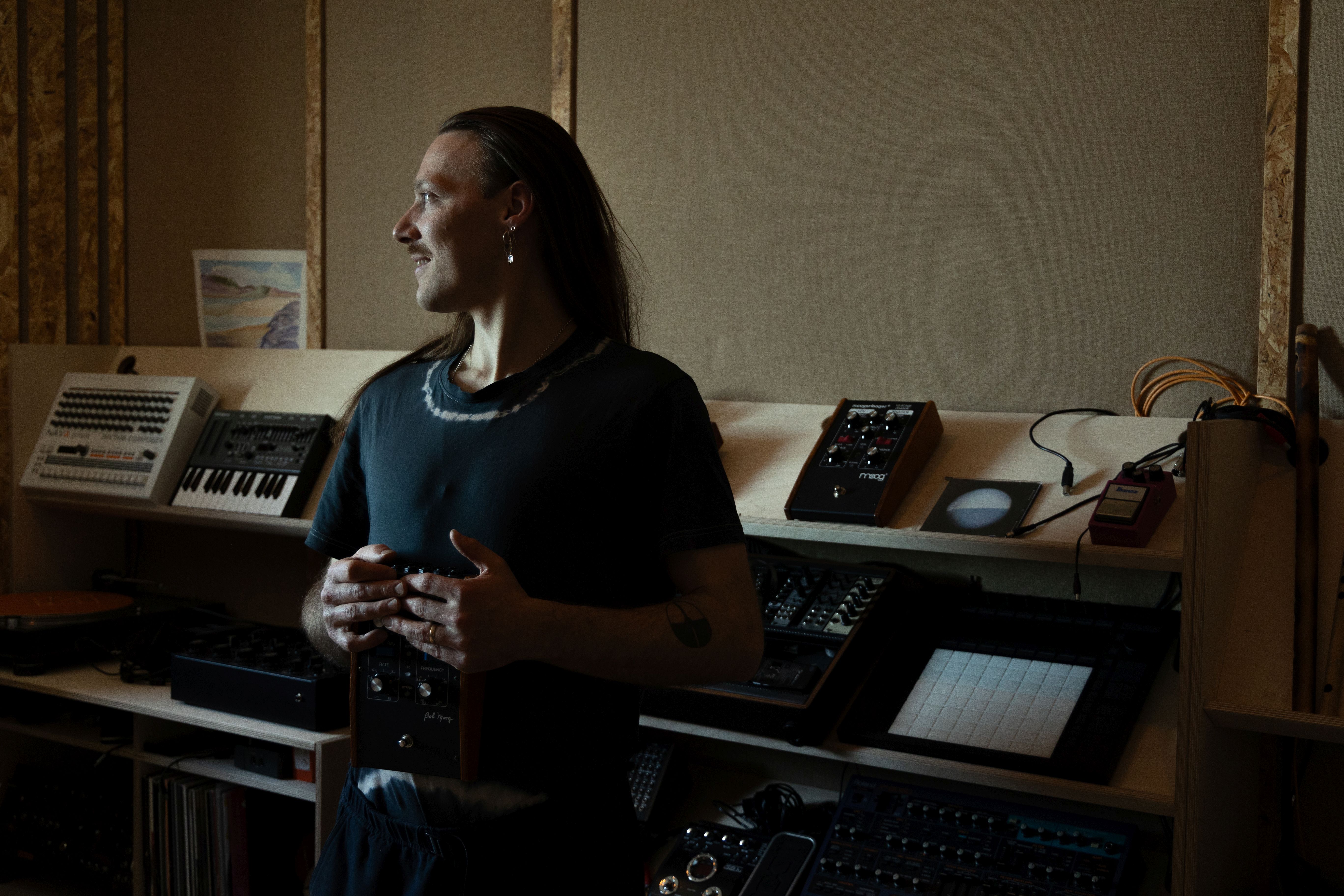


Part 1
Name: Bendik Baksaas
Nationality: Norwegian
Occupation: Producer, musician, composer, improviser
Current Release: Bendik Baksaas's Flex Core LP is out October 11th 2024 via Snick Snack.
Recommendations: I would like to share a work of my favourite artist Maria Brinch. it's called “The Swimming Pool”, print, ink and paint on fine wool. Maria makes out of this world tapestries and paintings. She’s also my wife, so I get to use her works for home decoration before they’re acquired.
I would also like to share the book Other People's Clothes by Calla Henkel. It’s a fun ride of a book, pageturner, funny and deep at the same time. It mixes very thoughtful and precise reflections on club culture, internet culture and the art world, into a humorous and intense thriller. it's really a unique book. Entertaining and challenging at the same time.
If you enjoyed this Bendik Baksaas interview and would like to know more about his work and music, visit his official homepage. He is also on Instagram, Facebook, and Soundcloud.
For the thoughts of one of his collaborators, read our Kjetil Jerve interview.
Do you think that some of your earliest musical experiences planted a seed for your interest in production and technology?
I remember music being a cassette or CD + a machine that could play them, with inbuilt speakers and recording capability. We had a black Sony with two tape recorders, so my parents showed me how to record a CD or cassette onto another used cassette, to share the music with friends. I did this in first grade of public school. It appeared to me a lot of fun working with the machine and making music into more music.
The added bonus of having to share that with my friends, giving them back a legendary Aqua-album instead of their old childrens music cassette they didn't like, was a base layer of the understanding that music is powerful when it's shared and experienced by those we relate to.
This was my first direct contact with music, other than my mother and father playing and singing to me. It was the first opportunity to myself interact with the technology: moving cassettes around and changing their musical energy. To the joy of the moment in work, and for the later appreciation of the other young people in my close surrounding.
Making music, in the beginning, is often playful and about discovery. How do you retain a sense of playfulness and how do you still draw surprises from tools, approaches, and musical forms you may be very familiar with?
Yes this is true. For a lot of people the road to becoming a master in your craft and art has a curve of enthusiasm and playfulness at the start, that slowly decays after the person understand the details and depth of finer work outside the persons technical and artistic reach.
When a composer and producer hits this point in their journey it's a good opportunity to work on mindset. If you are in the game for long time, it is inevitable that you will have several low points in your career. Those valleys are for learning. Staying humble and search for knowledge and input to grow. Sounds complicated, but it's easy, just start with getting sun in your face every day. If it's cloudy, still spend your lunch and as much daytime as fits in contact with the sun.
When we connect tough points of time, (months and months stuck on an album, less gigs, less money), to positive times in our health, we undermine the fear that is often related to prolonged time of low frequency emotions. That makes them much more managable, and also lets them capture less time than necessary of our day.
Staying playful is easiest done in this way for me: Quantity before quality. May sound counterintuitive, but the thing is that when I strive to make quality, I am usually in my own way. My pre-perceived idea of what the vibe of the track will be, is sometimes not physically possible in the audioverse. That's why I stay playful through two very opposite modes:
1. Free jam. Playing and working only with hands and ears on a modular synthesizer, or cassette deck and tape delay.
2. Drum programming. I work with 909 Core Kit in Ableton plus distortion and saturation and other internal effects to make soundscapes and drums. I usually make one minute loop with a little twist. I use a bit more than one hour on this “excercise”, and always come out with a new groove in the end. Sometimes it's great.
I keep coming back to these two approaches to create the initial material of tracks. I do it often so I have a lot of music to make into final tracks in the next layer of the process. I love to do it, never gets boring, always new rhythms and feelings to appear.
For your own creativity, what is the balance and relative importance between what you learned from teachers, tutorials and other producers on the one hand – and what you discovered, understood, and achieved yourself? What are examples for both of these?
The defining thing about balance is that it is never constant, never frozen. In the live 3d-simulation of Yin Yang, it is spinning like a centrifuge in all directions all the time. Balance is about flexibility and using as little muscle as possible to maximum effect on a healthy physical and spiritual level. The dancing movement of walking on a slim trunk of a fallen tree can be zoomed out to depict the developing journey of a musical artist over many years.
I am a big believer in the transitioning of craft and knowledge through p2p work like in the old times, a craftsman or craftswoman would always have their apprentices around. People in study directly from the master over many years. This was how people always learned their skill, the idea of a big common school is quite young in the long historical context.
I have a lot to thank many different people that have mentored me through the years. If it wasn't for the technical and artistic skills I learned directly from them I would not be able to make the music I do and live it the way I do.
I also work as a mentor myself, both privately and as external force on the electronic music education in University of Agder. I understand the point that, now that alot of good tutorials are on youtube, music can sound more similar as the same approach is often used, and in this way limits the growth of genres because it is a stagnation of new musical input.
As far as I see I this is not a problem. Of course, lame copycats will always appear around great movements of art, but so what. Every person needs to be their own filter of signal and noise. There will be noise. Choose to listen to and support with money and attention what you perceive as quality and the problem disappears. The old systems of cataloging music on the internet needs to drown in their own amount of files, and we need new and creative, positive ways to distribute and share music between us. Holding it digitally, easily shareable, but also private and with ownership that lets you rediscover your loved music later.
Coming back to the constant noise of tutorials and “how-to-live-your-life”s. Sometimes we are in a valley, and it's a good thing to use the opportunity to educate yourself about something. Be aware that you need to actively chose something that brings you up and is good information. When we work ourself upwards, coming up into the mountain, we tune down the amount of information and suggestions coming in. Because we are already there. We make a lot of music. Some of it is great.
To sum up: I learned music production and artistic performance through mentors and teachers and fellow producers. I cherish the moments in learning, and I hope I will always stay here.
Developing a personal and honest artistic voice is an ongoing process for every living musician. This is only done through developing the ear and musical experience. It can only be done by personal work, it requires pairing it with learning the technical craft of what you perceive (how to shape audio frequencies in time). Finding and expressing this voice takes many years (ca 10) for alot of people. There are some exceptions, people doing it in a year or two.
How and for what reasons has your music set-up evolved over the years and what are currently some of the most important pieces of gear and software for you?
When I was 19 a fellow bassist showed me Ableton Live. I had made some experimental pop and musique concrete in Audacity on a crashing laptop earlier, but when I first got my hands on a white macbook and Ableton Live it changed my life.
Through playing electric bass in the nudiscoband Proviant Audio I had discovered the magic of the 4/4-kick. Most of my early work was influenced by this music and popularity of disco, nudisco and house in Oslo in 2008. I worked mainly with vinyl samples and Ableton. The track “Baby” is a good example of this era.
After a few years I started getting interested in synthesizers. I met the norwegian slampoet Fredrik Høyer and started making a lot of music with him. I had fallen in love with minimal club music in Berlin and my productions suddenly had fewer elements. The tracks “Ode til alt Ute” and “Elegi over Avicii” are good examples of this.
After spending too much time in front of the blue screen, I fell completely in love with hardware around eight years ago. I started playing strictly improvised dawless gigs, though I love playing hybrid now. My remix of Susannna's “The Ghost” is made live in one take on Pulsar 23 + a keystep to make the arpeggio.
My setup both in the studio and live has gone through many waves. For a good time now I have landed on:
Studio: Ableton for drums and processing, small modular case for riffs/melody/perc, Fulltone Tube Tape Echo + Eventide Space + Tascam Portastudio 414 for fx. Distressors for compression. Most important of all: Genelec S360A to actually hear what I'm doing. The last missing piece was those monitors, and if I had gotten them earlier I wouldn't have had to waste so much money on drum machines and eurorack to try make the music sound good.
Live: Allen Heath Xone96 + Ableton live to play, loop and mix stems from tracks and drum loops refined in the studio. For expression and improvisation I use a hand luggage sized Eurorack case. Eventide Space and Strymon Timeline for fx, or the tape echo and tascam if travel allow it.
The reason for the changes in setup have been development of my aesthetic preference. I like to use the same machines live and in production, because then time spent on music benefits me in both situations.