

Part 1
Name: Aniek de Rooij aka Alberta Balsam
Nationality: Dutch
Occupation: Producer, composer, vocalist, songwriter, DJ
Current release: Alberta Balsam's new album One Way Trip to Gaia is out now.
If you enjoyed this Alberta Balsam interview and would like to know more about her music, visit her on Instagram, Soundcloud, and Facebook.
What was the first time you were consciously impressed by technology – in and outside of music?
I’ve always been fascinated by science and technology, even as a child. Visiting the astronomical observatory and the Space EXPO with my dad were some of my favorite experiences. I had shelves full of books about spaceships and the galaxy, and I’d spend hours tinkering with an electronics experimentation kit I found endlessly fascinating.
When I discovered Ableton, it completely blew my mind. It opened a whole universe of possibilities for music-making that I hadn’t even imagined was possible. Before that I only knew that you could play an instrument, but never even imagined you could make it yourself.
I’ve since embraced my love for gear and technology! Diving into how it all works and understanding the new devices is my thing. I even read gear manuals on holiday for fun. Yes, you could say I am a real gear nerd.
Tell me about one or two of your early pieces that you're still proud of (or satisfied with) in terms of production – and why you're content with them.
I think being satisfied or happy with your own productions is something that takes a long time, especially if you want it to be consistent and not just a lucky shot.
One of my earliest tracks was released on a Rotterdam label called Lowriders under a different name, ANIK. I had to change that name because, besides the name being highly unoriginal, that year about 4 different acts with the same name emerged and it became a big Spotify mess.
But the tune, I think it holds up—I like what I did sound design wise, which has birds that go mad in the background, and it still sounds good on a big sound system.
It took me a couple of years after that to create something on the same level, which can be discouraging sometimes.
When it comes to arranging, sound design, performing, composing, etc – what are currently concrete topics and aspects that interest you and where you want to improve or simply challenge yourself?
Right now, I’m focusing on diversifying my live performances. I used to do strictly hardware based live sets, but currently I am collaborating with visual artist Timaeus. He created a whole visual world for the album. Besides the artwork for the album, that really matches the world I was envisioning, he also created a music video.
With all this material in hand we wanted to create an audiovisual liveshow. For the liveshow it made much more sense to do more with Ableton, as it is so pre-composed and I want it to really be a project that belongs to the album.
I think it is impossible to do this all live, I improvise using drum machines on top, have quit a lot of macros to control and process, with everything rendered into different stems and I process my vocals a lot, as I actually also did in my former liveset. 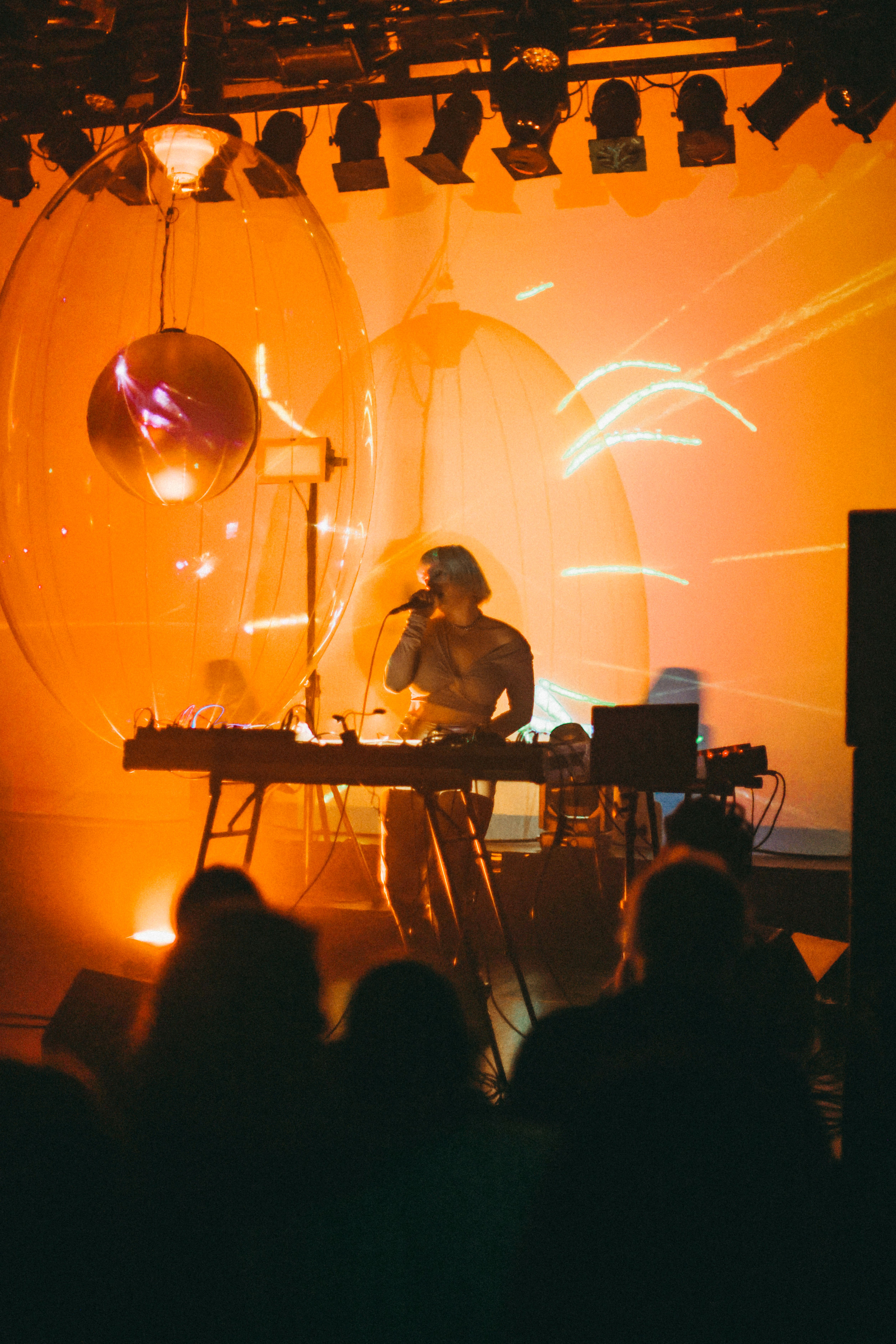
Alberta Balsam Timaeus Live Photo by Hessel Stuut
We made this into quite an ambitious project, performing not just with projections but also with a translucent orb that is on stage and that has built in lighting. Like an egg from which the organisms that are the visuals originate. It’s really quite spectacular. 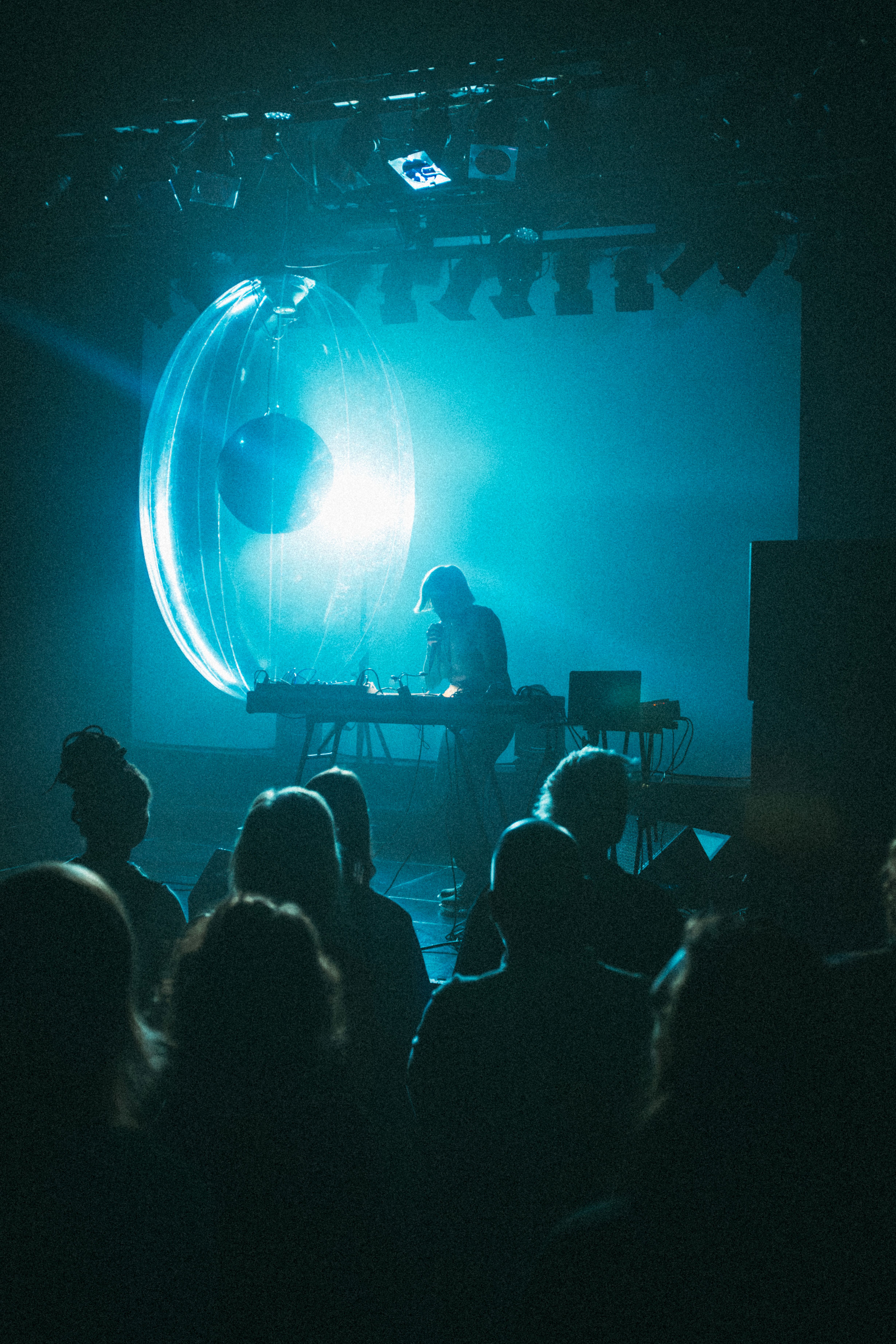
Alberta Balsam Timaeus Live Photo by Hessel Stuut
I’ve also started diving into Unreal Engine, a game engine, with my VJ, Timaeus. It allows for incredible interactive audio design, and I’d love to use it in the future in art-related projects—maybe even creating an interactive album down the line. The idea of merging visuals, sound, and interactivity is something I’m really excited about.
Besides that I am exploring composing for a broader palette of instruments—not just electronic but also classical—and explore new dimensions in my sound design. I also keep feeling the need to improve my craft on the mixing side. It is essential that your track sounds good and this is the most difficult part to get right.
Do you keep up with recent developments in terms of gear and software? If not, why not? If so, what are you looking for?
Absolutely! Staying updated with gear and software feels like a hobby for me. I enjoy watching modular rundowns and gear reviews on YouTube—definitely better than doomscrolling on Instagram.
That said, I’ve realized it’s important not to get lost in the endless chase for new tools. I have definitely been guilty about this. At one point, I thought every new piece of gear was “the missing link” in my music journey. It’s tempting too, if you see your favorite artist, like Objekt, Tzusing or Autechre, using a certain piece of kit, you think that maybe this is their secret, and that maybe that’s what you need?
But the truth is, the magic comes from learning your tools inside out—not from piling up more gadgets. Now, I’m working towards a “capsule collection” of gear: only what I truly need for my creative process, nothing more. Carefully selecting what’s really part of my sound.
For example, I’m really into the Machinedrum for drums and synthesizing drum sounds with the ARP2600, so I’m starting to let go of gear that doesn’t serve a clear purpose or doesn’t get any use.
[Read our feature on the Elektron Machinedrum]
[Read our feature on the Behringer 2600 Gray Meanie]
[Read our feature on the ARP 2500]
How and for what reasons has your music set-up evolved over the years and what are currently some of the most important pieces of gear and software for you?
I treat my studio like I treat my home—constantly tweaking it for better ergonomics, sound, and workflow. I find a cozy and warm ambiance essential; I want it to be a place where I want to spend a lot of time.
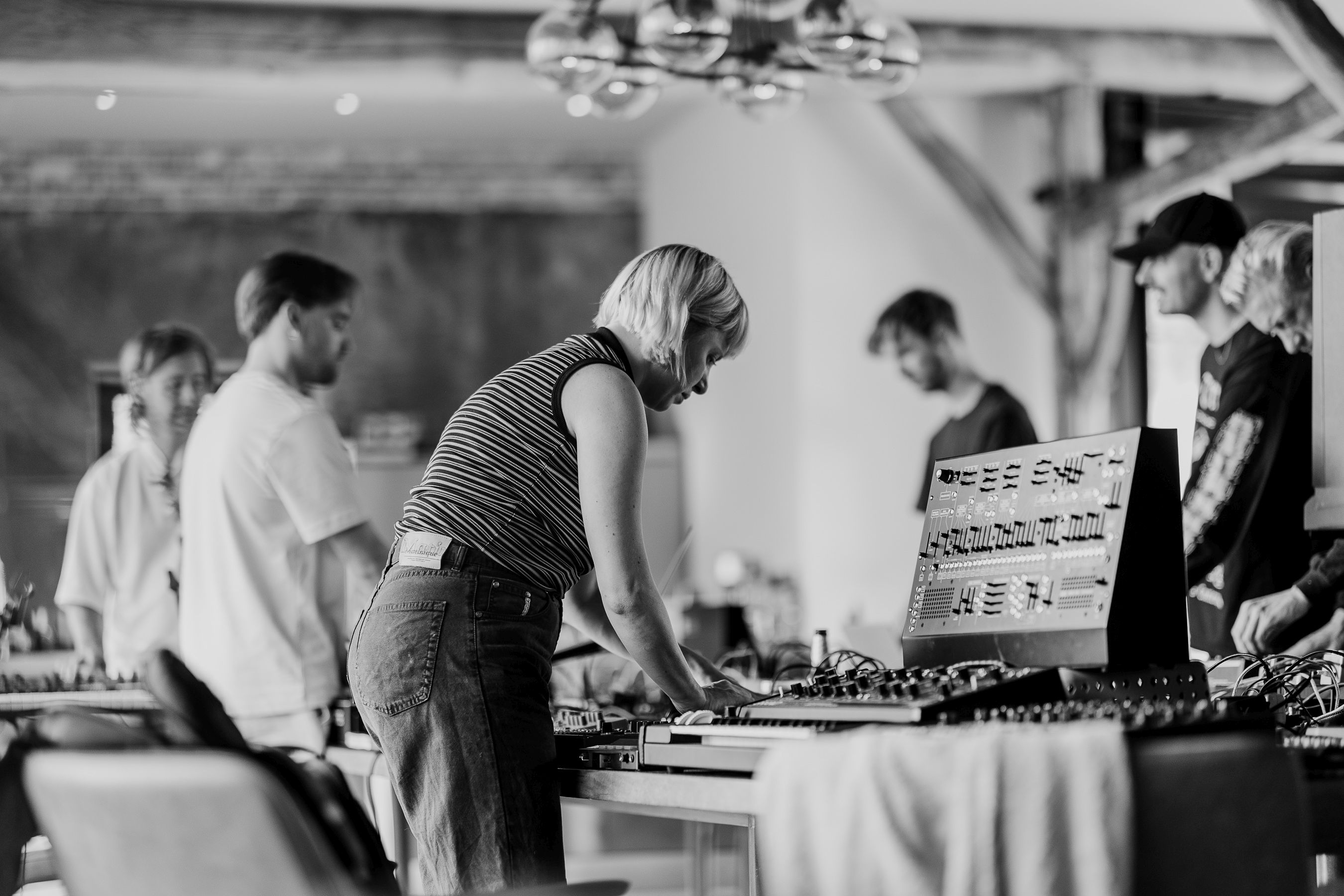
I change gear a lot. I can think and talk about this for ages, driving my boyfriend crazy with my ideas about studio improvement. I think it’s quite obsessive. I started out using just Ableton and a MIDI keyboard and overtime I gradually added hardware, like the Analog Rytm, JX3P, Sixtrak, Octatrack and the ARP2600. I’ve also, only just recently, started going into modular.
When you start having so much gear, everything gets more complicated, you need MIDI splitters, patchbays and bigger soundcards. I want everything to be pre-wired, making starting up a new tune seamless. I still struggle with the fact that I have to pull out a lot when having to play live, and that really messes with my workflow and my nicely configured studio. Therefore I have a flexible spot which is the top of my desk that always has a midi out ready and 4 stereo ins going to my soundcard. I also have two outputs from my soundcard ready from my patchbay. I mostly use them to process sounds through my modular FX.
For synths, I rely heavily on the OB-6 and the Arturia V-Collection. For mixing and processing, plugins like FabFilter, Soundtoys, and the Eventide H3000 are essentials. My biggest challenge now is improving the acoustics of my room—it’s not as sexy as buying a new synth, but it’s far more critical for achieving great mixes.
Jean-Michel Jarre maintained that, despite the advances in virtual technology, we are still "analogue animals made out of blood and bones who need buttons and knobs to touch.” In how far is this statement true or false for your own music?
I think this is more true now than ever. In a world where we’re bombarded with digital media, there’s something deeply grounding about physically interacting with hardware. Turning knobs and pushing buttons adds an organic, hands-on element to music-making that can’t be replicated on a screen.
For me, working with hardware makes the process feel alive—it’s playful, intuitive, and much less like “work.” I think the more you integrate real-life manipulation into your music, the more life your work takes on.
What are examples of production tools/instruments that you bought for a specific purpose?
I think every tool should be bought for a specific purpose, because if it doesn’t have a specific purpose, it’s highly likely you do not necessarily use it.
So for doing live performances specifically I bought the Octatrack, Analog Rytm and Digitone and I have some small modules like the Vermona Mono Lancet. I bought the Machinedrum specifically for its ace drum sound, it cuts through everything and sounds so unique.
Then I have the ARP2600 for sound design, I create everything from weird squirks to super distorted kicks using the ARP2600. My modular I bought at first for processing my voice live, but I use that more to process all kinds of stuff and to interface with my semi-modulars.
For pads I have the OB-6, the JX3P going into an Avalanche Run a Six-Trak and a Pro-3. I did not find yet the polysynth that 100% rocks it for me.