

Part 2
I wonder if part of the issue already comes about because pretty much everyone thinks of the voice not just as a “foreground” instrument, but one which requires accompaniment. Do you think it would help if children were to sing in vocal ensembles again more?
That’s an interesting possibility!
We’ve been used to hearing the voice acapella (solo or as a group) for centuries, and maybe it’s something we’ve forgotten about recently. Or maybe in certain settings it’s become less common!
But reconnecting to the voice as a self-sufficient means of music-making can only be a positive thing.
Do you think that, as part of the construct you're describing, male musicians will also often not choose to take on the role of jazz vocalist?
I can’t speak to the experience of the male jazz vocalists, and would be very interested to hear more from someone who has experienced it firsthand. But the gender issues that affect female vocalists certainly also affect vocalists of any gender.
It’s a very femme-coded profession, and as someone a little further away from the femme side of the spectrum, I can imagine the types of difficulties that would come up.
I do think it’s a reason there are less male vocalists!
What could the structural support you mentioned concretely consist of?
I can list a few things, speaking both from my experience and from talking with colleagues.
First, within singing lessons, use of sheet music and music terminology from the start, rather than focusing only on text and learning music only by ear. Within institutions, inclusion of vocalists as equal melody instruments in instrumental ensembles and classes (rather than having separate classes and curricula). Also in institutions, having extra ear-training and theory/harmony support available for those who need it, and encouraging vocalists to excel in these areas.
A few more: vocal music and vocalists should be taught as an integral part of the jazz tradition rather than a separate subgenre! Vocalists’ recordings should be studied for more than just learning the lyrics or noticing the emotional component of the music, but as holistic masterful musical performances to be analyzed and transcribed just as any horn’s would! Jam session leaders can normalize having vocalists sit in in the same role as any other melody instrument (and together with other melody instruments!) without it needing to be a “Vocal Jam Session”!
My incredible former teacher at The New England Conservatory, Dominique Eade, published an article in Downbeat a few years ago about supporting vocalists in institutions, and she mentions additional things like instructors being well-versed enough in vocal music to give equally comprehensive feedback to vocalists in their ensembles.
NEC got many things right, actually. I loved, for instance, that private lessons weren’t based on instrument - I, a vocalist, took lessons with saxophonists and pianists, and non-singer colleagues could take lessons with Dominique.
The list goes on, and I’d be very excited to hear more conversations like this being had!
I'd love to know more about the vocal performances for Mímica: Música para quatro instrumentos, please, and the qualities of your voice that you wanted to bring to the fore.
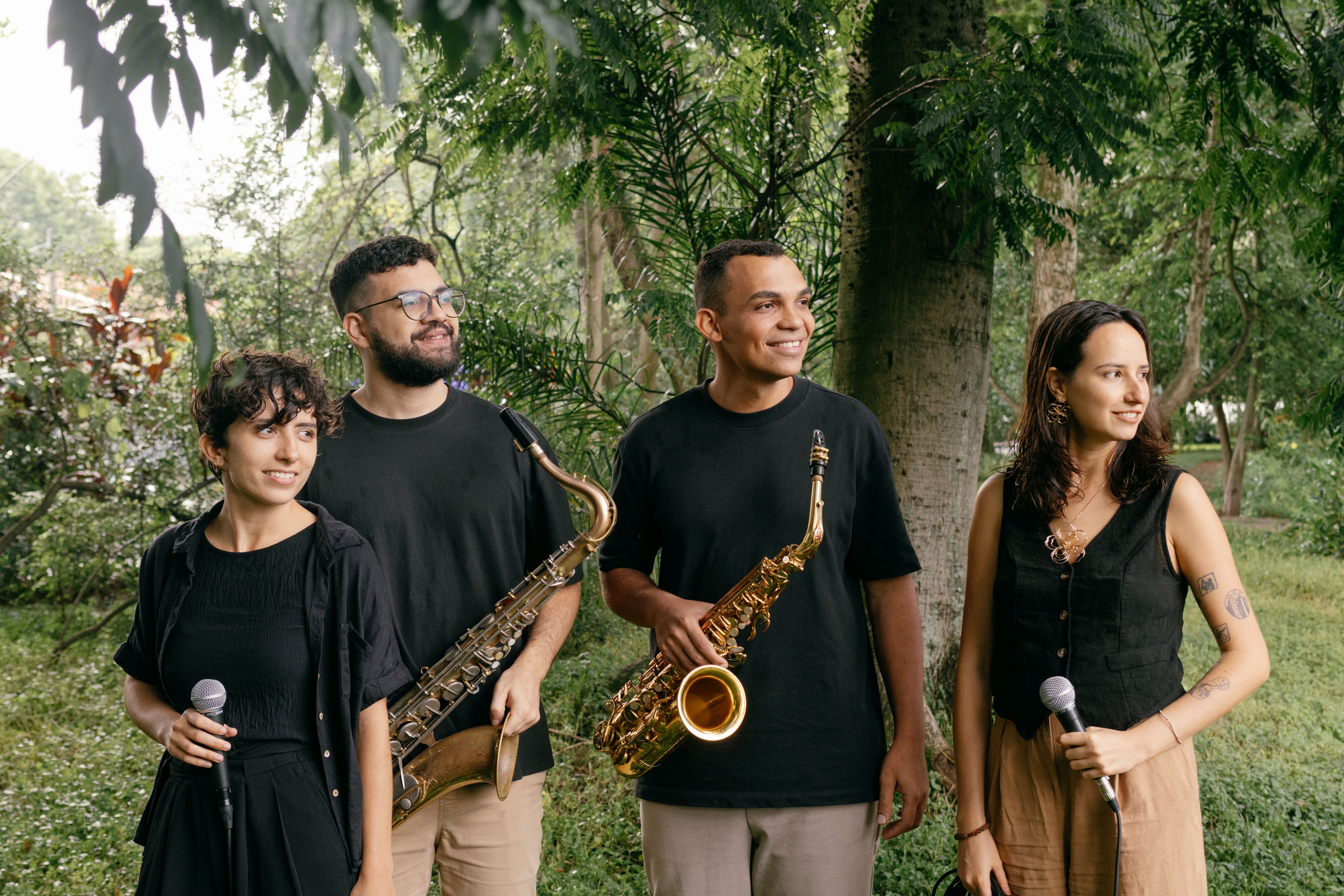
My latest/upcoming release is with a chamber quartet I put together with two voices (myself and the wonderful Marina Marchi) and two saxophones (Marlon Cordeiro on tenor, Lucas Sales on alto).
This project stemmed from me loving large-ensemble writing and wanting to be a part of it. And wanting to poke fun at the concept of “voice as an instrument” or “singing like a horn”, which is something you hear a lot within the Jazz world, especially regarding wordless voice. I don’t love that term because it feels so reductive to describe what we do as an imitation of something else. The voice IS an instrument, what I’m doing isn’t imitating a horn, it’s just making music.
So I wrote a suite of music called “MÍMICA” or “mimicry” and tried to see how far I could push that comparison. When I started reading about the concept and learned a bit more about mimicry as a method of survival through imitation (like how stinger-less hoverflies stay safe from predators by looking like bees), and to see the saxophone (perhaps the most quintessential of Jazz instruments, especially in the straight-ahead, uptempo, bebop world) as the metaphorical predator of the voice really makes me chuckle.
Through the album, I wrote a lot of material contrapuntally, pairing one voice and one saxophone in twos and weaving together the resulting timbres. A lot of this comes from a project I used to have with fellow NEC grad Isabel Crespo Pardo, a vocal duo we called Chululu where we would arrange re-compositions of Brazilian popular music songs. It was a great workshop for me, and I owe a lot of the aesthetic quality we reached in MÍMICA to that duo project with them.
As far as vocal performance, though, in MÍMICA, Marina and I are mostly working to make ourselves sound like a hybrid ensemble with the saxophones, which means singing in very controlled timbres with clear tones, minimal vibrato, subtle articulation. The end goal was to blur the line between the timbres of the voices and the saxophones, which requires a very specific type of singing.
But I really enjoy existing in this blurred, blended state, rather than having to be a soloist, and I love the effect that it has in the music.
I'd love to know how that works – making the voice sound and feel like a saxophone.
Well, there’s a lot you can manipulate in your sound depending on how your part relates to the rest of the music.
For example, if I were to sing something as a soloist, I would need to make sure my part stayed in the foreground of the texture. I could do that by making sure my microphone is turned to a high enough volume, of course, but also by articulating phrases with more definition (clear attacks, sufficient breath support of the notes) and making my timbre fuller, less airy. To blend with a saxophone, I need to do the opposite, to be a part of the background, maybe even a bit more muted than the sax.
I pay close attention to the timbre of the person I’m playing with and find a way to nestle into the sound - with less volume, more subtle articulation, more breath in my timbre. I needed to match the position of the sax more equally, like in a contrapuntal situation, it would help, instead, to clearly match it's articulation (attacks, falls, portamentos) and try to keep a timbre that’s at a similar intensity and body as the horn’s.
When you're writing song lyrics, do you sense or see a connection between your voice and the text? Does it need to feel and sound “good” or “right” to sing certain words? What's your perspective in this regard of singing someone else's songs versus your own?
This is a great question - I have focused so much on carving out space for singing wordlessly, but I actually have a lot of fun working with text as well, both as a singer and as a composer.
I love languages and linguistics and sounds, and the way I relate to text is more through the sound rather than the meaning of the words. I also grew up speaking two languages and worried about having an accent in both - so the absence of words feels like home in a way that lyrics in any language never have.
That being said, I do really love text that feels odd, abstract, or ambiguous, because I feel more free to explore the nooks and crannies of the text compared to a more straight-ahead, figurative lyric like in a lot of Jazz standards, for instance.
Brazilian music standards tend to have a lot of great options, actually, and Filó Machado, Caetano Veloso, João Donato and Djavan are examples of lyricists whose work I really enjoy performing. Outside of Standards repertoire, I really enjoy working with poetry, especially concrete or more abstract pieces.
[Read our João Donato interview]
I do think the text needs to feel good in order to sing it, which is why I often avoid singing the lyrics to certain Jazz standards if I can help it - singing a long list of love songs unironically doesn’t feel authentic to me, so if I have to do it, I usually find a way to repurpose those words or to abstract their meaning by playing with pitch, timbre, rhythm.
Some more traditional Jazz folks might frown upon that, but it’s actually something many singers have done to get around lyrics that feel icky. And it feels sexist to oblige singers (who are mostly women) to spend full sets performing tunes with titles like “The Man I Love”, “Someday My Prince Will Come”, and "My Heart Belongs To Daddy”, earnestly and with expression.
I'd be curious whether, when you're singing, “wordlessly,” you're still awarding a particular meaning to each melodic turn – as it were reversing the abstraction process– or if you're really thinking of the lines like an instrumentalist?
I’m not usually singing instrumental melodies thinking of specific words or feelings, if that’s what you’re saying. But if you mean “meaning" in the sense that any melody carries weight and direction and purpose regardless of text, then I’d say yes, absolutely.
There’s a sense sometimes that an “instrumental" approach is meaningless one, that’s just about calculation. But I think that actually, the best great players and composers approach instrumental melodies with the same amount of meaning and intention as if there were text. You might argue that even the most mathematical, atonal music can carry meaning as well - because meaning doesn’t need to necessarily be lyrical or expressive.
So the only difference, I think, is that music with text gives the player a more specific direction and more pre-determined articulation (the sounds of the words themselves, as compared to free choice of syllables for the singer). But regardless of text, there’s so much possibility and it’s really up to the player to bring out what they want.
Maybe it’s similar to improvisation over chord changes as compared to free improvisation.
Where do you see the ongoing relevance of the standard repertoire?
The standard repertoire is a beautiful exercise in working within a tradition.
To me, having regular contact with standards is a big part of being "in shape", musically. Despite all I’ve said about treating the repertoire critically, there’s still so much value in connecting with other musicians through shared tunes and connecting with a tradition that is larger than oneself. Playing standards with others is also an important exercise in improvisation and spontaneity that original music doesn’t always provide.
Besides this, Jazz-influenced music as a whole is Afro-diasporic (the US term Black American Music is very relevant here, and this is true to Brazilian and Latin American musical traditions as well), and we have a responsibility as musicians and teachers to uphold the centuries of history that made the work we do today possible.
Just reading more about the project, I thought how great it would be to have a wordless jazz vocal solo performance, similar to a solo recital on a horn. What are your own ideas for the future to push the idea further?
I love this - I’ve written a few pieces for solo wordless voice as exercises/experiments in the past, and would be really curious to explore the concept further.
For now, I’m focused on writing for the voice as part of ensembles, but at some point it would be a great challenge to approach something solo!