

Part 2
What role do electronic tools and instruments play for your creative process? What does your creative space / studio look like and what tools does it contain?
I'll be the first to say that I'm not the most tech-savvy. I'm always trying to expand my understanding and knowledge, but fingers on keys is where I'm most comfortable. I have a deep proficiency on the piano so that's where ideas flow the most easily. I can try things without getting bogged down in the "how".
That said, I've been pushing myself over the last few years to get more comfortable with my Prophet '08 because I love how it sounds. As I've gotten more proficient with that, it's started to become a deeper source of impetus and inspiration.
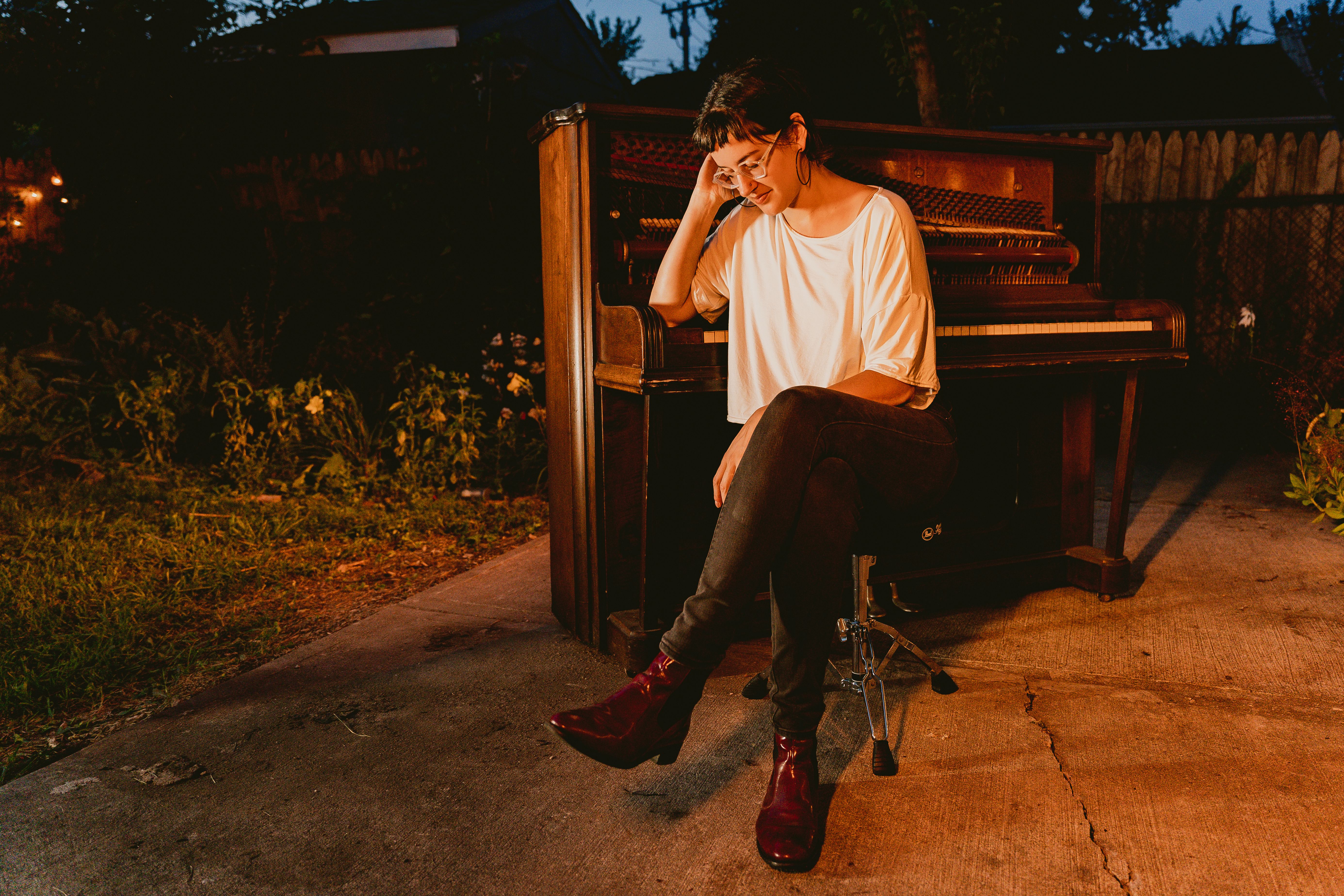
My creative space right now includes three acoustic pianos -- my grand piano, my Keybird portable upright that I tour with, and my very old Kimball upright that I will die with because I love it so much. Next to those I have my Prophet '08 synthesizer, a Novation bass station, and a small handful of pedals. That's generally my performing setup (usually with just one or two pianos), so I try to keep that ready and available at all times. I used all of those pianos and keyboards on my new record Alight!
I share my studio with my husband Sam Torres who is an amazing musician and engineer and who co-produced my new record with me. We share a lot of tools, and one that has been a huge source of inspiration is our Roland Chorus Echo. It just adds so much! It's on every track of my last album In Our Softening, and several of the tracks on Alight!
I've also collected strange and wonderful keyboard instruments over the years, including a melodeon (an American-made pump organ of sorts from the mid-1800's), a Wurlitzer, a chord organ, and a strange Hardman, Peck & Co. "minipiano" with 72 keys.
It is my impression that adding a conceptual, non-musical dimension to one's work is almost a prerequisite for commissions and grants. How do you view this tendency and how “conceptual” is your own approach to writing?
It's interesting because by far the largest grant I've gotten was not conceptual in the slightest. Maybe it was a fluke!
I agree with you though. I don't feel like I create particularly "conceptual" music, and I've also talked about how I don't often write idealogical music that is pulled directly from the external world. There are amazing artists who create that kind of work, and I think it's enormously important. But it's not the only way to create, and I think it's a mistake to view that as inherently more important.
From a funder's point of view, I could see how a work conceptually about x issue might be seen as an easier bet. There's an immediate hook. There's a promo strategy. From an investment standpoint, that makes sense. But music exists in all ways, programmatic or not, and I believe we need all of it.
Musician Gabriel Kahane wrote about this in one of his newsletters a few years ago. It stuck with me. He talked about "negative space" in music. He wrote: "At its best, negative space is a kindness, an act of generosity toward a listener which says, 'I have left just enough room in this song for it to become yours when you graft your meaning onto mine.'"
I might be taking a bit of a leap here from conceptual work to programmatic / idealogical work, but I think they're related. We need work that lets listeners go wherever they need to go, just as much as we need conceptual work with specific narratives. And everything in between.
Sometimes the simplest, non-programmatic music can have the biggest impact, precisely because it left that negative space.
Working with long forms, complex concepts or new vocabulary is potentially more challenging today because they require us to remember things that happened perhaps minutes ago – while most of us are finding it hard to focus even on what's happening right now. Both as a composer and as a listener yourself, how do you deal with this?
I feel extraordinarily lucky to do the work that I do, precisely because it forces me to have a much longer memory than I think I would otherwise. But I have to work at it, as I'm sure most people do.
When a project, like an album, takes 3 years to complete, you are forced to take the long view. It can be hard to explain to my friends and family who aren't artists what it is I actually do on a day-to-day basis, because the road is so long. You get used to seeing the path forward in the darkness. There's an extraordinary amount of creative imagination that goes into that, imagining how a project can come together in a few years time.
I don't know that I have any specific ways of dealing with lack of focus beyond just doing the work (and other general wellness things like exercising regularly, protecting my sleep, and limiting screen time). I know for sure that it's gotten harder for me to focus as the years have gone by and my attention has gotten pulled in more and more directions.
But again, I think that's where the work comes in. Focus is a muscle like anything else. If you're going to live shows that push you as a listener, or listening to whole albums regularly, or working on longer-form projects, you're inherently exercising that muscle.
How, would you say are live performances of your music and your recording projects connected at the moment? How do they mutually influence and feed off each other?
They're intertwined. Because my composing starts from a performing place, my recorded work is inherently organized around my playing.
My newest record (Alight!) was fun to make because we gave ourselves a lot of freedom to play around with layering and production and collaborators. While we were working on the record, I was also simultaneously performing most of that music. So there were concurrent timelines of development for the same music.
I love when the same song exists in different forms and iterations. My song "Quarry" is a perfect example. I adore the album version so much, but the way that I perform it as a solo artist is very different! I've tried to remove any pressure on myself to make my live performing sound like what's on the album. I don't think that's helpful, or particularly interesting in some cases.
I usually perform solo, for both logistical and financial reasons. It can be a nerve-wracking challenge being a single person on stage. I'm lucky though that I'm actually not alone in carrying the energy. My partner Sam Torres travels with me and does my live mixing. He's an extraordinary live sound engineer and the only person who knows exactly what I'm looking for in my sound. It's immensely reassuring knowing that he's making creative mix decisions and helping me ride the energy of a show.
That said, I'm constantly evaluating what I can do differently to be as effective a performer as possible. Part of that might be looking at how we did things on a recorded version and seeing how I might emulate elements of that in a live setting. There's certainly a back and forth dialogue that happens between recording and performing.
But ultimately, I see them as different art forms that deserve their own individualized attention.
To some, the advent of AI and 'intelligent' composing tools offers potential for machines to contribute to the creative process. What are your hopes, fears, expectations and possible concrete plans in this regard?
My very optimistic hope is that AI will have the unintended effect of making people realize how much they need human-made work. I try very hard not to paint with overly broad brushstrokes, because I know that there are AI tools that are genuinely helpful in certain industries.
That said, I think AI companies are evil. I think the hoarding of resources is evil. I think the fact that these companies are dictating the future of our utilities and resources for the sake of their own profit, is evil. And for artists in particular, it's impossible for me to not have a jaded view here because of how our work is being stolen and profited from. Artists have always gotten the last and smallest piece of the pie, and AI has only made that worse.
My fear around AI is that it minimizes community. For instance, if you use an AI tool to mix and master your album, you're losing the connection and community that would have come from involving those one or two other people in the process.
Yes, there are serious financial constraints that most of us face, I'll never downplay that. But how can we be creative with our financial constraints? And how can we find and lean on our village to help bring a project to completion? Our villages add immeasurable depth to the music we create. AI costs us. With AI usage, we're severing those potential connections. We're enriching corporations and billionaires. And we're contributing to the ongoing degradation of our planet.
Lastly, AI is reducing work to the average. If you have your album mixed by AI, it's inherently going to start sounding like everything else. AI aggregates. A friend recently told me about someone who fed their song into an AI tool. They wanted help structuring the song to make it more "anthemic".
What's interesting is, the band recorded it the way AI came up with. And then they rerecorded it the original way because the band supporting this individual didn't like how it turned out the AI "way". So, not only did this person waste resources coming up with something they didn't end up using, they minimized their own voice and creative instinct in the process. That makes me extraordinarily sad.
My hope is that AI proliferation will have the effect of reminding people why we create in the first place -- that there will be break-off factions for whom AI is a catalyst: to create more imperfect, human, messy, wild art that seeks for nothing else than to connect us to our humanity.
The Montreux Festival intends to preserve its archive of recordings for future generations. Do you personally feels it's important that everything should remain available forever - or is there something to be said for letting beautiful moments pass and linger in the memories of those that experienced them?
I don't think that everything necessarily needs to be archived for future generations. I'm also a bit of a pessimist when it comes to digital storage. Part of me wonders ... how long will we able to sustain this infinite amount of storage considering the resources it requires? But that's a different issue.
I absolutely believe that live music happens in the moment, and I also believe that recording and archiving a performance doesn't need to take away from whatever magic happens in the moment. We can do both. At the same time, I don't think we need to feel an urgency around preserving and archiving everything. Music has been around since the beginning of our history on this planet. I find great comfort in that.
No matter what we do, if everything goes to shit tomorrow and we lose everything, we'll still make music. We'll still gather in groups and make music. Music will still be passed down to future generations in the way that it always has, through cultural memory and oral/written traditions.
Now that I think about it, perhaps there's something to be said for not preserving a performance. Why are we so important that we need to archive every little thing?