

Part 1
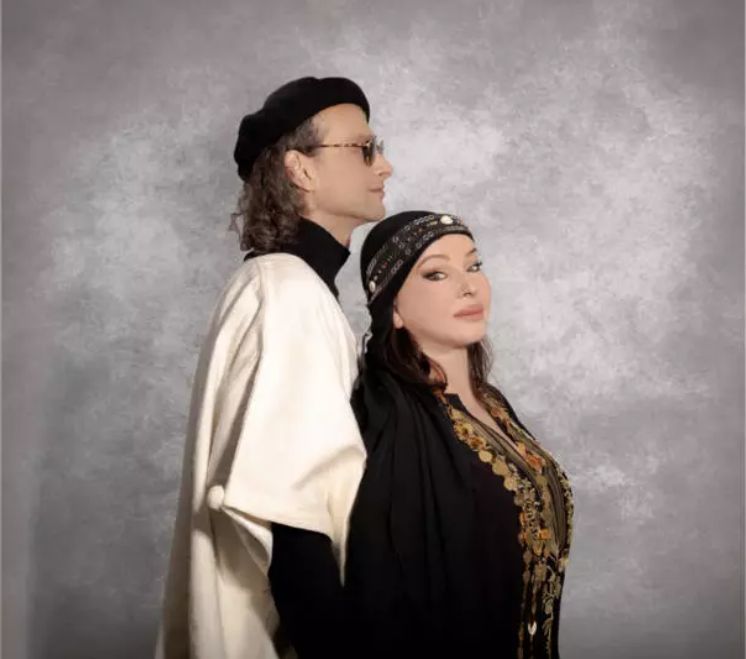
Name: Natacha Atlas & Samy Bishai
Nationalites: Belgian (Natacha Atlas), Egyptian (Samy Bishai)
Current release: Natacha Atlas & Samy Bishai's new album PARALLEL UNIVERSE VOL 1 is out via Airfono.
If you enjoyed this Natacha Atlas & Samy Bishai interview and would like to find out more about their music, visit them on Instagram: Natacha Atlas; Samy Bishai.
For a deeper dive, read our Natacha Atlas interview.
Where does the impulse to create something come from for you? What role do often-quoted sources of inspiration like dreams, other forms of art, personal relationships, politics etc play?
The music largely shows up uninvited, crashes the party, and won’t leave until you ply it with booze and drugs, then it passes out on your sofa, and snores monstrously.
But seriously – stuff pops in over the mental radio which runs 24/7, and drives you mad until you either get it down on tape or page, or something temporarily more important interrupts you, and then it’s gone forever, never to be seen again.
For you to get started, do there need to be concrete ideas – or what some have called a 'visualisation' of the finished work? What does the balance between planning and chance look like for you?
This is the tricky bit about writing anything, I think.
It’s all very well having an abstract visualisation of, for example, the timeline of the thing. Or perhaps, the tone, tempo or groove of the thing - but they’re only shades of a colour. Not actual lines describing and signifying a communicable concept or emotion.
So, until SOMETHING is actually on the page, you haven’t written anything. Including a starting point. Which is what you need in order to write something. Which you don’t have. So you can’t. Therefore, all writing is impossible.
Except – clearly, it isn’t. Or to rephrase, just because no one has a definitive answer for the chicken versus egg question doesn’t mean omelettes aren’t real.
Is there a preparation phase for your process? Do you require your tools to be laid out in a particular way, for example, do you need to do 'research' or create 'early versions’?
I tend to really dislike anything that ritualises or fetishises the creative process – I think it creates a false idol of the clay feet variety. It’s also subliminally elitist.
Creativity is the everyday garden variety miracle that all humans can access-it’s one of the two things we are good at, pattern recognition being the other.
Do you have certain rituals to get you into the right mindset for creating? What role do certain foods or stimulants like coffee, lighting, scents, exercise or reading poetry play?
Sadly, nothing focuses the mind more sharply than the ticking of the clock when it’s down to a single-digit number of hours before the deadline.
Otherwise, my favourite time to write is so close to waking up that the day hasn’t had a chance to interfere with the infinite possibility of perfectly good music existing unmolested by reality crashing the party.
For your latest release, PARALLEL UNIVERSE VOL 1, what did you start with? If there were conceptual considerations, what were they?
There were some initial conceptual considerations revolving around the sonic cornerstones of the album, stylistically speaking.
We knew from the start we wanted it to have electronic, programmed beats - with fairly specific attributes - but also we had to work out ways of reconciling some of the apparent contradictions of the conceptual “shopping list”. So, we liked the idea using Arabic traditional rhythms like a Baladi or Wahda Kibeera - but gene-splicing them with alien attributes.
So for a Baladi, which has a straight feel, we wanted to see if we could make it work with a shuffle sub-division and not suck. Which opens the floodgates for a meeting point between groove vocabulary and Arabic rhythms, which are percussion-derived, rather than kit drum or kit samples, which most modern Western music employs. Or using quarter-tone Arabic scale tunings on a Moog monosynth, under-pinning dense harmonic stacks, and juggling the resultant inevitable dissonance tension till it felt like music …
It was a very long list … but ultimately, they were more starting points to get to the part where there’s enough down that the music tells you what it wants, then it’s all a lot easier.
What makes lyrics good in your opinion? What are your own ambitions and challenges in this regard?
Very broad question; to answer in equally broad terms, it would depend upon their function within the musical context.
For example, we’re very fond of the lyrics on “Moonchild” (Strange Days, 2019), which was the album closer. It’s a dreamy, metaphysical tone-poem, whose words work for the musical setting in terms of poetic evocation and signification as much as their sonics and resultant atmosphere.
So we like to think of them as “good” lyrics - but they probably wouldn’t work as well over a chorus of, say, 50 Cent’s “It’s your birthday”!
By way of contrast, “Haga Zay Kidda” (Parallel Universe, 2026) presents itself as a downtempo Mahragan/RnB hybrid with shades of 90s Egyptian pop ballads.
But then the chorus refrain takes a sharp left turn into the driving, chant-style rhythmic litany of syllables so characteristic of Mahragan/Arabic rap, with a (compared with the imagery of Moonchild) harder edge to the figures of speech employed, rooted more in the sometimes forceful subversion of common turns of phrase used for political commentary to express rhetorical questions about the nature of how we relate to each other on the micro and macro scales of human experience.
What are areas/themes/topics that you keep returning to in your lyrics?
They say art mirrors life - An erstwhile favourite is how the world is heading to hell in a hat-basket with a one-way ticket on the bullet train express.
Never gets old, given the current shape of reality.
Many writers have claimed that as soon as they enter into the process, certain aspects of the narrative are out of their hands. Do you like to keep strict control or is there a sense of following things where they lead you?
The thing is, both.
Writing, for me, it is very much an Ouroboros - a snake eating its own tail. One can attempt to subvert the flow to one’s will, but one can never be certain that one’s will is not in turn being subjugated to that of the music.
But then playing often parallels writing in this regard – the leader sometimes leads, and is sometimes led - it’s a volatile reversible relationship.
There are many descriptions of the creative state. How would you describe it for you personally? Is there an element of spirituality to what you do?
For me personally, creativity is often what happens when thought processes get out of the way.
When writing, I become acutely aware that all sections of my mind pull their shutters down and close for business. Any theoretical or technical musical knowledge I thought I had access to sort of melts away and ceases to be. And even if I could access it, it would seem strangely foreign and largely incomprehensible. It becomes more of a process of knowing the un-name-able. An unaccountable familiarity with the unknowable …
And a complete absence of conscious thought. Which I suppose places creativity slap bang in the middle between meditation and flow. Or perhaps it’s the third point of a triangle ?
Once a piece is finished, how important is it for you to let it lie and evaluate it later on? How much improvement and refinement do you personally allow until you're satisfied with a piece?
That’s two different questions, ha ha!
First answer: it’s less a question of importance, more a case of inevitability. Experience teaches us the vagaries of sonic subjectivity – in the sense that whatever you think it sounds like when it comes back from the mastering session will have very little to do with what it sounds like a year later – subjectively.
Which neatly brings us to the second question - how much endorsed tweaking is allowed?
Contrary to popular belief, I intensely dislike working to a set of eternally shifting goal posts – I don’t generally relish the thought of mixing without any idea of where we’re going. By the time the work gets to mix stage, I usually have a very clear idea of how I want the sounds to behave and relate to each other – in spite of all the tangential suggestions inevitable to the process.
Generally, once everything is doing what I feel it ought, my “pre-mix” impressions of what it should sound & feel like, I’m quite happy to down tools and print the mix. The catch 22 is how close you’ve actually got to that ideal – and recognising that you’ve run out of tricks (and/or time/budget) and it’s time to let go. But that’s why deadlines were invented – ha!