Name: The Necks
Members: Chris Abrahams (keys), Tony Buck (drums), Lloyd Swanton (bass)
Interviewee: Lloyd Swanton
Nationality: Australian
Current release: The Necks's new album Bleed is out via Northern Spy.
If you enjoyed this The Necks interview and would like to know more about the band and their music, visit their official homepage. They are also on Facebook.
For a deeper dive, visit our creative profile of The Necks.
Just as with many others, your discography has a “covid gap” between 2020 and 2023. Many artists compensated by going online and doing streaming performances. How do you personally look at this development both as musicians and listeners? How does this experience compare to performing in the same space with the audience?
As a performer it's a little strange playing to just the crew in the room, and yet possibly being watched by thousands of people (or by hardly anyone!). But it's really no stranger than being in a recording studio, for instance, with its separation into soundproof booths and the musicians monitoring each other via headphones. It’s a great way to get across to potentially an awful lot of people.
As a listener I personally find it a pretty unsatisfactory experience, unfortunately! When you’re sitting there in a concert space watching a performance, you might not be aware of it, but usually your eye is roving constantly across the spectacle.
In a live streaming situation however, you’re entirely dependent on the choice of camera shots they're giving you. Even a performance with many cameras does not get close to the number of landing points you cast your eye upon in a face-to-face performance.
The way I understand it, for your recordings, you do discuss a few concepts before entering the studio. What was that like for Bleed?
I think Bleed was one of those ones where we didn’t do much pre-discussion at all. We just rolled tape and started to follow our instincts.
As we worked our way through laying tracks, and then mixing, a direction slowly started to present itself to us.
Where does the impulse to create something come from for you? What role do often-quoted sources of inspiration like dreams, other forms of art, personal relationships, politics etc play?
I have no idea where it comes from.
Many years ago, my then-toddler son and I found a dead bird in the garden, and we did that time-honoured parent/child ritual of giving it a burial. And of course we knocked up a headstone with a wooden stake and a small square of plywood, and I was trying to think of what to write on it. I don't write poetry, but over the next few hours a piece of doggerel came to me unbidden:
Beneath here lies a bird unknown
Once it flew, but now it's flown
Farewell, sweet unknown bird
We never met
But your sweet song was heard
I have absolutely no idea where that came from! I checked on the internet to see if I hadn't just subconsciously remembered someone else’s words, but it seems to be a Lloyd original.
I can't say that dreams, other arts etc offer any overt inspiration for me, but who knows if they're touching me on a subliminal level.
Non-verbal communication seems to be an important aspect of your music with The Necks. If music is the language, do you feel as though there can still be misunderstandings?
There are definitely “misunderstandings”, but the great thing about music is that because it is less specific than language, there is the potential that the misunderstanding can be turned fruitfully into something good; possibly even better than what everyone was striving for at the time.
I often say that although I marvel at the degree to which we Necks can read each other’s minds, we will never be able to completely do that, and that is what keeps alive the possibility of these happy accidents of miscommunication.
And vice versa: What creates the feeling of understanding?
A level of trust we established at the very beginning, which we have cleaved to ever since.
With your performances, once the process has been set in motion, it seems as though it develops a logic of its own and flows from your interaction. What about that first note, however?
Sometimes it’s a motif I thought of as I was driving to the gig! (But I’m just as likely to have forgotten all about it by the time we’re on stage.) Or it might be an area that I had been practising in recent days, so I decide to offer it up.
As to how the others respond, it’s equally likely to be a complete surprise as it is to be exactly the sort of thing I was thinking they might come up with. If the latter, it's not as if that piece is then set in stone.
Every single note that any of us plays (or decides not to play) in the next hour or so is a potential turning point for the piece.
Recordings for Bleed took place at 301 Studios. That place seems to have become your new home, after the Electric Avenue and Megaphon studios earlier. What is 301 like – it seems like a huge place!
It has one very large room and a few smaller options. It is one of the few remaining recording spaces in Sydney that can accommodate a decent-sized orchestra.
The current space is the third iteration of 301 that I’ve known since the early 80s. Originally it was the house studio for EMI Records. They have a clear commitment to being state-of-the art. It's not cheap, but one of the things that sets them apart is the superb technical support on hand, so there are very few technical issues, and in those rare instances that there is a problem, it's fixed very quickly.
I think their philosophy is that if a client is paying top dollar for their studio, they expect to be able to utilise every single minute they're in there.
How does the choice of recording environment influence the music you make, would you say?
Well most recording studios, of necessity, don't have a lot of resonance to work with, so that aspect of our live performances is completely absent. And the usual procedure is to have the instruments as separated as possible, to minimise the sonic “bleed” (there’s that word again!) from one track to another.
Studios are designed to cancel out any uncontrolled frequencies. So that means that for me, recording isn't always a particularly exciting process. I enjoy every single aspect of making a record, except for actually being in the bass booth with the headphones on, doing a take!
But that’s not to say that we should consider recording in a more lively acoustic. Microphones, for all their modern sophistication, still aren't as discerning as the human ear, and the result can often be a bit of a soup. We most easily get the kind of records we want to make by using a recording studio.
What do you still remember about the recording of Bleed at 301?
I remember not really knowing where that piece was heading, but that was exciting!
There's a really intense moment in the piece around the 2'50'' mark, where the reverb seems to shift from the piano pedal to an artificial one. Is that something that happened during the performance or took shape in the mixing process?
No, that was definitely added in the mixing process.
When you're in the studio, how would you describe the creative state for you personally?
As I suggested above, in some ways it's about as far from ideal as you can imagine.
So I think the key is to trust in one’s instincts and known strengths, (but to still have a bit of recklessness lurking) and to stay focussed on a longer-term goal, which is the release of a finished record sometime many months later. 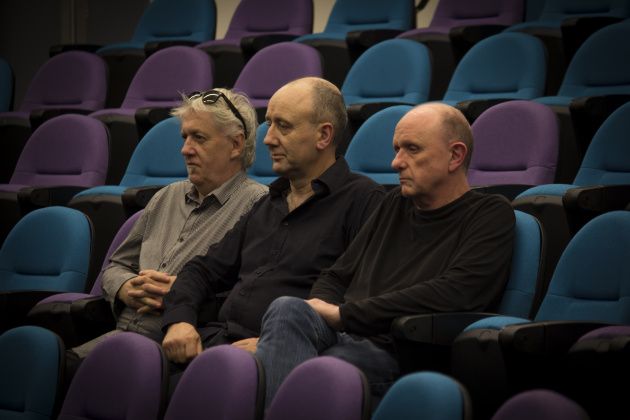
The Necks Interview Image by Camille Walsh Photography
You've stressed Tim Whitten's importance for your studio recordings several times. It reminded me of how Nigel Godrich is a vital component of Radiohead's albums but was never fully part of the band. Can you talk just a little bit deeper about his involvement?
Before we worked with Tim as The Necks, we had each worked with him as individuals, or at least knew him to be a very fine engineer. He had not really done anything like The Necks before, but he is so good that we clicked instantly. He is incredibly patient with our long-hand method of composing. (We record almost everything in real time, rather than laying down sequenced tracks, which I think is one thing that gives our albums their identifiable character.)
With our modus operandi, some engineers would probably start to feel like the project is going nowhere, but Tim has enough experience with us to know that even if we don't know where we’re going, we do know we’re definitely going somewhere. We’re not treading water.
He is invaluable as a sounding board; open to any crazy ideas we have but always willing to tell us what is feasible and what’s not. And he has spent so much time working with our pieces and their unwieldy duration that he knows how to file and order things so that we don't create an unworkable mess further down the track.
I am also curious how you see the role of production and the balance between the composition and the arrangement for an album like Bleed?
It's all part of the process, but there’s no way I could apportion each role. It varies from project to project anyway.
Can you tell me about the sculpting of the sound of Bleed?
Couldn’t tell you anything about the technologies we used; I’m quite the luddite.
The varying approached to sound that you hear were really just things that occurred to us collectively and individually through the recording process and particularly in the mixing stage, and we would ask Tim if he could find some technique or bit of gear that fitted our description.
For some artists, the end of a performance or a recording can create a sense of emptiness. What is this like for you – and how different is this sensation with a studio recording like Bleed compared to a live gig?
In the live context, if it's an emptiness, it's a good emptiness. There’s nothing like that feeling of having given your all, produced a piece that you feel good about, and getting a response from the audience that tells you that they agree.
In the studio, by contrast, there’s almost none of that. But there’s the ongoing gratification afterwards because of the permanence of the recording process. There’s our own pride in our records, and there’s the responses we get from fans and critics, sometimes years down the track.
A concert is a musical performance in a given moment. What, then, is a recording?
A musical performance over many given moments. Not only are there the many “performances” involved in recording and mixing a multitrack recording, there are the limitless subsequent “performances” of that piece by listeners in their homes, their cars, on their headphones …
If there is more than one piece on an album, listeners can alter their encounter with the album by using shuffle play. If the album is across two sides of an LP, listeners can choose to immediately turn the disc over at the end of Side A, or they can insert a period of their own life between listening to the two sides – minutes, hours, days …
That’s not to say recordings are superior to concerts!
Creativity can reach many different corners of our lives. Do you personally feel as though writing a piece of music is inherently different from something like making a great cup of coffee? What do you express through music that you couldn't or wouldn't in more 'mundane' tasks?
Any act or action or thought can be executed creatively. They all have their unique characteristics. I’m reluctant to give them any sort of hierarchy. Musicking is the most familiar mode of creation to me.
And I do think music has something that sets it apart from all other forms of expression – at its base, it's about vibration, and I think that offers us some sort of tantalising glimpse into the very fundamentals of the universe.

 The Necks Interview Image by Holimage
"A recording is a musical performance over many given moments."
Video