Name: The Necks
Members: Chris Abrahams (piano), Tony Buck (drums), Lloyd Swanton (bass)
Nationality: Australian
Current release: The Necks's Bleed is out October 11th 2024 (physically) and October 18th 2024 (digitally) via Northern Spy.
If you enjoyed these thoughts by The Necks and would like to stay up to date with the band and their music, visit the trio's official website. They are also on Facebook.
The following thoughts about various aspects of her work are sourced from several interviews The Necks have given over the years. For a deeper dive, follow the links to the full versions.
For an even deeper dive, visit previous interviews we've done with members of the Necks:
[Read our Tony Buck interview]
[Read our Tony Buck and Magda Mayas interview about Improvisation]
Australian Background
Lloyd Swanton: "I can’t not reflect my environment and my upbringing, and I’m sure the other boys would say the same. The trick is ascertaining exactly what those elements are and how they appear in the music. Once you try to get more specific it gets very muddy very quickly. But there’s a few metaphors that we think definitely apply.
We’ve often talked about how when you go for a really long road trip in a very vast, flat landscape at any given moment you don’t notice the landscape changing very much, apart from the bushes and the fence posts flashing past you at 100 km an hour. But in terms of the larger landscape, you don’t really notice anything. But then you concentrate on something else for half an hour and when you look up you realize things have changed completely.
I think we’ve applied the same sort of scale to our improvisations. Quite often, at any given moment in a Necks’ piece you could say, “There’s not a lot going on right now,” and we would probably agree. But we would probably say, “Get back to us in half an hour and see where we’ve ended up.” And it’ll be like, “My goodness, that’s very different.” So, there’s that.
And also, I just feel as someone who grew up on the coastal fringe of Australia, even if you’ve spent very little time in the desert – and I haven’t spent much time in the outback or the desert – you can’t not be aware of it. You’re aware of it just over the horizon I think. Even when you’re living in Sydney or Melbourne or Brisbane, definitely Perth because you pretty much are in the desert there.”
From: Cyclic Defrost
Spirituality
Lloyd Swanton: “The main thing that nourishes our music is vibration. The aliveness that vibration gifts to music. I’m interested in many forms of artistic expression, but I feel that music, by dint of it being a product of vibration, stands apart from all other art forms.
We are keying into the fundamentals of the universe when we play music. Vibration is a glimpse of the infinite.”
From: Musictrust
Lloyd Swanton: “I guess I’d describe myself as a nihilist these days. I essentially believe we don’t exist for a lot longer than we do exist and that’s the defining fact about life, that it’s a very firm holiday from non-existence.
I range from the urgency of realising that every minute of life is precious to complete fatalism that nothing you do is going to change a thing and I reckon both of those come out in the music of The Necks.”
From: RUSSH
Approach & Concept
Chris Abrahams: “It’s an organism. The three of us have a chemistry and we prioritise the sound of the ensemble. We’re not the first improvisers to want to be in the moment, but our particular approach to being in the moment meant that our pieces had this slowly unfolding, long range viewpoint. We never actually sat down and said let’s play pieces that last for an hour, but we did aim to be in the moment and if there’s no reason to be in a different moment, sustain that moment.”
Tony Buck: “Little timbral changes (for example the relative dynamic of the cymbal to the piano) can be quite significant – the sound of the music is what signifies the form."
From: Musicomh
Tony Buck: “There are things that we don’t do in our music; there are parameters we’ve decided to work within. Different groups that I’m in concentrate on ways of playing that might exclude some ways of playing. Within a jazz context, there are functions that you’re required to fulfill, especially in the rhythm section: soloing, accompaniment, and all that stuff. So within free improvisation, everything’s on the table and nothing’s off the table. I don’t think that’s what we do. I think there are things that are relatively off the table.
[...]
Our self-definition, as a band, is based on how we use material; the sources themselves are quite open. So we bring ideas that we’re attracted to and ask, “how can we use this?” And then we deal with the material in our own way.
[...]
When we started, we were interested in documenting a moment: that came from our experience in jazz. But we also had lots of experience with rock bands, so we knew the power of multi-tracking, editing, and doing retakes. So, very early on, we thought, “let’s not limit ourselves to just documenting what we do; let’s use the studio for what it has to offer.” We’ll do a part and refine it: we’ll improvise something and then listen back, and say, “I can do that better,” or maybe move things around a bit.
From: Passionweiss
Lloyd Swanton: “We’re really all about being normal. Only then can the extraordinary happen.
We don’t meditate or anything, and don’t require perfect silence backstage, but on the other hand probably don’t appreciate too many people visiting the band room.”
From: The Quietus
Lloyd Swanton: “On stage, things can get quite orgiastic, but outside of performing, The Necks is a festival of rectitude.
Giving each other space. Being best friends doesn’t mean being in each other’s faces all the time. And always thinking long-term. People always interpret that phrase in terms of setting five-year goals, and other such control-freakery, but in my case I’d say it means having the attitude that whatever you’re doing, you might be doing it in thirty years time. And seeing that as a good thing.”
Tony Buck: “I think we tend not to push anything too hard, in the sense of forcing things. That applies to the music, the personal relationships, the ambitions of the group. That’s not to say things dont get intense at times – musically, personally, logistically – but never forced or pushed around.”
Chris Abrahams: “I think another important aspect is that there’s no musical leader; no main composer or lead instrumentalist. Also, If someone doesn’t want to do something, it doesn’t happen. We all respect this.”
From: Australian Jazz
Chris Abrahams: “I think part of the ethos of the group is that we try to not get in the way of the music. And I know that that sounds kind of like a weird thing to say but I would say “getting in the way of the music” would be trying to pre-meditate what we’re going to do at any given time. Because we don’t try to do that. We try and make things unfold while we’re doing it, without a kind of – you know – “OK I did this a few weeks ago and it sounded really good and I’m going to do it again.” Like that kind of idea would not be what we would want to do.
But the concept of The Necks is to not really know where we’re going. To have the music unfold while we’re doing it. And for us to react to that unfolding while it’s happening, and for that feedback to happen. And so the music is being constructed whilst being informed of itself as it’s happening, so to speak.
I mean, we don’t ‘trial’ things really. You know, we play.“
From: Xpress Magazine
Performing and Improvising
Lloyd Swanton: Over the course of a tour, there’ll be certain themes we return to, but we’re not taking stage with the intention of picking up where we left off.
Over the course of doing these big pieces—because they are really big—your mind might start casting back to similar situations you’ve been in quite recently. And you might think, “let’s try it again.” And it probably won’t be the same anyway. If it doesn’t work, then you start investigating elsewhere. But if it does work, that’s wonderful.
From: Passionweiss
Lloyd Swanton: "I always say, after so long playing together, we can almost read each other’s minds, but if we could, that would be boring, and it’s the fact that one can never fully know what is going on inside someone else’s head that keeps us so excited by this way of playing, after all these years."
From: The Quietus
Lloyd Swanton: "The funny thing is that we often get asked is what we are experiencing in the more ecstatic moments of our live performances. And to some extent when you’re a performer, as the old cliché goes, someone has to stay home and mind the baby. We can’t allow ourselves to go quite as far off the end of the pier as our audiences can. We do still have to play our instruments, and we do still have to honour the integrity in whatever it was that we have set-up up to that point, we can’t just let it fall in a heap.
But we do still have some pretty extreme experiences ourselves. Those clichés about not feeling like you’re playing your instrument anymore; you’re just experiencing the vibrations but you don’t have a conscious awareness of making any decisions anymore. But somehow you must be.
And I’ve also gone to great pains to explain that that state isn’t necessarily always the best state for making great music in. I’ve done gigs with The Necks when I’ve been absolutely exhausted from days or weeks of touring, I’m so distracted I feel physically exhausted before I even get on stage, and actually I’m quite preoccupied with how inadequate I feel to present music and yet something magic happens, and I’ll hear a recording later and go, “Wow, that was good I was so distracted.” It can work to your favour."
From: Cyclic Defrost
In the studio
“It rarely takes more than just an email discussion. There have been albums where we’ve literally all sat there in the control room on the first day and looked at each other and said, ‘So, who’s got an idea?’ And one of us will drop something into the ring and say, ‘What about this?’ and then we’ll pursue that. We might spend a day or so going up some dead ends, but usually by the second day the direction of the album has well and truly been established.”
From: RUSSH
Chris Abrahams: “There are elements to a studio record that are like live playing but the way we add material and overdub is very different. We’re very much in to using whatever is available, whatever we can bring to the recording. That might be electric guitars or keyboards, or simply using the resources of the studio. We never look at a record as something we would go out and tour.”
From: Misicomh
Lloyd Swanton: A studio is a very different thing now than it was in 1987. We’ve never overtly referenced classic recordings, and we’re probably not going to suddenly go really lo-fi.
We tend to use the recording studio as the venue for making the sounds that we make and recording them faithfully. And then we might mess with it a bit, but there’s not a huge amount of treatment. We’re not audiophiles; we’re not suddenly going to try to evoke an ambience of 20th century recordings.
I respect people that do that sort of thing, and I like it a lot. But that’s not what we do.
From: Passionweiss
Chris Abrahams: “When we play live it’s more or less always piano, bass and drums. Acoustic instruments. And a big dimension to the live performances is the coalescing of all the elements while we’re playing to kind of create other… kind of sounds. So the sustain of the piano mingling with the wash of the cymbals to make a kind of audio hallucinatory thing. To make sounds that don’t appear to be possible, or coming from the three instruments.
And I don’t think we really do that in the studio. Because if you want to give the impression that there’s an organ playing or there’s a choir or cellos or whatever otherworldly kind of noises, or music that’s not you … If you want to do that in the studio or on a record then people tend to hire a cello or a choir or use samples.”
From: Xpress Magazine
Commercial Success
Lloyd Swanton: “There’s probably some free improvisers that think we’re a total sell-out, but on the broad scale of things I think we tend to be at the non-commercial end of the spectrum.
[…] It’s ironic isn’t it, that of all the bands I’ve been involved in, the one with the least ambition has actually turned out to be the most commercially successful. And I’m really, really proud of that, because I don’t think it’s ever coloured our music, we’re still Chris, Lloyd and Tony, getting on stage and doing what we did 30 years ago with no intention of it going beyond the room it’s played in.
So I’m very proud that we’ve opened up people’s eyes and ears to that sort of thing. And hopefully turned some people on to different ways of hearing music.”
From: Cyclic Defrost
Lloyd Swanton: “We’re not looking for a breakthrough. There’s an understanding in the band that if we never got another great offer or exciting chance to do this or that we’d still have that magic whenever we got together and played.
I can imagine us in a nursing home together still making music together, arguing like shit but still getting a great deal of satisfaction in making music together.”
From: RUSSH

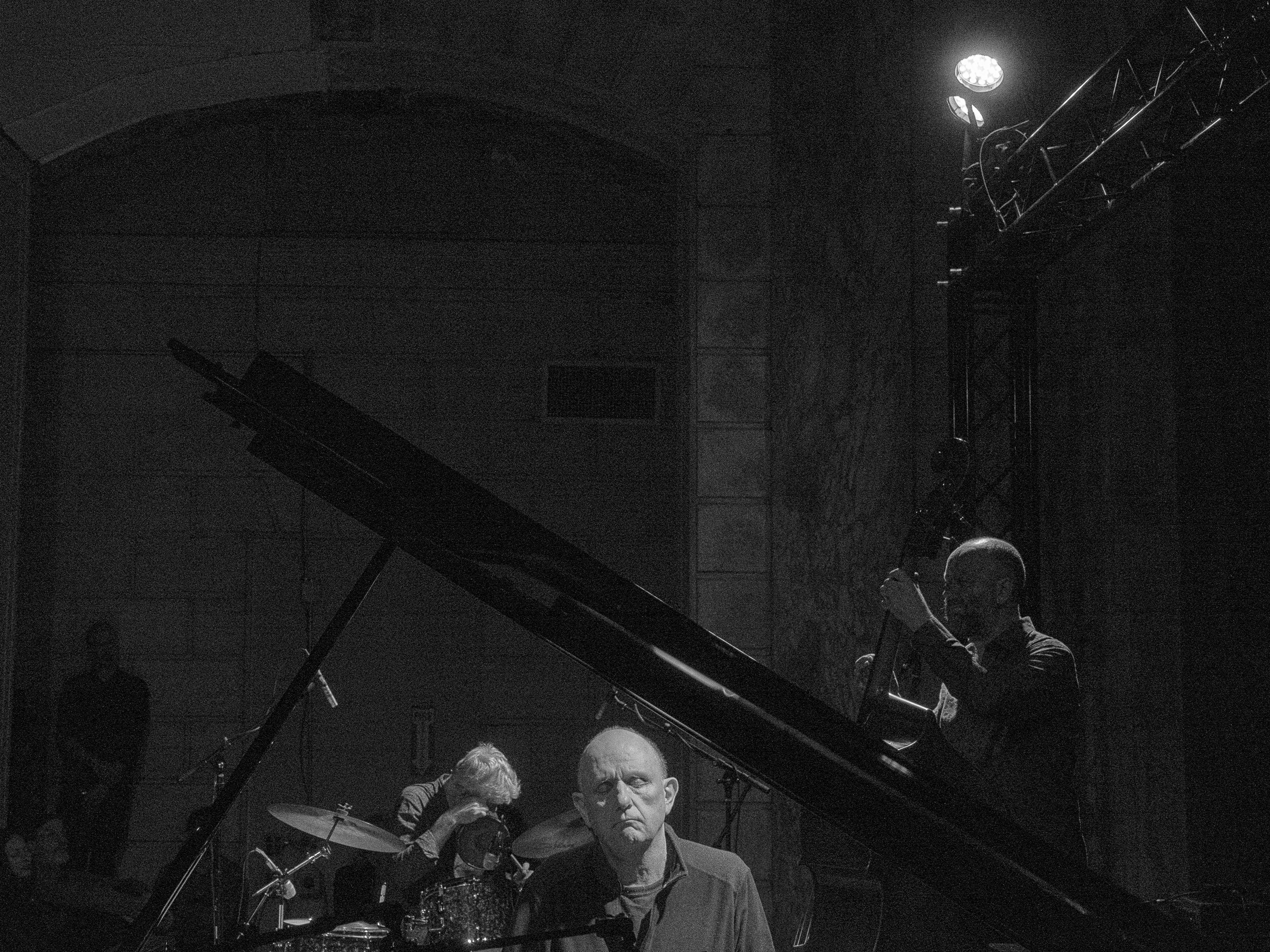 The Necks Interview Image by Devin Oktar Yalkin
"We’re really all about being normal. Only then can the extraordinary happen."
Video