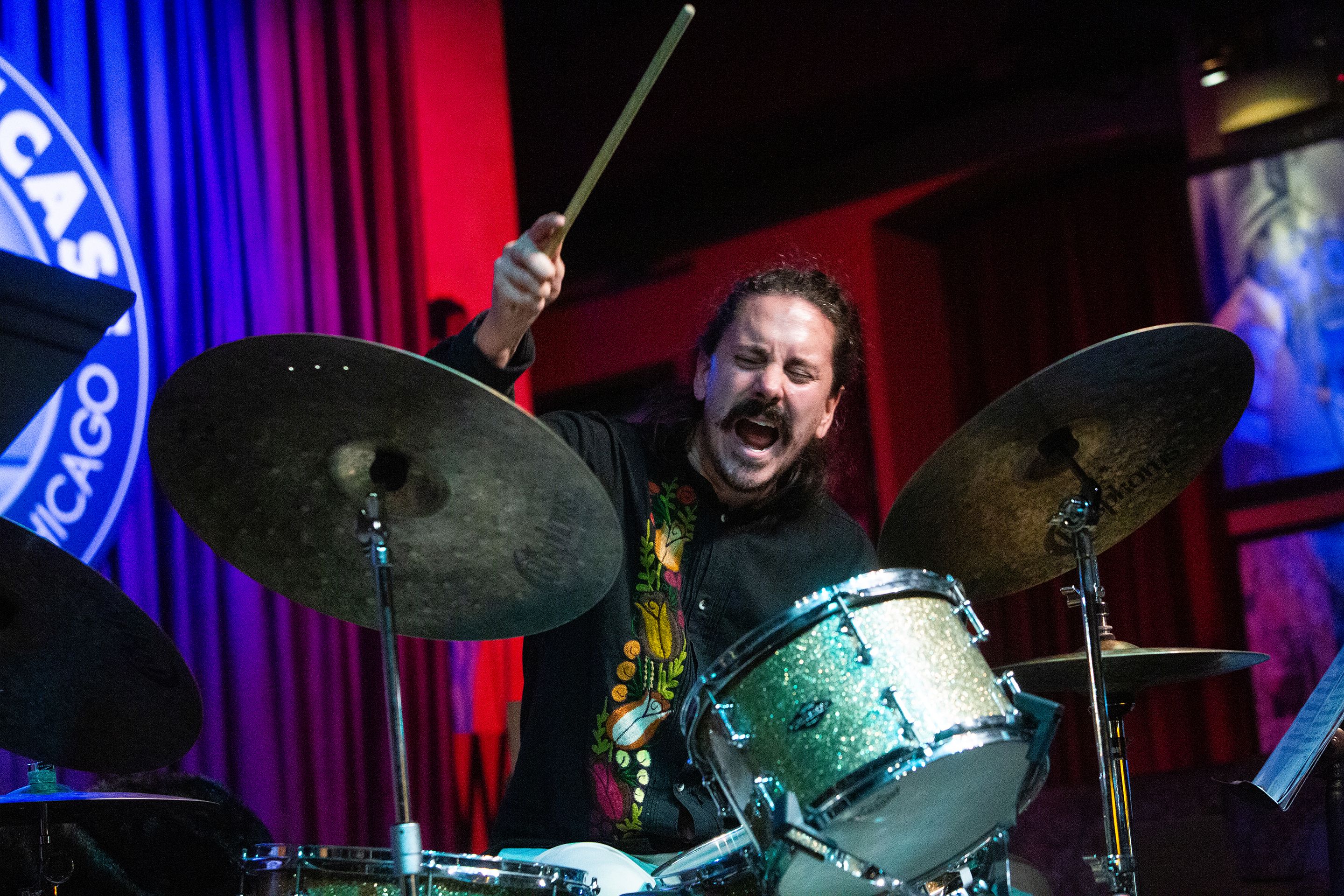


Part 2
What is the relationship between harmony, rhythm and melody? How do non-percussion instruments contribute to the overall rhythmic texture of a piece?
It is all one thing (harmony, melody and rhythm). I try to play the drums from a perspective of melody and harmony, as much as one of rhythm.
And I believe the music is always best served when the “melodic” and “harmonic” instruments play with as much rhythmic intent as I do. This is how we get in the groove.
Do you feel that honing your compositional / songwriting skills has an effect on your drumming skills?
Absolutely. There is no good drumming without music.
So the more you develop your ear towards form, harmony, texture, dissonance/consonance, tension/release, story telling, etc. the better you are equipped as a drummer to serve the music.
This is a song that I wrote, lyrics and music to. Knowing the journey described by the music helps me build the ambience around it.
I've long been intrigued by bands or ensembles where the drummer is the leader and/or main composer. In as far as it is possible to generalise, what do you think changes in terms of the music or performance in these situations?
The rhythm section can control a lot of the sound/identity of a piece. Off the top of my head …
Listen to Chick Corea/John McLaughlin's 5 piece band with Brian Blade or Vinnie Colaiuta and you are in for two very different, although equally amazing train rides.
Or Directions in Music, with Willie Jones III or Brian. Same thing.
As a sideperson in many recordings/gigs, I see many composers/band leaders who aren’t drummers, who come to rehearsals and/or gigs without having an idea of what they want out of the drums (and sometimes the rhythm section as a whole). The drums and the rhythm section are gonna define a lot of the character of your pieces, so giving that much power to other people to define your song is a lot of trust, and also a lease on the identity of the composition perhaps.
Where I’m going with this is that in as far as one can generalize, drummer led bands may have a bit more control over these identities of their music because in many cases they come with a realized vision of what the piece will sound like as far as the arrangement and rhythm section role.
How are you making use of the timbral and textural potentials/possibilities of your drums and percussion instruments when making music?
In any way that I can. Using different types of sticks, brushes, mallets, or playing with my hands; attacking with these tools at different angles or surfaces of the drums; preparing the drums or cymbals with mutes or things that would alter their sound.
All this trying to explore as many distinct sonic possibilities as the instrument allows me … this is a continuous process that I continue to dive into.
This is a ballad from the new record played by three drummers (a rare occurrence), in it you can see all of us pushing the textures of the instrument and creating different landscapes together.
How has technology, such as drum machines and sequencers, impacted the way rhythm is created and perceived? Has it been a concrete influence on your own approach?
This is a very large question with many different angles.
On a positive note, I think there has been a conversation though time, where technology imitates humans doing art, and then does something we can’t, and then we imitate that and find something new … and back and forth we go … and we have an interesting development in the music which is encouraging and innovative.
On a negative note … it’s definitely put some people out of jobs and perhaps homogenized a lot of music and beats (Where someone like me may be more interested in the imperfect signature pockets of different musicians for example).
It hasn’t been much of an influence in my approach … I think I’m trying to go at it a different way. But I love what others are doing with it.
Physical strain is a particularly serious issue for many drummers. How does it manifest itself, how do you deal with it and in how far does it affect your creativity?
I have had injuries in the past both hand and back related. I remember having terrible sciatica at some point … only being able to practice 20 minutes at a time, having to squat between songs at a jazz club to mitigate the pain …some hand stuff too from practicing with tension and without self–awareness. I don’t deal with it anymore.
How have I dealt with it: As far as technique goes, I have continued to study and meet with people that I consider experts of the instrument and who have been able to guide me in more sustainable approaches to the instrument. The two that come to mind at the moment are Bill Bachman and Dave Weckl.
As far as the back pain and all, I try to take care of my body as well as I can. I work out regularly, I hydrate seriously, and I try to make more good decisions than bad ones when it relates to my diet. It’s a long journey, and it's all about the tiny everyday decisions.
Many recording engineers have remarked that the drums can be particularly hard to capture. What makes drums sound great on record and in a live setting?
This question varies depending on the style of music and the impact that you are trying to make with the music.
When it comes to the type of jazz that I listen to the most (very acoustic and organic), I think the best is to get an engineer who is faithful to the sound and understands the project. The drummers that I listen to the most, spend hours upon hours perfecting their sound, mixing their own balances while playing live, and developing their dynamic range and control.
When it comes to a live setting or a record, I am just looking for an engineer who is able to capture and communicate that sound as faithfully as possible. My guy is Scott Steinman. Been working with him since 2012 … He is the best!!!
Listen to this track! There are 42 channels in this recording, every drummer live in the room, and everybody’s personality and sound come through clearly:
Drums and percussion are remarkably often used for physical therapy / healing. What, from your point of view, makes them particularly suitable tools for this?
Two things:
One of the most hospitable places that I can imagine most (perhaps not all) of us have had, is our time in the womb of our mothers. A time where we cannot see, smell, or taste, we are tuned to the heartbeat of our mothers. Most of us (if not none) of us remember this, but the experience I think is carved into a deeper part of our being.
I have friends who work in musical therapy, and who shared that giving babies in NICU a metronome can help the babies tremendously. Music, drums, and percussion connect to these same pathways, and can help us heal and connect in many ways.
When you have a bunch of energy built up (many times negative), drumming is a creative, constructive, and alleviating way to let it go.