

Part 2
From very deep/high/loud/quiet sounds to very long/short/simple/complex compositions - are there extremes in music you feel drawn to and what response do they elicit?
I’m always drawn towards simplicity, whatever that may mean. It fascinates me how hard it is to create a simple piece of music that is good, because when you limit yourself, all of the extra elements that make things complicated and add more decision making, fade away. So I’m always pushing myself towards simplicity, but simultaneously I love working with complexity as well, even if it’s only some sort of compositional strategy or framework that I’ve created for myself. I like composing music that is more than meets the eye.
From symphonies and traditional verse/chorus-songs to linear techno tracks and free jazz, there are myriads ways to structure a piece of music. Which approaches work best for you – and why?
For a long time, I was very obsessed with ending each piece the way it began. Something about that full circle is very gratifying, especially when it’s not always noticeable. Lately, I’ve been pushing away from that a bit, and I often don’t follow any specific form. I usually create certain parameters for a composition once the initial idea has begun. I find that if I don’t do that, my tendencies (good and bad) get the best of me and the music loses its essence. I also utilize the techniques of counterpoint, both as a set of rules to follow and break when the time is right. It’s fascinating how much music was written following this method, and it’s truly challenging to write music without breaking any of the rules.
Could you describe your creative process on the basis of one of your pieces, live performances or albums that's particularly dear to you, please?
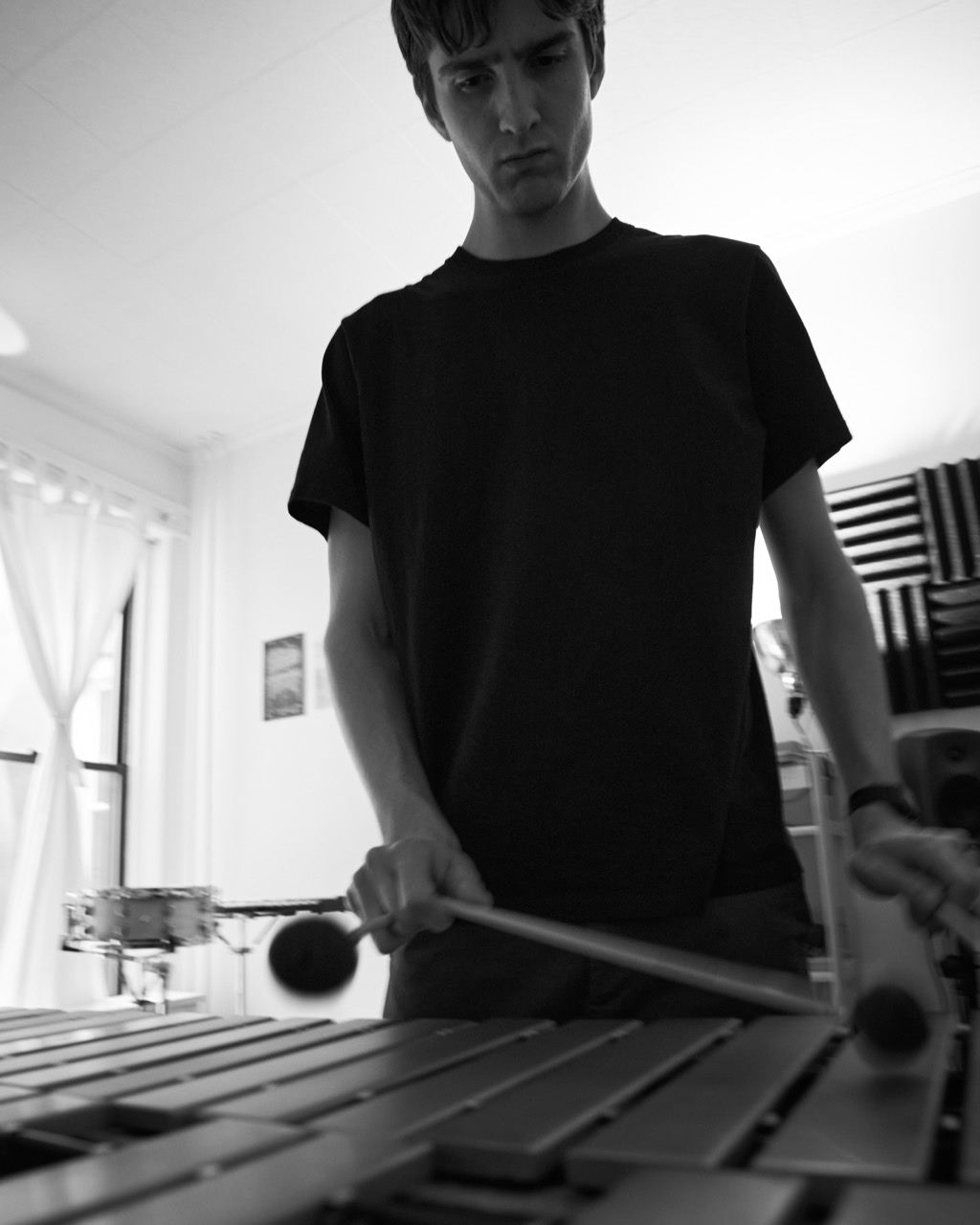
My new album Rubber Wing involved a very long process of conceptualizing, composing, and experimenting on the vibraphone. I began composing often very small frameworks, sometimes just a two bar phrase, sometimes a bit longer. I would call them “Solo I”, Solo II”, “Solo III”, etc. and I ended up with a big pile of compositions. I spent a lot of time sorting through these. Once I had this concept of a Rubber Wing; a mechanical wing made out of a material that would never sustain flight, everything began to fall into place. I was constantly playing the compositions, either on vibraphone or on synthesizers. I knew that I wanted most of the music to involve both instruments, but most of the pieces just started out as solely vibraphone, electronic organ or synthesizers. I composed a lot of the synthesizer parts after working with only vibraphone for a while, once I found which notes or timbres I wanted to add to the music. The vibraphone is very pure and synthesizers can be both pure and rich/complex, so a lot of the process was finding ways for these two instruments to work together, and even blend into one sound. I ended up with eight tracks that I felt utilized this sonic palette best, while conveying the concept of the album.
Sometimes, science and art converge in unexpected ways. Do you conduct “experiments” or make use of scientific insights when you're making music?
I usually don’t think of what I’m doing as an “experiment”, but I do a lot of experimentation within my creative process. Probably the most experimentation is around synthesizers, finding different patches and getting lost in them. I pay a lot of attention to tuning, beating patterns, and resonance when working both with the vibraphone and synthesizer. I’m hoping to explore some other types of tuning in upcoming projects, as well as using more extended techniques on the vibraphone.
How does the way you make music reflect the way you live your life? Can we learn lessons about life by understanding music on a deeper level?
Definitely. My music comes out of a place of patience and close listening, and I try to bring those practices into my daily life constantly. For example, multitasking less and focusing on one thing at a time has been a new practice of mine. I’m never perfect at it, but I think it comes out of my musical process of using patterns, and limitations to create honest music.
Do you feel as though writing or performing a piece of music is inherently different from something like making a great cup of coffee? What do you express through music that you couldn't or wouldn't in more 'mundane' tasks?
I think it has some similarities. If I’m being honest, I’m often wishing my coffee would brew faster, so that I can get on with the day. But I do feel that the metaphorical process of grinding beans, carefully putting them into a filter, and waiting for the water to boil definitely has some crossover. Composing differs largely in that it requires a lot of contemplation, and it’s not as simple as following steps to create the same thing each day. Sometimes I’ll have the same composing process for multiple days, but it’s not predictable how easy it will be to create something I’m happy with, nor does it happen as often as a great cup of coffee. The things I’m able to express through music come out of the slowness, and self-questioning that is involved in making it.
Every time I listen to "Albedo 0.39" by Vangelis, I choke up. But the lyrics are made up of nothing but numbers and values. Do you, too, have a song or piece of music that affects you in a way that you can't explain?
Mad Rush by Philip Glass comes to mind immediately. I first discovered it in high school when I was more emotionally insecure, and it really ripped me open. Every time I listen to it, I’m brought back to that place. There’s a great video online of Philip playing the piece himself and he explains a little bit of the conceptual framework beforehand. Every time I listen to it, I find myself wondering what he was feeling when he composed it, and how it came to be.
If you could make a wish for the future – what are developments in music you would like to see and hear?
I wish for new forms of financial security for musicians, and ways that the underground and avant-garde can continue to survive. I’ve been following the development of AI in music, and I’m both curious and nervous to see where it goes. I also really hope to see more venues that are able to support experimental music. In New York, while there are many great venues, a lot of smaller shows have moved to secret spaces and basements. I love those types of shows, and the feeling of being somewhere that not many people know about, but I would like to see some new homes for new music opening up, that are somehow able to sustain themselves in such challenging financial times.