

Part 2
Take us through a day in your life, from a possible morning routine through to your work, please.
It can really depend on what I'm working on at the time. It's usually a mix between my different practices (playing music, engraving, drawing …).
I like to play music in the late morning and afternoon, and draw late at night. Drawing is for me the perfect time to listen to music and discover current projects and works of other artists. I also listen a lot to the radio and read books that feed my practice indirectly.
It is also crucial that the working day be punctuated by time outside. It can be a walk, a team sport, sharing time with my friends ...
Could you describe your creative process on the basis of a piece, live performance or album that's particularly dear to you, please?
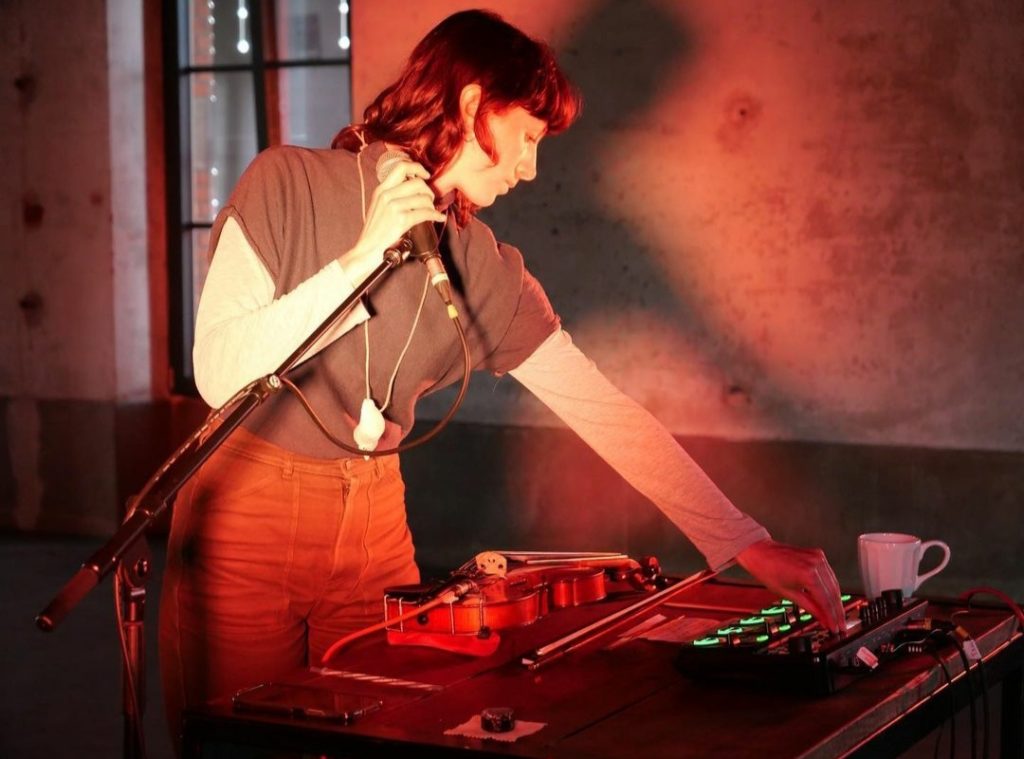
For the last set, I started with improvisation, deciding beforehand on a combination of different instruments for each piece. Like the movements within classical music, I have chosen distinct atmospheres for each one.
I considered the concert as a triptych in three movements. When I found an ideal balance between each piece I concentrated on it separately. I took notes to remember my choices and practiced each day until I was happy with the result, removing or adding elements in the process.
Recently, I also started to write short texts. This is an important new element. I use them to sing. I think of them as prose or short stories that often deal with flora and fauna, entities in the organic world, and human interaction with it. I imagine it thanks to my observations outside, memories of walks, my books on insects or plant species.
Listening can be both a solitary and a communal activity. Likewise, creating music can be private or collaborative. Can you talk about your preferences in this regard and how these constellations influence creative results?
Lately, I have enjoyed creating an encounter between music and other mediums and practices. I have worked and still continue to work with female dancers. It's an intense experience to see bodies interact with your music.
I have recently been following Jeanne Colin's solo project. She questions the imprint that dreams leave on our bodies and our gestures in her piece Abysse, Solo d'un corps rêvant. I also worked with Ateliers Indigo which currently support artists with disabilities and where the dancer Magali Cote improvised on my music during a Cabaret called the Cosmos Cabaret made of visual performances also including movement, speech, scenography, music and video.
I also took part in a film festival where I played in Maya Deren's silent films. It was interesting to assemble the works of two women from two eras. I chose to play on the work of Maya Deren because in the world of Hollywood cinema she invented new narrative modes and because she focused on the representation of women. In her short films she depicted many types of women, which contrasted the stereotypical, objectified female characters in mainstream Hollywood films.
Each project was / is a matter of listening. I also like to improvise with other musicians. To feel that the other listens to you and to make her / him understand that you pick up his messages is a powerful thing. You can feel a strong connection playing with someone else, especially when you understand what means the other sets in motion to establish communication with you not with words but with sounds. Sometimes it's good not to go through words.
Like all meetings, other musicians allow you to learn more about yourself and through this exchange you influence each other mutually. This is the whole purpose of the Gebogen Ogen project on which I am working with Siet Raeymaekers: two creatures from different species and worlds who try by various means to communicate with each other via sound and voice.
How do your work and your creativity relate to the world and what is the role of music in society?
Music is a good communication tool as I said before. I consider that listening to or playing music is a method of healing and bonding people. I see it as a privileged way to tell stories, to talk about experiences that are as much interior, intimate, political as systemic.
For me, moments of creativity are also refuges that build a world parallel to “reality”. The two worlds are porous and mutually nourish each other. The world I create with my work allows me to establish pauses. Thanks to it, I can regenerate myself.
In my plastic work and let's also say with the music in a less direct way, I represent scenes of fictional flora and fauna where the creatures are like mystical entities that I celebrate as forces. I also imagine timeless scenes of community life, sorts of future / antique life where humans, fauna and flora live side by side.
I don’t put a clear political message inside it, but my practice carries with it, in a non-direct way, ideas, projects, utopias, fears, states of mind, attention to specific ways of being, a watch out for forgotten things ...
Art can be a way of dealing with the big topics in life: Life, loss, death, love, pain, and many more. In which way and on which occasions has music – both your own or that of others - contributed to your understanding of these questions?
I wouldn't refer to this as an understanding of these questions, but a help to support our responses to them.
Music is a strong support for all these experiences.
How do you see the connection between music and science and what can these two fields reveal about each other?
I like to keep under silence the scientific aspect of music. Otherwise I fear it will shatter what I feel as a strong magic and dull its mystical aspect.
I prefer to learn how plants are reacting to it. How other bodies are feeling music.
Creativity can reach many different corners of our lives. Do you feel as though writing or performing a piece of music is inherently different from something like making a great cup of coffee? What do you express through music that you couldn't or wouldn't in more 'mundane' tasks?
I really do not award the same attention and respect to those tasks and creation. I think when I’m performing a piece I’m not anymore in the world of “mundane tasks” and these disconnections are crucial.
Moments of music are much more intense and full of a “non-religious sacred”.
Music is vibration in the air, captured by our ear drums. From your perspective as a creator and listener, do you have an explanation how it able to transmit such diverse and potentially deep messages?
It depends on the receivers and if the antennas are opened. If the listeners are sensitive and available, the messages will be received in all their intensity.
It depends on the imagination of the translators of these messages. Even if the message is full of a multiplicity of layers - if the antennae of the listeners are not well erected nothing will happen.