

Part 2
There are many descriptions of the “creative state”. How would you describe it personally? Is there an element of spirituality in what you do?
Yes, I think there is, although not necessarily in a religious sense. For me, spirituality in music is above all a form of suspension of time.
There are moments during a concert or a recording when you stop thinking technically about the instrument. You are no longer thinking about notes, harmony or form. You are simply inside the sound. It is very difficult to describe because it does not last long and cannot be programmed.
I have always searched for this condition also through my relationship with the traditional music of Sardinia, with canto a tenore and cuncordu. In those forms of music there is something very ancient: sound is not simply entertainment, but a relationship between people, space, memory and community.
I believe this dimension can also exist in jazz.
Once a piece is finished, how important is it to let it rest and evaluate it later? How much space do you allow for improvement and refinement before considering yourself satisfied? How does this process work in practice?
I have learned that you need to know when to stop. You could modify a composition indefinitely. But there comes a moment when continuing to correct it simply means being afraid to let it go.
Generally, I try to create some distance. Listening again after some time allows you to understand immediately whether something was truly necessary or not. In the studio, this becomes even more evident.
With Ritornare, and particularly while working with Manfred Eicher, the issue was not to achieve an abstract perfection. It was to preserve the truth of a musical moment. A small imperfection can contain far more music than a technically flawless performance. The difficult thing is to recognise which of the two you are hearing.
How do you think the meaning or effect of an individual track is strengthened, clarified or perhaps contrasted by the EP or album it belongs to? Does every track need to be coherent with the larger whole?
For me, an album is still a complete work. I know that today a lot of music is heard as a sequence of individual tracks, but I still think of the album as a journey with its own dramaturgy.
This is particularly important for Ritornare. Each composition must be able to stand on its own, but when it is placed beside the others it acquires a different meaning. There are tensions, breaths, fullness, emptiness, more narrative passages and others that are more abstract. Even the silence between two tracks can have a function.
An album should create a place that the listener enters with the first track and leaves differently at the end. It is a conception of the record that ECM has given extraordinary importance to throughout its history, and it is very close to the way I think.
What is your view of the role and importance of production, including mixing and mastering? In terms of what contributes to the construction of a piece, what balance is there between composition and arrangement or performance?
In music like ours, production should never be a decoration applied at the end. It is part of the musical thought.
With Manfred Eicher this is particularly evident. Production begins long before the mix: it begins with listening, with the choice of a take, with the duration of a passage, with the relationship between the instruments, and above all with the way space is perceived.
For Ritornare, the work of Stefano Amerio was also fundamental. He was responsible for all the recording and the mix. I had already worked with Stefano on several previous recordings, so there was already a deep understanding between us regarding sound, the way I play, and the dynamics of this music. The meeting between his technical and musical sensitivity and Manfred’s philosophy of sound created the chemistry this album needed.
During the listening sessions in Munich, Manfred repeatedly spoke about the need to let “the wind and the sea” breathe through the music. That image stayed with me. Because Ritornare did not need simply to sound beautiful or perfect. It needed air. It needed distance, movement and depth. You cannot hold the wind, and the sea never keeps the same shape. Perhaps for that very reason, those words perfectly described the character of Atlantico as well.
Composition provides a geography, but it is the musicians who decide how to cross it. Recording, production and mixing have to preserve that sensation. Sound is not the container of the music. Sound is part of the composition.
Music and the artwork that accompanies it are often closely connected. Can you talk about this in relation to the current project and, more generally, about the relationship between images and sound for you?
I have always had a very visual relationship with music. I probably think in images much more than I realise. Atlantico, even in its name, contains an image: an enormous expanse that simultaneously separates and connects continents, cultures and histories.
When I first saw the cover of this album, with that flock of migratory birds, together with the title Ritornare — strictly in Italian — I immediately felt that there was a very strong relationship between them. Are those birds leaving, or are they returning? We do not know. And that is precisely the ambiguity I find extraordinary.
Migration contains departure and return at the same time, the memory of one place and the need to reach another. Looking at that image, I immediately thought of the relationship between dream and reality. Almost like the magical realism that has accompanied my imagination since the birth of Atlantico: a perfectly real image which, if you look at it long enough, slowly begins to tell you something else.
The title Ritornare contains the same ambiguity. It does not simply mean going back to a place. You can return geographically to the same point, but you cannot return to the same time.
Perhaps the birds on the cover know their destination. When we began Atlantico’s journey again, we probably did not. And this is also what makes the relationship between that image and the title so close to the music on the album.
After finishing a piece or an album and releasing it into the world, there can be a sense of emptiness. Do you recognise that experience? And how do you return to a creative state afterwards?
In this particular case, I do not feel Ritornare as the end of something, but as the beginning of a new journey.
After the album is released, we will have many concerts in Europe, Asia, Africa and South America. Atlantico has always been profoundly connected with travel, encounters, cities crossed, stages, and the transformations that every concert brings with it. For this reason, the album is not a destination: the journey will continue, and the music will continue to change from night to night.
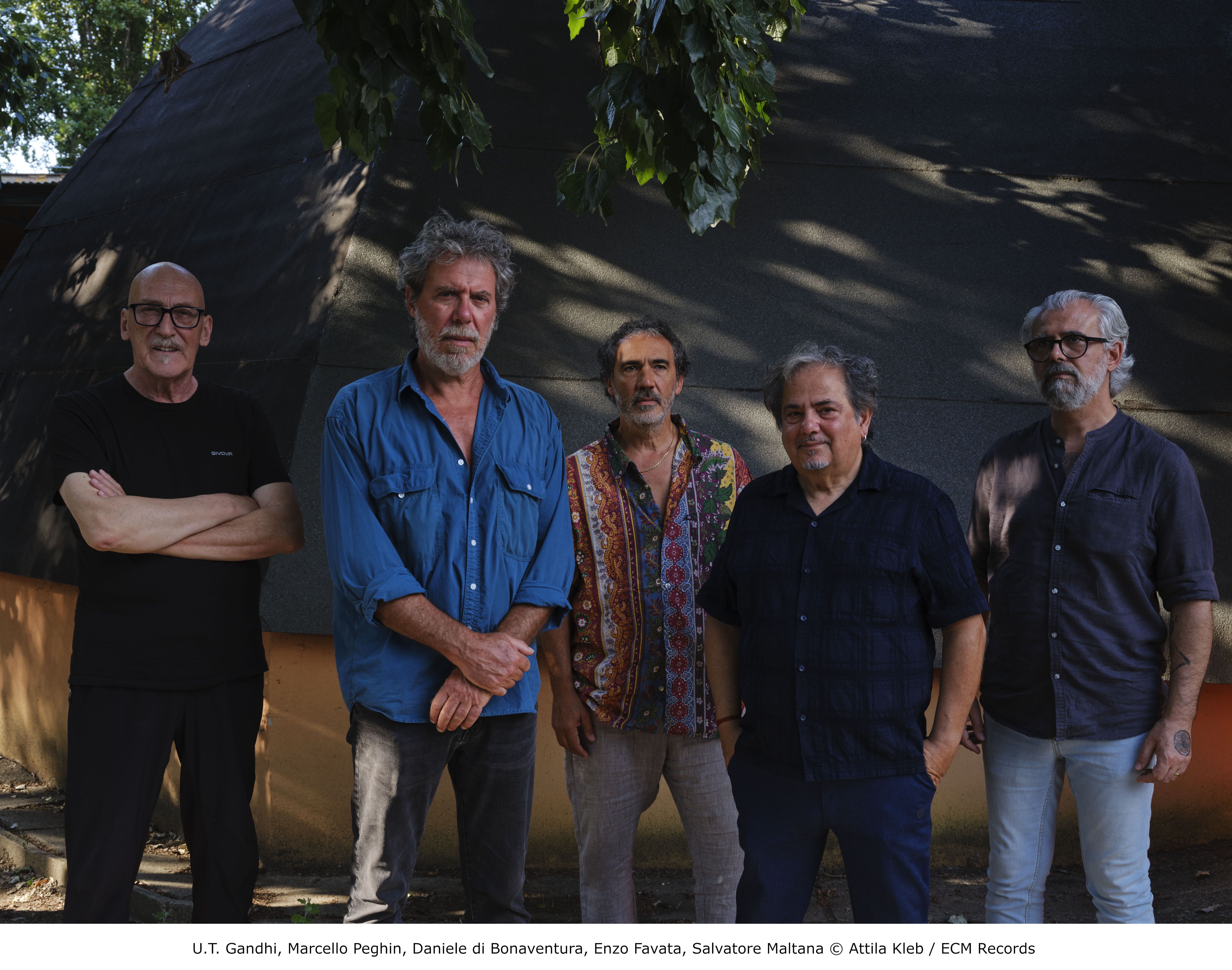
Of course, all of this has taken on a different meaning today after the loss of U.T. Gandhi. Gandhi will always be with us, because that deeply personal drumming, that extraordinary percussive poetry, has become part of the deepest identity of Atlantico.
I do not think a musician like him can simply be replaced. Whoever takes his place will need to bring their own personality and find their own voice, but inevitably they will encounter that musical and human trace. Gandhi’s drumming, his way of breathing inside the music, and that particular poetry of rhythm will be a great source of inspiration for whoever continues this journey with us.
Perhaps this too is contained in the title Ritornare: the journey continues, but it carries with it the people, experiences and sounds that made it possible. Once again, it is something that resembles that border between reality and imagination that has always fascinated me: a person is no longer physically on stage, and yet their sound continues to appear inside the music.
So Atlantico will continue to travel. And Gandhi, somehow, will continue travelling with us.
I would be interested in some examples of comments from listeners or critics about what they thought some of your compositions meant or about the impact they had on them. Have there been any “misunderstandings”, or have you gained new interpretations yourself through them?
I find it very interesting when someone attributes to my music a meaning completely different from the one I started from.
I do not consider it a misunderstanding. From the moment a work is released, the composer loses part of his authority over its meaning. A listener may hear nostalgia in a piece that for me was born from curiosity. They may imagine a landscape I have never seen. They may recognise something from their childhood in a melody created thousands of kilometres away. This interests me enormously.
Atlantico has always generated this kind of reaction because its music does not belong entirely to one precise geography. The Mediterranean, South America, Europe, Sardinia, improvisation, folk memory and jazz can appear and disappear.
If the listener finds a story inside this music that I had not anticipated, it means that the music has become theirs as well. And that is probably the best possible result.
Creativity can reach many different areas of our lives. Personally, do you think writing a piece of music is inherently different from making, for example, an excellent cup of coffee? What do you express through music that you could not, or would not want to, express through more “everyday” activities?
I believe creativity exists in many apparently simple actions. Preparing something to eat, telling a story, arranging a space or even finding a practical solution to a problem can all contain imagination.
The difference is that with music I can enter territories that verbal language cannot reach. I can place melancholy and happiness, memory and desire, belonging and distance inside the same sound at the same time. I do not have to choose a definition. This is probably what I continue to love most about music after so many years: it can say two opposite things at the same time, and both can be true.
Perhaps Ritornare is exactly about this. To return means to look back. But it also means to begin leaving again.