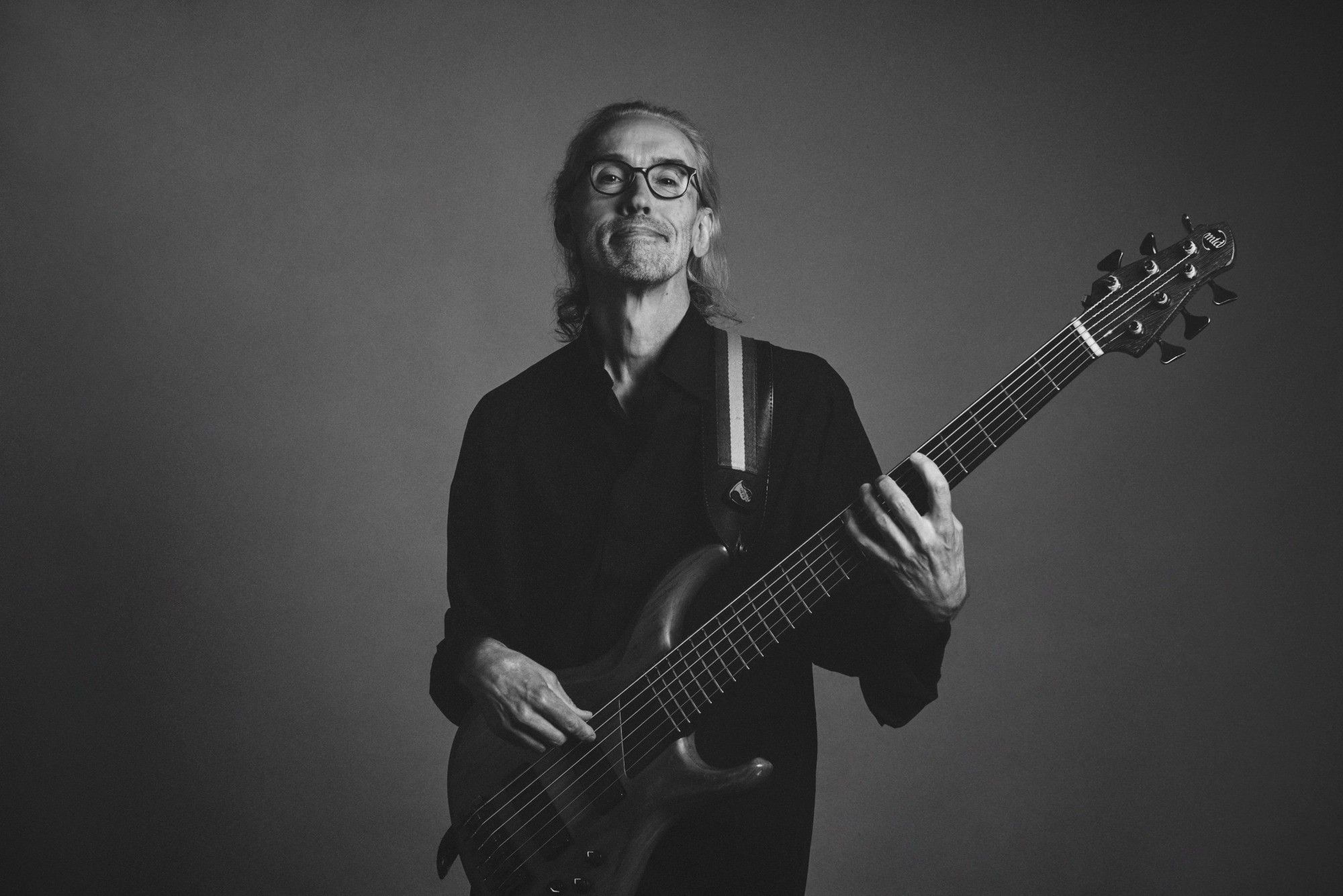


Part 1
Name: Björn Meyer
Nationality: Swedish, Switzerland-based
Occupation: Bass-guitarist, composer
Current release: Björn Meyer's new album Convergence is out via ECM.
Recommendations for Bern, Switzerland: Whenever you get a chance to visit make sure not to miss “Orbital Garden” - a wonderfully unique venue for inspiring music. … and a coffee, a concert or an exhibition in PROGR - an equally unique “Centre for cultural production” in an old school-building in the middle of town. In summer you should also try and get a swim in the river Aare.
Topics I am passionate about but rarely get to talk about: I am passionate about acoustics — sound and resonance — but I also do get to talk about it on a regular basis. See the following excerpt from the liner notes to Provenance for example:
The electric bass in acoustic space
“..Sound”
I have been fascinated by acoustics for a long time now, how they affect the creative process and our experience of sound. Already very early in my relationship with the electric bass I came across what many see as a paradox. Even though the instrument Is technically non-acoustic, the music, as well as its impact on a listener, is deeply Influenced by the properties of the space where it is played. The many different ways in which acoustics affect my compositions, improvisations and ultimately each performance, have always been sources of surprise and inspiration. There Is definitely a second member in this solo project - the room!
If you enjoyed this Björn Meyer interview and would like to stay up to date with his music and upcoming live dates, visit his official homepage. He is also on Instagram, Facebook, and bandcamp.
Where does the impulse to create something come from for you? What role do often-quoted sources of inspiration like dreams, other forms of art, personal relationships, politics etc play?
For me, “to play” is the most important state of being in order to allow for any creative process to take hold and unfold. Most new ideas, impulses and creative accidents come to me whenever I find myself fully immersed in the act of playing - without trying to achieve something.
Put in a larger context, I don’t see creating music - or any art for that matter - as something separate from being alive. Therefore the main source of inspiration for any musical idea has always been a more or less chaotic blend of what affects me as a human being in everyday life. Nature, encounters with friends, loved ones and strangers, world political developments, environmental issues, inspirational art, loss, joy etc.
However, I need to open the door — to play — in order for any new idea to manifest.
For you to get started, do there need to be concrete ideas – or what some have called a 'visualisation' of the finished work? What does the balance between planning and chance look like for you?
The process and the balance differs from project to project. But for my solo-work I am definitely very open to creative accidents (call it chance!), more so than I am when more people are involved.
As a solo-performer I can react on any impulse and change musical direction, dynamic expression, intensity or even key- and time-signature in an instance if it makes musical sense to me. That is a great creative freedom but also a huge responsibility that goes as much for the recording of a new repertoire as for performing live.
I do have a plan when I start a concert or a recording but there are always parameters that can’t be fully controlled and that will ultimately impact the way the music unfolds. How does the room react to dynamics? Are there frequencies that resonate with the venue or emotional resonances within the audience? How does the instrument - and how do I - respond to the room? etc.
Is there a preparation phase for your process? Do you require your tools to be laid out in a particular way, for example, do you need to do 'research' or create 'early versions’?
I do like some measure of order (being born a Virgo) but since I am travelling quite a lot I have learned to also enjoy the moment of slight chaos in daily routines and embrace the challenges of creating under less than optimal circumstances.
It often takes time for the music to reach a performable structure, form and dramaturgy. The many steps on the way can be seen as research, but often it is more of an intuitive way of playing with the material that leads to a version that I feel comfortable presenting to the world.
Again, the important thing for me is to not want to achieve a certain result but to be open to the process and listen honestly. Obviously this is different when writing for larger ensembles where a repertoire often needs to develop in a more structured way.
Do you have certain rituals to get you into the right mindset for creating? What role do certain foods or stimulants like coffee, lighting, scents, exercise or reading poetry play?
I do feel good when I have the chance to exercise or meditate regularly and I do enjoy having a cup of coffee every so often, but I can’t say that they are necessary rituals for creating.
A somewhat regular daily routine (without touring) is very helpful for me to get things done. However, next to creating new music, there are many things that want and need to get done and since I can not force inspiration, I will share the time between many different aspects of being a part of the society I live in - music obviously being a very important part of it.
Sometimes a great cup of coffee can trigger a new idea but most of the time something completely unexpected will show the way and then it is helpful if I have the chance to act on that impulse without having to rush to the train or check-out of a hotel ...
For Convergence, what did you start with? If there were conceptual considerations, what were they?
Convergence is the result of time and an ongoing evolution. Starting from the very first concert I played after the release of my first solo-album Provenance in 2017, my relationship with my instrument, the repertoire and the act of performing solo has gradually deepened and developed.
At the same time, life itself has offered many changes, challenges and wonderful surprises that have strongly influenced the trajectory of what I feel the need to, and what I am able to express in my music.
Conceptually I had only one thought about this release: to stay true to the idea of recording and presenting the “Electric Bass in Acoustic Space”. There are still so many sounds and emotional levels of the instrument that, at least to me, can only be experienced when there is a room involved. Starting with his invitation to record my first solo album Provenance in the acoustically fantastic Auditorio Stelio Molo in Lugano Manfred Eicher (producer and founder of ECM) has been very supportive of this ambition.
For Convergence he invited me to work in an equally inspiring room at Bavaria Music Studios in Munich and the way in which Tonmeister Michael Hinreiner managed to record this repertoire has again set a new standard for me.
Tell me a bit about the way the new material developed and gradually took its final form, please.
I remember the feeling when I first played the opening two bars of what slowly became “On Hope”. It was something I hadn’t heard before and the sound triggered many excursions into similar ideas.
At some point I was juggling a handful of parallel compositions until they all finally boiled down (converged) into one. Without knowing it at the time that was the start of the new repertoire.
Looking back, this process repeated itself on other compositions as well like “Gravity” and “Motion”.
“Magnetique” developed in a slightly different way and is still very much an improvised structure.
It changes every time I play it, develops and takes new paths, which is something I really enjoy.
“Nesodden” came out of a moment watching the interplay between two canoe-paddlers and a family of geese outside Oslo. The melodic development and harmonic structure came in a single flow and I only had to (wanted to!) do some minor adjustments to the form.
“Rewired” is an improvisation using the very inspiring sonic possibilities of preparations. I have done a lot of experiments over the years and the palette is growing.