Name: Bernhard Living
Nationality: British
Occupation: Composer
Current release: Bernhard Living’s A Continuity of Form is out now.
If you enjoyed this Bernhard Living interview and would like to know more about his music, visit his official homepage. He is also on Facebook. His complete work is available from his bandcamp page.
For a deeper dive, read our earlier 15 Questions Interview with Bernhard Living.
Entering/creating new worlds through music has always exerted a strong pull on me. What do you think you are drawn to most when it comes to listening to and creating music?
The linear movement of tones - and the combination of tones to create chords and harmonic structures - is something that interests me - whether the music is by Thomas Tallis - Franz Schubert - Anton Webern - or Morton Feldman. It is the tonal movement through time that I find truly inspiring - both as a listener and as a composer.
Asked to define what music is - the composer Igor Stravinsky replied that music is the organisation of tones. Asked the same question - the composer Edgard Varèse said that music was the organisation of sound. I am going to side with Stravinsky in his description of music and composition - and feel that tones and harmonic structures are the essential and fundamental components of music as an art form.
There seems to be almost infinite possibilities of combinations of using the twelve tones of the equally tempered chromatic scale. In the "equal-tempered" scale - each semitone is equal to a ratio of the twelfth root of 2, or 1.05946. The relationship between music and mathematics is an interesting one - and is something that I would like to explore more fully in my future work - especially within the concept of infinity.
Charle Ives described his last great work - the ‘Universe Symphony’ as ‘a ‘universe in tones’ and through the symphony - and though the use of tones - to be able to gaze into the infinite.
I am very interested in the development of Western (Occidental) tonal music; from early ideas about music by the Greek philosopher Pythagoras; to the Tudor period music of Thomas Tallis and William Byrd; the baroque music of J.S. Bach; the classical period compositions of Ludwig von Beethoven and Franz Schubert; the modernist compositions of Igor Stravinsky - Arnold Schoenberg - Alban Berg - Anton Webern - and Charles Ives; the jazz composers and musicians John Coltrane and Eric Dolphy; and the ultra minimalism of Morton Feldman.
By basing a large percentage of my work on using tones and harmonic structures - my compositions become an engagement with the past - not its destruction or erasure - but of its perpetual development and movement through time - in which the past becomes an important part of the present future. I regard my own work as a continuation of this process.
I have always listened to the music of Bach - and have found that the formal purity of his music to be very inspiring. I feel that there are mores secrets in Western tone-based music that are yet to be revealed.
[Read our Sebastian Oswald interview about his approach to re-arranging Bach]
As a professional musician - I played the flute - I used to love playing Bach’s ‘A minor partita’ for flute solo - and that once one gets beyond the technical difficulties of performance - the music pulls one along and one loses sense of self - as if you are moving through the music - as well as the music is moving through you.
It all sounds rather mystical - which is something that I do not like - but there are no other words to describe the experience.
As a composer Bach - as well as other of the great composers - was touched by something deeply profound - and he passes that profoundness onto the listeners and performers of his music. There is also something similar - for me - in the music of Anton Webern and Morton Feldman.
One of the ways in which I engage within the tonal continuity of music is to use harmonic or melodic fragments - or tone cells or twelve tone rows - from composers of previous generations.
These include compositions from my albums ‘Today Comes From Yesterday’ and ‘All Together Through Time.’ My ‘Today Comes From Yesterday’ album consists of three compositions based on twelve-tone rows from three of the leading composers of the twentieth century.
‘Composition 2018.04 (Untitled)’ is based on the tone-row from Anton Webern’s ‘Variations Opus 27’ (1937):
‘Composition 2021.10 (Untitled)’ is based on the tone-row from Arnold Schoenberg's ‘Suite for Piano’ Op 25 (1921) - and alternates singe tones with dyads. The composition was first performed at Iklectik - London - 20.10.2021 - which was the hundredth anniversary of Schoenberg's composition.
‘Composition 2022.05 (Untitled)’ is based on the tone-row from Igor Stravinsky’s ‘Epitaphium’ (1959).
And the album ‘All Together Through Time’ include a work - ‘Composition 2023.04 (Untitled)’ - that consists of alternating tones from high and low registers - and is based on tone-rows from leading composers of the twentieth century - with tone-rows from Alban Berg - Morton Feldman - Elisabeth Lutyens - Arnold Schoenberg - Karlheinz Stockhausen - and Anton Webern.
The Greek philosopher Heraclitus claimed that "everything flows” - highlighting the constant change in the universe. Yet - the idea of "all together through time" suggests that there is permanence amidst change - and that a thread of continuity runs through the ever-shifting landscape of existence.
On a more practical musical level - the phrase of ‘All Together Through Time’ points to the idea that composers and musicians across generations are bound together by shared experiences - compositions - musical ideas and histories. Our actions and decisions ripple through time - affecting future generations and intertwining our destinies.
From the earliest sketches to the finished piece, tell me about the creative process for your current release, please.
The ‘From Here to There’ album’ - which was released in July 2024 - consists of three compositions:
Composition 2023.02 (Untitled)
Composition 2023.03 (Untitled)
Composition 2023.09 (Untitled)
Like the titles of my other albums and releases - there is no direct relationship between the title and the content of the compositions. The compositions themselves are titled/catalogued with the year in which they were composed - and the order within that year. For example ‘Composition 2023.02 (Untitled)’ was the second composition composed in 2023 - and ‘Composition 2023.03 (Untitled)’ was the third - etc.
All of my compositions since 2010 have been produced using a formal grid system - and I find that working within a rules-based order - and one with clearly defined barriers and boundaries - gives me more creative freedom than working with an anarchistic ‘anything goes’ approach. (See below for more about grid and rules)
From Here to There
The ‘From Here to There’ album consists of three experimental tone-based compositions that explore the use of different harmonic structures in non-traditional musical forms. The basic ideas for these compositions were sketched out in a notebook - then later developed and expanded upon within the Ableton environment.
The first stage of the production process is to create the MIDI files - either for single tones or chords. When this process is complete I then export the MIDI into audio - and re-import the audio to use as the audio assets and components of the compositions. The final stage is to place the audio files on the timeline in accordance with the ideas that I had developed in the notes. This is the ‘composition’ part of the work.
I sometimes use the artificial intelligence chatbot GPT to create random number tables that help to determine the order of the tones and chords (see more below). I do the mixing while I am arranging the sounds. As I am not making dance or pop music - I do not feel the need ‘master’ the master audio output.
‘Composition 2023.02 (Untitled)’ consists of a tone-line moving in semi-tones and minor thirds - within a pitch range between A1 to C3. It suggests never ending permutation and endless movement through time. Composition 2023.03 (Untitled) is based on a seven-note tone-cell of C - C# - D - D# - E - F# - A# - and which appear as two-note dyads and three-note trichords. All the elements are of the same length - and the sounds move at a glacial pace through the time-line. Composition 2023.09 (Untitled) is based on the chord sequence (changes) from John Coltrane’s 1960’s jazz composition ‘Giant Steps’.
The GPT artificial intelligence programme was utilised in the production of these compositions - and created randoms number tables which were used to determine the order of the tones in Composition 2023.02 and Composition 2023.02 - and the order and length of the tones in Composition 2023.09.
The GPT AI programme is certainly artificial - but it is not intelligent in any deep or profound way - and it will never match the levels of human thought or conciseness. AI did not compose the works - but was used merely as a digital tool to accomplish the painstaking and time-consuming work which would have been difficult to accomplish manually. From the start - I had a clear general overview of what the compositions would be and sound like. There was clear purpose and intent on my part.
Titles
Titles are used simply to identify each album project - they are also used to give an indication of my philosophical interests and concerns.
The title "From here to there" is a philosophical concept that encapsulates several themes and interpretations.
Philosophically - this phrase signifies the process of change and transformation. It highlights the movement from one state of being or understanding to another. This can be related to the development and evolution of ideas - or broader social changes. It also refers to the passage of time - where "here" represents the present moment and "there" represents the future.
Philosophers like Heraclitus have explored the nature of time and change - emphasising that life is in constant flux. Or - in a more literal sense - ‘from here to there’ addresses physical movement through space.
1 / 2

Next page:
Part 2
Part 2
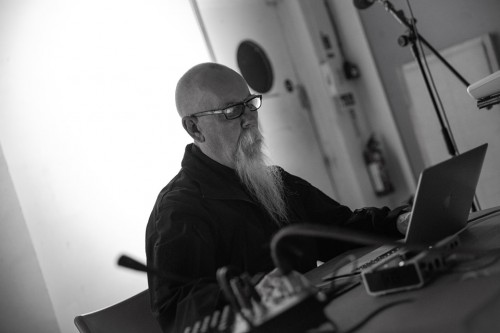 Bernhard Living Interview Image by Yvetta Sedlakova
"Working within a rules-based order gives me more creative freedom than working with an anarchistic ‘anything goes’ approach."
Content