

Part 1
Name: Basile3
Nationality: French
Occupation: Producer, DJ, performer
Current release: Basile3's new album 43°C is out via InFiné.
Recommendations: About AI stuff: I just started reading Ways Of Being, Animals, Plants, Machines : The Search For a Planetary Intelligence by James Bridle
I also believe in the power of fiction to offer new perspective and possibilities. If no one else has done it yet I'd suggest to read Ursula Le Guin work, especially The Dispossed and The Left Hand Of Darkness.
If you enjoyed this Basile3 interview and would like to stay up to date with his music and work, visit him on Instagram, Soundcloud, and Facebook
Do you think that some of your earliest musical experiences planted a seed for your interest in production and technology?
Definitely! Being born in 1993, I have witnessed in my home the beginning of personal computers, the Internet, file sharing (… and free music) and even streaming pretty early with radioblogclub. Thinking about it now, I think my whole family was pretty technology friendly, for instance my older brother was quite into all these new computer technologies so I discovered them pretty early.
We also had a Dreamcast and this game Phantasy Star Online (a game that could be played online, it was very new at that time ...!). The opening music in this game was maybe one of my first encounters with this kind of very synthetic, jazzy, dreamy japanese music which is definitely a big influence in my sonic palette.
Also my other brother was already around 16/17 when I was still a small kid and was a bit part of the graffiti and hip-hop movement, and I remember trying to scratch vinyl even though it was kinda forbidden to do it because I'd ruin the record.
What were your very first active steps with music technology and how would you rate the gains made through experience?
Well, when I was 12/13/14 my group of friends and I were more into rock, Pink Floyd, the Doors, it was also this big garage rock revival with The Strokes, The Libertines etc. So at some point some of my friends wanted to also found a band …
I was not playing music at that time and was a bit late with that, also I thought picking up guitar or bass or drum was a bit too common and was interested in being a bit different. So I thought I could learn the keys and maybe be a keyboardist in the band. I think this idea had a big impact on my musical journey.
By taking piano lessons I discovered the jazz repertoire and was really curious about that, especially Bill Evans. I was also starting to be a bit more focused on keyboard/synth sound in records and trying to find indie bands which were incorporating synths, so I guess I was starting to analyse the production/arrangement part of a record.
But also the main thing it brought me was that I discovered music software. I didn’t have a piano at home and my older brother who was already into music pretty seriously gave me a copy of Reason (a DAW) and a midi keyboard. It was a whole new world slowly opening to me even though first it was just to practice the keys. I slowly started using Reason to make my own compositions … without being in a band.
Were/are you interested in the history of production and recording? If so, which events, albums, artists, or insights stand out for you?
Yea definitely, following what I was saying above, bands like The Doors or Pink Floyd definitely made me curious about all the little details in their compositions and trying to figure out which instruments were played.
There was also this Alphabetical album by Phoenix my brother used to listen to, which is very special to me even today. I saw them mentioning recently that at that time they were trying to do pop/rock music with the tools of early 2000’s Rnb and I always come back to it.
In the same way there was this band called Hot Chip, I was quite fascinated by their live performances and music. They were doing this weird intimate pop with a lot of electronic machines and I love to listen to the first albums even these days.
Then followed the big Ed Banger era, nothing was the same after Justice started to drop their music. I really dived into electronic music. And I think for me it’s people like Feadz and Dj Mehdi who opened the doors to this hybridization between techno, electronica, rap, r’n’b and club music. Quite quickly after came Night Slugs, Sound Pellegrino, Club Cheval and they really opened the whole doors.
At the same time I was still into jazz and especially when it was more fusion with synthesiser like some Herbie Hancock, or Chick Corea albums.
Anyway I was and I'm still listening to a loooot of music and always seeking for new things, and also reading about music history etc.
Making music, in the beginning, is often playful and about discovery. How do you retain a sense of playfulness and how do you still draw surprises from tools, approaches, and musical forms you may be very familiar with?
That is such a good question, in some way with this album 43°C I feel like I've come to a term with the way I have been doing music. It was a bit of a struggle to finish this record but I tried to keep in my mind these little moments of epiphany that existed when I started any of these tracks.
I usually tend to create with no preconception of anything, being very free and playful about the first ideas of a song, and not knowing what it should be for. Then another big part of the work, which is maybe more the one of the producer than the musician, is to make sense of this idea and make choices about the aesthetic direction it should follow.
Also a lot of “fxs” sounds in this record were made during the “sound design” session, which is basically a moment in the studio where I experiment very, very freely not knowing what kinda sounds I'm aiming for and recording everything. Then I listen back, find interesting parts, cut them, export them in folders. In some ways I can use them in songs to look for unexpected sounds happening from time to time. That’s definitely a Brian Eno trick aha.
The last thing to do to keep a sense of surprise and excitement is trying to take some distance with the demos before coming back to them and then listen to them with a very fresh ear and see where you would like to make them go. But overall, that’s a very very difficult thing to do when creating anything I'd say. Even more in this “editing” way I makemusic.
For your own creativity, what is the balance and relative importance between what you learned from teachers, tutorials and other producers on the one hand – and what you discovered, understood, and achieved yourself? What are examples for both of these?
I think when you read music theory and music biographies you can understand how this idea of novelty always comes from people who learnt things and then break the rules. Maybe also sometimes because they learn it the wrong way, and also by being constantly curious.
I think I always had this mindset of finding the one thing that really interested me inside a bigger thing, it’s a process of translation, I don’t really know how to explain it. All I know is I'm having a hard time understanding people who are into doing it the way it has been done already, following the rules, tradition. For sure it depends on the context, but just by being a white middle class guy from France born in the 90s there’s a lot of things that wouldn’t make sense for me to do. I never really understand Western people who are taking all the codes of a specific genre which has nothing to do with their experience of the world or their time.
As long as I like dub and post-punk, old-school house and respect their importance in the sonic possibilities they offered, I don’t understand why some people today are just trying to recreate a sound and aesthetic that was then very new and about reaching new sonic possibilities but which is now some kind of conservative nostalgia?
Don’t get me wrong - a lot of interesting artists are taking dub, post-punk, house music to interesting and relevant places today as well. It just maybe doesn’t sound like it to some purists.
How and for what reasons has your music set-up evolved over the years and what are currently some of the most important pieces of gear and software for you?
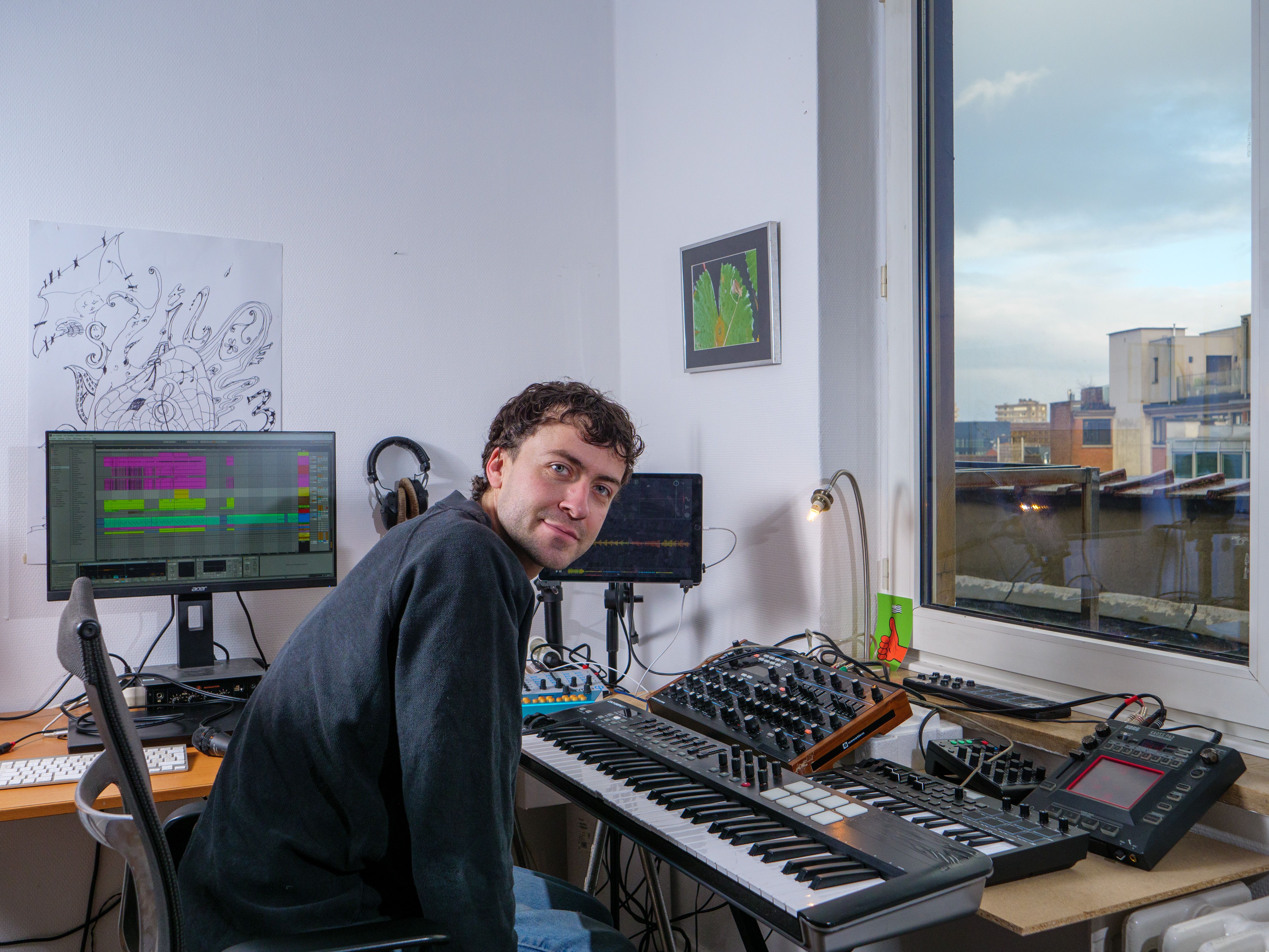
It is mostly computer based, everything in Ableton, with some mics to records some stuff. But I haven’t really used hardware in the album.
Most of the synths on the album come from Arturia's VST replicas of very classic vintage synths (Synclavier, Prophet, Jupiter …)
But I'm getting into it! I have now a Novation Peak which is a great synthesiser, I also use the ipad for live shows, lot of great granular apps on it.