

Part 1
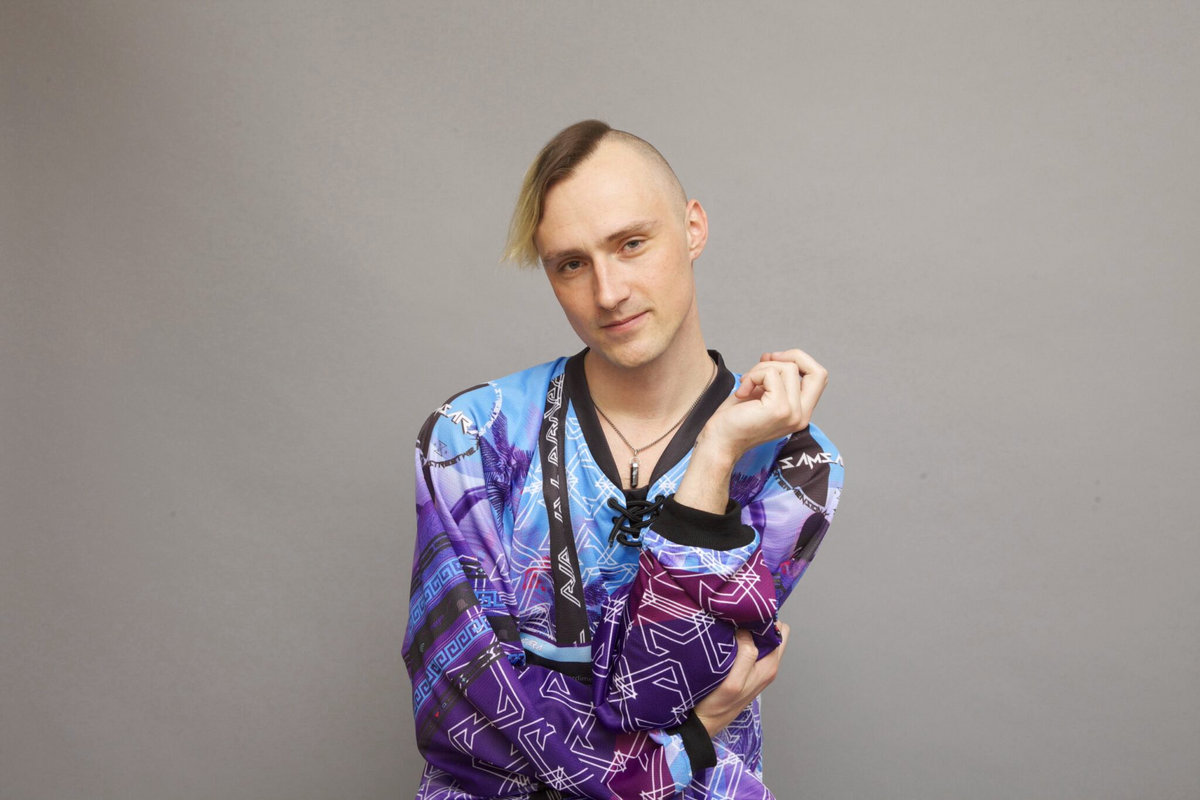
Name: Ariadne Randall
Occupation: Multimedia artist, composer, producer, songwriter
Nationality: American
Current release: Ariadne Randall's Her Water Dream / A Blue Thumbs Up is out via Oxtail.
Recommendations: In this interview, I’ll mentioned a lot of my heroes – Joni, McKenzie, etc. So here’s two bangers for the road:
I’m recently fangirling hard on the paintings of Hamid Yaraghchi, who’s showing in a group show I’m also in called Dark Botanicals, at the gallery which represents my visual art, Galerie Peter Gaugy, here in Vienna. There are also lovely works by Ernst Lima, Lauren Nickou, and Letizia Wirth in the show.
I keep finding Vilém Flusser’s Into the Universe of Technical Images an important and prescient text for understanding our current Western brain rot technoscape of algorithmic capture; and, perhaps, pointing to some good opportunities in the mess of it too. He predicted emojis and memes. Not bad for the 80s. Don’t get him started on vampire squid.
A friend just gave me Bell Hooks’ The Will to Change: Men, Masculinity, and Love, and I’m super curious, but can’t report back yet.
If you enjoyed this Ariadne Randall interview and would like to stay up to date with her music, visit her official homepage. She is also on Instagram.
Do you think that some of your earliest musical experiences planted a seed for your interest in writing lyrics or poetry? How and when did you start writing?
First, thank you for these thoughtful and compelling questions. I’m grateful for the opportunity to speak on so many matters close to my heart.
The question of beginnings is a curious one for any artist, I think. Rilke addresses this indelibly in his “Letters to a Young Poet,” which I would recommend to any person beginning a path in the arts.
It’s possible that, aside from those who seek primarily to be seen (itself valuable and important) any person who is drawn to such matters is drawn by forces interior to them which would take root in any circumstance: some desire for the outer world to reflect the richness of the inner, perhaps, or some need to take that inner world and turn it outwards for the pleasure of others, and for some particular, tender heart to be seen which would otherwise remain invisible.
This might be what sometimes is referred to as self-expression, though I’m unsure how much of the Self in the Jungian sense is really involved in art making; my small-s self feels mostly like a secretary that takes dictation and does logistics for its boss. Coffee, rent, a room of one’s own.
To the geographically or culturally distant among the readers here, I would also advise that it’s helpful to be an outsider because no one tells you what you can and cannot do and what is and is not important. A raw, more genuine relationship to cultural artefacts is possible when one comes from a position of total ignorance. (Try to listen to opera or raga or Webern as an alien; it’s quite a curious exercise.) As a kind of intuitive, casual example, I might contrast the Fruity-Loops-based cellphone music coming from the global South – filled with majestic discovery, retourned local tradition, and unalloyed joy – with the weight I sometimes sense in Europe, where ideas of history and class lay heavily on children’s judgements of the possible and the important, on what young and vibrant artists see as available and true, and in what the educated curatorial class considers relevant for funding by governmental bodies. All the synths in the world won't buy you courage or something to say. And the nice thing about freestyling what to give a shit about is that whatever is true for you won’t be wrong even if it changes later. The old Zen koan applies: not knowing is most intimate.
Generalities aside, for my love of language, music, and art in general, I must point to a source which surprises me somewhat: my challenging, beautiful, and troubled mother, who passed away from suicide last month after a long battle with mental illness, while I was composing a 30-minute song cycle for the Vienna Volksoper on “Queer Joy”; those pieces were dedicated to the unexpected kindness she showed towards trans and queer persons in the late days of her life, including me.
Why her?
Because in the rural Southern farms and Apocalyptic churches among cowboys and meth and tough men and the like, she was the only soul I knew until my teens that loved art. She was – outside of her Church work as a minister’s wife – a singer, painter, poet, children’s book author and illustrator, and former teacher. A staunch anti-racist in a time and place that wasn’t popular, she was one of the first white educators to work in the integrated schools of Little Rock in 1968; attended an all-Black teachers’ college, and was a lifetime honorary member of its honour society (the choir pictures show a square-jawed, blonde woman singing her heart out). She taught me to read at age three, hiding Post-Its with parts of speech and vocabulary words among the garden leaves and horse barns. Being rewarded handsomely in candy for each 100% speedrun of the King James Bible as a kid was helpful, if disturbing: it teaches one the core rhythms of English and has a lot of juicy references you can pull out at the worst dinner parties ever.
Perhaps one further story will suffice: she grew up in a one-room schoolhouse in rural Arkansas in desperate conditions; however, her mom believed in “culture,” and they would listen to records by “Batch” (Bach) and “Choppin;” (Chopin) – of course, there was no one for a hundred miles who might tell them how these words were spoken. My mom passed on this love to me, and so in this way, gave me life twice, despite the hardships her illness engendered. So, thanks, Laura.
As to when I started writing: like many things in my artistic life, it began with a dream – that is, against my will. My father and I were homeless and sleeping on couches on the wrong side of the tracks in the Inland Empire. I was thirteen. I woke up with a full rhyming poem in my head, dictated in my dream: a rather Romantic piece about the transience of youth. I had to write it down on paper since there weren’t smartphones back then. It was standard fare, in a way: the young have the most time to feel the tragedy of brevity; the old are too busy living.
Anyway, nothing much has changed in terms of process: it’s not always dreams, but things arrive, and I try to do what little my goofy, neurodivergent self can in terms of nurturing whatever into existing, whether it’s a “good” work or not. (And if one gets in the habit of pressing “record”, it often won’t be, and that’s okay. The muscle is what matters here, I think, aside from technics.)
It is sometimes said that “music begins where words end.” What do you make of that?
I love the genre of aphorisms about music. "Music is frozen architecture"; “music is organised sound”; “all art aspires to the condition of music” (you can tell a working musician didn’t write that one). But this one is new to me.
To be honest, I struggled with this for an embarrassingly long time. I studied classical composition and always wrote poetry, then tried writing songs on guitars and pianos; all that. But I was never happy with the results: a poem on the page was so different than sung words, and music seemed to have an essence to itself which was diluted by the specificity of meaning which words seems to impart. (Perhaps we could say: I thought music ended where words begin.)
I’d never even been to a poetry reading, coming from where I did. I preferred to set the poems of others, which seemed distant enough to relate to, somehow. I didn’t know much then about Sappho and Homer and how their music was all sung; and I admired and envied the great songwriters I knew of – Bob Dylan, Paul Simon, Leonard Cohen, Lauren Hill, Thom Yorke, Chuck D, Joni Mitchell, Kurt Cobain, Sufjan, etc etc – who were doing this ancient thing that humans do and in such gorgeous ways.
(Not to mention Rudimentary Peni and Laura Jane Grace and Propagandhi and Julia Holter and Jawbreaker – Kembra Pfahler’s brother! – and St. Vincent and Dave Longstreth and whoever else was blowing my innocent mind in the aughts.) I would never want to underestimate the influence of Jimmy Cliff, the Cure, Korn or Nine Inch Nails or Metallica's Master of Puppets either. (The latter is definitely the best song cycle entirely in E minor that I know of.) And then there were the illegal desert raves powered by generators next to one of America's largest air force bases: military planes overhead, trance below, burning tires, blown-out pupils, people that big cities like to forget exist – and my first gay crushes. And it’s possible that discovering Björk’s Post, Debut and Vespertine as a teen made me even gayer than I was, and that’s a lot.
[Read our Julia Holter interview]
I mention this history to say that now, being less convinced and ideological than I was in my 20s, I have only questions about these things. We raise our voices and sing; we make melodies; they mean something; and everyone across time has done it, so it must be something we need to do. I certainly do, I think.
My friend April Wilson, the composer, argues that melody carries some kind of innate truth specific to itself. I think this is why we can enjoy songs without caring about the words. Why does repeating words work so well? Why is repeating a melody with new words so effective? Elizabeth Upton, the UCLA medievalist, is also interested in these questions, but I don’t know that there’s any answers.
The solfège Do-Re-Mi in Phillip Glass’ Music in 12 Parts seems as poetic as any lyric. Why? I don’t know.
I don’t think anyone really understands music, and if someone says they do, they’re either naïve or lying.
Entering new worlds and escapism through music and literature have always exerted a very strong pull on me. What do you think you are drawn to most when it comes to writing?
Gosh, good question. My cheeky answer would be to quote the title McKenzie Wark’s new auto-fiction/memoir: “Love and money, sex and death;” but I do have a more serious answer too.
Like you, it seems, I always loved exactly what you say: new worlds, perhaps an escape from this one, perhaps making a new one somehow. People sometimes defend the novel as a way to build humanity by experiencing the lives, thoughts, and suffering of others. Reading Tolkien and Herbert and Asimov and Lewis and all of that as a kid gave me a world that was vaster than the small one I knew.
But I do think people have themes that follow them and can’t be escaped. Marina Rosenfeld told me once that sometimes young artists go around looking at the world and seeing what kind of artist it needs; but that one doesn’t really get to choose what kind of artist one is. This clocks.
[Read our Marina Rosenfeld interview]
For me, if I had to put it into some rough formulation, I’d say what touches me is: first, the gap between the world we could make and the world which greed and cruelty make; second, the fleeting beauty of primary experience (love and money, sex and death, plus, hopefully, really good tacos); and finally the weird way we’re just tossed into reality somehow and supposed to know what to do with it and what a consciousness and self is and what that means.
Robert Ashley’s works are kind of all about the latter, and I see him as a weird road novelist of consciousness more than a composer, though he’d disagree profoundly, I’m sure. You can hear his influence on the record; I don’t think I’d have found a way through “[h1.1] blunted (dover beach)” or “[h1.2] blue (da ba dee)” without his techniques.
[Read our Robert Ashley interview]
As I approach middle-age, I like real stories more. Perhaps it’s a congenital weakness. I try to write from what happened to me or people I know. I love fantasy but see it as a means among others, one frame that can work. The inner world can always be fantastical. Most people’s are, I think. Even anxiety is a kind of fantasy. From a Zen perspective most of our thought-forms are best understood as LARPing. Anyway, I don’t think people have to go far to travel great distances. Maybe that’s the escape you mention. I do think that’s good. Reality is hard enough.
My friend and sometime collaborator Asa Horvitz once said something to the effect that art can – and perhaps must – be a space outside of “reality” in which we can reflect upon and question it, to imagine other possibilities. It’s not always safe and not always possible in the so-called real world of social relations and power structures – not that art escapes those, precisely. Tennessee Williams thought much the same about theater.
I don’t know. We need it all, somehow.
What were some of the artists and albums which inspired you early on purely on the strength of their lyrics? What moves you in the lyrics of other artists?
Oh, guuuuuuuurrrrrl! I mentioned a few people above; those were the core people that got me into it, back in the days of collecting CDs in my isolated rural bedroom. Of those, I’d say Joni Mitchell meant the most to me, particularly Hejira, which she seems to think is her best work, too.
I saw the haunting cover photo in a big box store, had never heard of her, and was instantly ensorcelled. (That’s how I heard about Jaco Pastorius, too, the greatest non-human baritone voice I know of.) I’d just never heard anything like it.
The lyrics on Paul Simon’s divorce record, The Rhythm of the Saints, were also important to me – I note here the appropriation/rights problematics –, as was OK Computer, Neil Young’s Harvest, and Bob Dylan’s Blood on the Tracks, the So Far CSNY compilation, The Doors’ Greatest Hits. And although there are few lyrics, Aphex Twin's Come to Daddy EP, Selected Ambient Works, and Richard D. James LP forever changed my perception of sound and rhythm.
I hesitate to mention some of the more cringe artists, too; I was just a kid and secular music, rock, or pop were not encouraged or allowed in the household. I was lucky to happen on some sophisticated stuff through my sister’s cool artsy boyfriends, who seemed like gods to me, passing on Miles Davis records and the like. I literally heard about Stockhausen from the liner notes to On The Corner. It was hard to hear music then so I went deep on the records I had.
Now I’m into everything: sh*tposting pop, hip-hop in all its forms, the Troubadours and Trouvéres of Renaissance Europe; you name it. There’s so many ways to express being alive, I like all of them that give something back to the listener. I think Nick Cave and Jenny Hval and Kendrick Lamar, among others, are putting out legitimately great lyrics-songs. And there’s so many songs that aren’t “lyrics” songs but have great lyrics for what they are and make people happy or sad or felt seen.
More not less, everything everywhere all at once.
I have always considered many forms of music to be a form of poetry as well. Where do you personally see similarities? What can music express which may be out of reach for poetry?
Great question. I agree. I touched on this a bit before, but here’s a different angle: why did the Late-Romantic composers invent the “Tone Poem”?
Obviously, written poetry (as opposed to e.g. rap) was more culturally important then, in the same way operas had a position basically like American musicals did in the midcentury or movies do now. But why “poem”?
Yes, the composers were looking for a method of organisation other than the by-then-tired Classical sonata form that arose from gentried, Enlightenment ideals of civilized discourse. Novalis wasn’t interested in civilization. But, on the other hand, the compositions weren’t in iambic pentameter or anything. Maybe a “poem” is something that condenses experience into a short, dense form, a kind of pearl. Like Dr. Who’s phone booth, it’s bigger inside than it is outside. Maybe that’s how music can be “poetic”.
As to what music can express in the way you describe: I don’t know, but music has the great advantage of not using words, which, after all, are kind of weirdly condensed nubs of stuff in their own right and a bit more culturally limited, both geographically and in their seeming to point to something real (c.f. Wittgenstein lol).
Whatever music points to, it’s harder to pin down, it’s more “abstract,” though I dislike the term for what is, after all, a quite precise form of very-material wiggly air. I think for most people it’s more a feeling than a concept. I like that, I’m not too big on concepts as a rule. Life always seems outside of them, to me.
The relationship between words and music has always intrigued me. How do you see it?
A goat leading a hamster through a field of wildflowers on a pink leash, streaming live on TikTok. In the distance, kids laughing, and the smoke of a burning town.
I’m just kidding, I don’t think I know. I tried to find something about this for the Volksoper pieces recently, but all I found was just to trust my intuition. That said, there is something about symbolic languages here, and the Gödel-incompleteness of systems, maybe; it could be that music and poetry plug up the rough ends where each leaves off. An orobouros of not-knowing.
Or maybe there’s the old things the Medieval composers started formulating, at least here in the West: rhythmic cadence, the music of the vowels, the lilt of a voice, Barthe’s grain de la voix.
I’m really spitballing, though, it’s something of a mystery to me, though I do think some familiarity with poetic scansion and melodic structure can sort of help instinct do its job in some kinds of work. The most alive things tend to come out without thought getting in the way. At least for me. So maybe it’s just a mystery.
I think I’ll say a bit more about this in answer to one of your later questions.