

Part 2
Do you still use equal temperament? What are some of the aspects and goals for which you find it suitable?
Absolutely, as I alluded to earlier I’m still obsessed with equal temperament. For better or worse, it’s the baseline for so much of how we understand and interact with music today.
Western musical language- our ideas about harmony, modulation, key areas, even what constitutes a melody- has become deeply intertwined with equal temperament over centuries of use. It’s not just a tuning system; it’s a framework for musical thought.
And the more you learn about the long evolution of tuning systems in Western music, you encounter the same musical problems medieval through baroque musicians had about tuning, temperament, mixed ensembles, modulation, etc.
You start to realize centuries of very capable musicians with certain musical goals landed at ET for a reason, and it’s an incredible answer to their questions and desires. No keys sounds bad, you can modulate anywhere, every interval is usable even if it’s not as sweet as JI, any instruments can play together, etc.
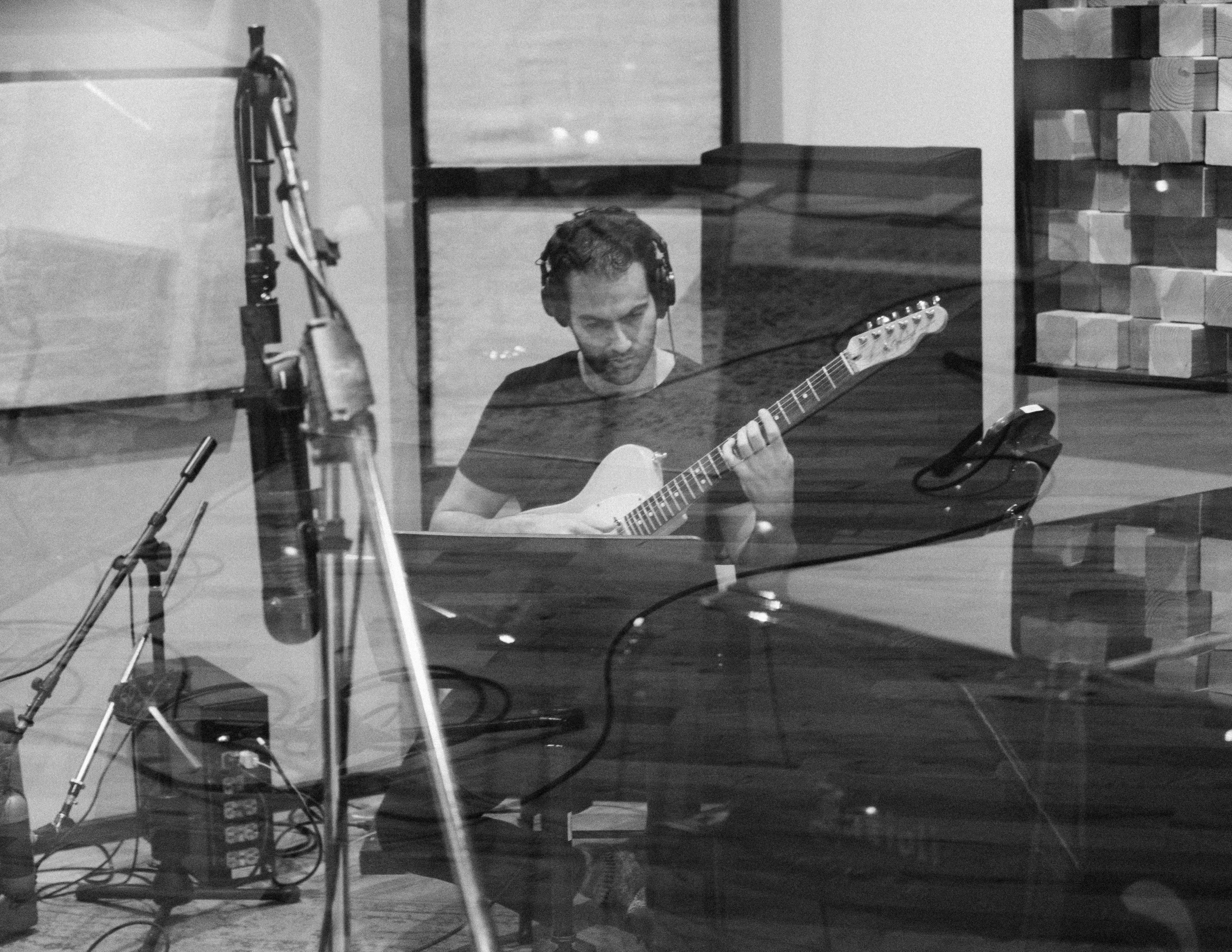
As a jazz musician, I’m constantly working within equal temperament, and I genuinely love it. My new project, a quartet with Phillip Golub, Mathias Jensen, and Steven Crammer, has me thinking a lot about the interplay between equal temperament on the piano and other tuning systems, like Just Intonation and quarter tones, on guitar and bass.
[Read our Phillip Golub interview]
[Read our Dream Brigade (featuring Phillip Golub) interview]
The piano actually handles certain harmonics—like the 1st, 3rd, 9th, 17th, 27th, and even the 29th—surprisingly well, so I often use those as a starting point. From there, it becomes a playground of tuning possibilities that blend and clash in compelling ways.
Sieh dir diesen Beitrag auf Instagram an
So far, the focus with regards to alternative tuning systems has mainly been on harmony. But melody is affected, too. How do you personally understand melody and what changes when it becomes part of a new pitch environment?
One way of thinking about melody is tracing movement through a sonic space that tells a story with its contour, weight, gravity, and gesture. It makes me think back to learning 4 part writing, species counterpoint, and what makes a good melody in Western Classical music; it also makes me think of early Indian classical lessons.
When you change this pitch environment, you don’t just shift the “notes,” you shift the terrain, and really the world your melody moves through. The emotional shape of the phrase, its pull and release, its sense of arrival or suspension- all of that transforms. Because what you have defined as arrival, tension, etc, has all changed.
In a new tuning system, certain intervals might feel wider or narrower, steps might be uneven, and familiar melodic clichés suddenly dissolve. You’re forced to listen more closely, to re-learn what feels like resolution, tension, or flow. This really invites different forms of expression and makes us question the fundamentals of “what is a good melody?”
For me, it’s less about fitting melody into a grid that we just swap out in different tuning systems, and more about exploring how melody reveals the character of a tuning system—how it brings out the specific colors and tensions that make that pitch world come alive.
That’s a very raga based idea- revealing, note by note, the space in which you are inhabiting and creating in the same moment.
With electronic tools, playing and composing in just intonation has become a whole lot easier. Do you find this interesting? What are some of the technologies, controllers and instruments you use for your own practise?
I definitely find it interesting—and honestly, I couldn’t have gotten started without those tools.
In the early stages, when my ears hadn’t yet fully adapted to Just Intonation, electronic tools were essential. One that really helped me was the Just Intonation Toolkit, developed in Max/MSP by Tom Mudd. It allowed me to program different ratios and experiment with them directly, which taught me a lot about the structures and sensations I was exploring.
But at a certain point, I hit a wall. I began to feel—as W.A. Mathieu once put it—like “an operator of an ingenious machine” rather than a musician who was actively tuning. That realization pushed me to shift focus. I set the tech aside for a while and committed to developing a hands-on, ear-first approach.
Since then, I’ve spent hundreds of hours creating and refining a system of ear training for Just Intonation.
I’m now finishing a book on the subject called Tuning the Ear. The first volume focuses on seven-limit ear training and also branches into related topics like non-linearity, harmonic frames, historical context, and analytic methods. I think of it as a bridge between the scientific and the experiential—something that empowers musicians to really feel these intervals in the body and the ear.
You can be someone approaching this for the first time or a master and I think you’ll get something out of this book. I also hope to contribute to standardizing certain things about JI- language, notation, methods. The book will be done this summer, and I currently teach private lessons and masterclasses on the subject.
Some artists approach tuning systems from a strongly scientific angle. In case you're interested in this, what do you feel 'research' could potentially uncover and provide in terms of tuning systems?
For me, research into tuning systems isn’t just about cataloguing what exists- it’s about understanding how people across cultures have listened to sound, interacted with materials, and shaped musical meaning.
Tuning is never just a technical framework; it’s a reflection of what different cultures hear, value, and prioritize in their sound worlds. Whether it’s the dense shimmer / swirling ombak of Gamelan, the buzzing resonance of African xylophones, the searing melodies of Persian radif, or the branching melodic networks of Indian classical music. Each tuning system tells a story about how people relate to sound in their environment.
Research helps us see tuning not as a fixed science, but as a living, culturally-rooted practice—one that encodes aesthetics, social structures, and historical memory.
Take Just Intonation, for example. It’s a useful starting point because it appears across many traditions—Persian, Indian, Western classical, Nordic fiddle, Mongolian khoomii, and more—suggesting certain acoustic patterns resonate widely. This mirrors how different societies have independently discovered things like zero or equinox calculations. Research can map out these convergences, tracing how psychoacoustic phenomena like combination tones, beating, and resonance emerge in musical practice.
Tuning evolves alongside instruments, environments, and aesthetic goals: you can’t separate a tuning system from the social and ecological contexts that gave rise to it. Whether shaped by the physical properties of local materials, the acoustics of communal spaces, or the symbolic meanings attached to certain sounds, each system grows out of lived experience.
Studying tuning systems ultimately expands our sense of what music can be—less about enforcing a universal standard, and more about tracing the diverse ways humans have listened, adapted, and created meaning from sound.
Where do you see the biggest potential for exploration at the moment?
I see the potential for exploration in all directions. I think we are in something of a golden age for this subject. I see so much great music happening that deals with tuning and all of the possibilities are very exciting to me.
Friends like Austin Wulliman, Chris Otto, Dan Trueman, Phillip Golub, Bergamot Quartet, Kengchakaj Kenkarna, Joshua Mastel, Mat Muntz, Dion Nataraja, Zekkereya El-Magharbel, and more are continually pushing the limit of what we thought was possible.