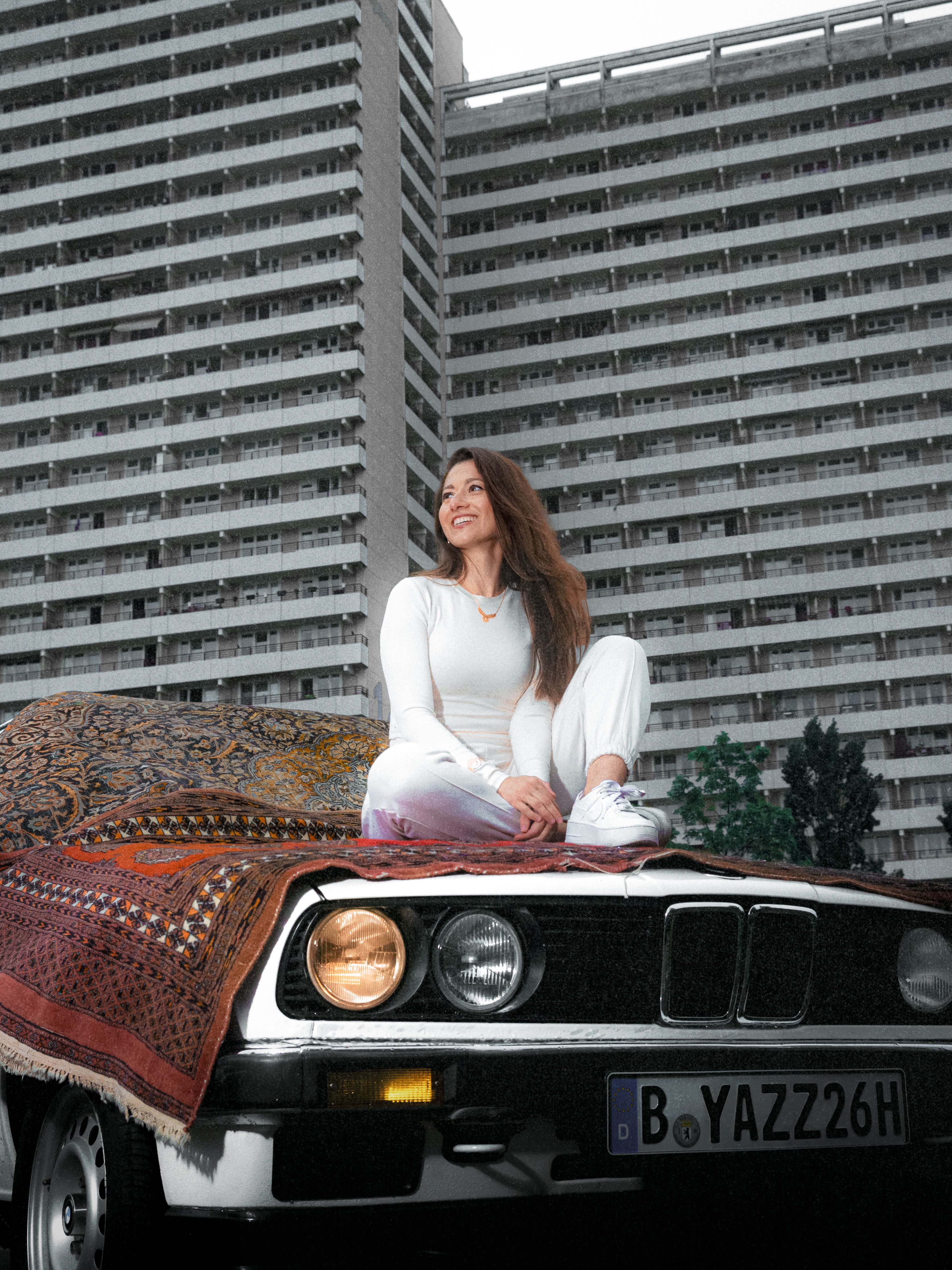


Part 1
Name: Yazz Ahmed
Occupation: Trumpeter, flugelhornist, composer, improviser
Nationality: British-Bahraini
Current release: Yazz Ahmed's new album A Paradise In The Hold is slated for release on February 24th 2025 via Night Time Stories. The second single off the album, “Into the Night,” is out now. The LP features her longtime band as well as a cast of collaborators, including vocalists Natacha Atlas, and Brigitte Beraha as well as percussionist Corrina Silvester.
If you enjoyed these thoughts by Yazz Ahmed, visit her official homepage for updates on her music and more information. She is also on Instagram, Facebook, and Soundcloud.
For a deeper dive, read our earlier Yazz Ahmed interview about improvisation.
Just like you, I grew up in between two cultures and always thought it had a huge impact on almost every aspect of my life. What was this like for you – how, would you say, did your bicultural background affect your views on life, art and music in particular?
I moved from Bahrain at the age of nine to South London with my mum and sisters. It took a long time to adjust to this new culture and I didn’t feel as if I belonged, so much so, I hid my identity for most of my childhood and into my teens.
It wasn’t until a reached my early 20s that I became more aware of my identity and started to embrace my mixed heritage. I became curious about the music I had left behind and began to regret that I had not been taught to speak Arabic. I felt detached. However, once I started to explore Arabic scales and rhythms, fusing them with elements of jazz, I began to feel whole.
One thing I was hungry for was to connect with other female instrumentalists with a Middle Eastern heritage who were embracing jazz. It was difficult enough finding women trumpet players to aspire to, but it seemed that Arabic jazz musicians simply did not exist. This made me feel insecure as to whether it would be possible to make a success of myself.
Art and beautiful artifacts are everywhere in Arabic culture, but being an expressive artist, or a creative musician, is not really considered a respectable career. This meant it was a struggle for my Bahraini family to appreciate the path I had chosen.
On my mother’s side of the family, it was very different. I come from a line of bohemian artists, musicians and dancers, so they were very supportive in allowing me to follow my heart.
A Paradise In The Hold deals with your heritage through music. After finishing the album, what would you say is universal in music – and what may, conversely, be very specific?
You don’t need words to convey your message or to spell out the narrative behind the music. Music has that unique ability to evoke deep emotions, on a primordial level, and this is what I hope to achieve – to be genuine, to compose and perform from the heart and leave the listener free to interpret their experience in their own way. I love listening to songs in a language I’m unfamiliar with, because it lets my imagination paint pictures.
However, on A Paradise In The Hold I do utilise some elements that are very specific to Bahrain. When a Bahraini listener hears certain rhythms, certain instruments or vocal timbres in my music, these will resonate in a very specific way, compared to how a listener from outside the culture will react. There are also Arabic lyrics in this album which to a non-Arabic speaker will be evocative, beautiful sounds, but which do carry an intentional meaning, which again will give listeners from different cultures their own experience.
I do include translations of all the text in the album booklet and in fact on one song, Waiting For The Dawn, we hear both Arabic and English versions of the lyric sung in counterpoint.
What was the starting point for A Paradise In The Hold?
In 2014 I was nominated to apply for a Jazzlines Fellowship in collaboration with Birmingham THSH, funded by the Jerwood Foundation. As part of this process, I had to present a concept for an extended composition to be researched and developed over the course of a year, culminating in a live performance at the CBSO Centre in Birmingham.
My idea was to create a suite, based around the folklore and folk music of Bahrain and happily I was awarded the commission. The first stage was a research trip to Bahrain from which I returned full of inspiration, bringing home books of poetry and songs, histories of Bahraini music and instruments, DVDs of performances and my own notebooks and field recordings.
Poems and stories were among the inspirations for the album. Since you told me in our earlier interview that music in itself is a process of storytelling for you, I'd love to hear more about how the inspiration process worked. Is the album retelling these stories through sound or is it possibly like a soundtrack to the tales? Is it a case of the music beginning where words end?
The album doesn’t have a specific storyline, and I’m not retelling old tales, rather it’s a collection of musings, my own stories viewed through and filtered by a new lens.
I allowed my mind to wander, daydreaming, and reacted musically to the emotions that surfaced.
The album is a record of how my identity has been evolving. You could say that the individual pieces are mini-stories or liken them to a series of impressionist paintings hanging in a gallery, each one complete in itself, but its significance enhanced by its proximity to the paintings around it.
Earliest recordings for A Paradise In The Hold date back to a trip in 2014. What memories do you have of that journey and the impact it had on you?
I felt absolute joy when I sat there in the club house of the choir of the Pearl Divers of Muharraq whilst they performed. The energy in the room was electrifying. I was in a trance. I felt inspired. I also have to thank Ahmed Al-Ghanem, from the Ministry of Culture and Folklore, Bahrain, for setting up the private concert, it was a very precious moment.
It gave me the opportunity to connect on a deeper level with the music from my childhood which I hadn’t embraced at the time. My only regret was not being able to see one of the women’s drumming ensembles as they were out of the country on tour! Hopefully next time.
Field recordings are generally an important creative element for you, it seems. What kind of recordings did you make during that 2014 trip? What kind of equipment are you using to get the best results?
Well actually I just record on my iPhone, sometimes with a stereo mic attached, if I’ve gone out intentionally to capture sounds, but on other occasions it’s a perfect way to react instantly if I hear something intriguing on my travels. Once I take these files back to my studio and start processing the sounds, the quality is perfectly acceptable.
One of the happiest moments in creating the album was in 2023 when I recorded my family members at their home in Bahrain, which you can hear on the track “Into The Night,” which was not part of the original suite.
The traditional clapping technique of Fijiri was an influence. What can you tell me about it and what impressed you about it?
The complex polyrhythms which create a very specific lilting swing are so quintessentially linked to Bahrain and the gulf region.
The exact clapping technique is important in order to create the bright ringing sound. It’s very difficult to execute correctly, it takes practice, but absolutely everybody in Bahrain seems to be an expert!
Other than the field recordings and your trumpet, what kind of sonic palette did you envision for the album at the beginning of the recording process?
The music was composed for my long-established seven-piece Hafla band, heard on my second album, La Saboteuse, featuring bass clarinet, vibraphone, fender Rhodes/piano, bass guitar, Arabic percussion and drum kit, a line-up with echoes of classic jazz fusion palates from the 1970s. In addition, for the first time, I wrote for voices, both wordless and with Arabic and English lyrics.
You actually don’t hear any of the field recordings in their natural state, apart from the chatter and hubbub of my family gathering.
I’d been working with the fabulous voice sculptor, Jason Singh, around that time. He’d really opened my eyes (and ears) to a whole new world of sonic expression and layering, by processing pre-recorded material.
[Read our Jason Singh interview]
We took the sounds I had captured and created new colours and textures, deep sounds from the ocean, the cries of sea creatures, and used those to tell the tales of the pearl divers, mermaids, sirens, and celebrations.