Name: Willy Rodriguez
Nationality: Puerto Rican
Occupation: Drummer, percussionist, composer, improviser
Current Release: Willy Rodriguez's new album In The Unknown (I Will Find You) is out via Sunnyside. It features Ingrid Laubrock on tenor & soprano sax as well as Leo Genovese on piano & Hammond organ.
Pure drum recordings recommendations: Each Caribbean island boasts percussion ensembles with rich musical and traditional traditions that are incredibly rewarding and educational for the listener. From the Muñequitos de Matanzas, Yoruba Andabo of the beautiful island of Cuba, to the less professionally documented Palos and Gagas of Haiti and the Dominican Republic, to the popular Puerto Rican Bomba and Plena, which today's superstar Bad Bunny has brought to the world stage. All these examples are extremely important in the history of music today. But in my opinion, the most rewarding experience is witnessing these ensembles live; it's invaluable.
If you enjoyed this Willy Rodriguez interview and would like to know more about his music and upcoming live dates, visit his official homepage. He is also on Instagram, and Facebook.
It seems as though most aspiring artists are drawn to the drums and percussion for one of two reasons: Creating sound/noise and creating rhythm. What captivated you?
For me, it was the distinctly different nature of the drum set compared to the Afro-Caribbean percussion I grew up surrounded by. My father was a professional percussionist for many years, so rhythm was always present in our home.
Being able to use all your limbs was entertaining to me. It opened up a world where rhythm became three-dimensional. The drum set felt like an entire rhythmic ecosystem I could navigate in real time.
When I listen to music, I see shapes, objects and colours. Others experience emotions. Everything around drums, on the other hand, is based on touch, vibration, and movement. Does this mean that your own perception as a listener is also more connected to touch, vibration, and movement? What happens in your body when you're listening?
When I'm deeply listening to the present moment, my body is no longer under my control; it's in the beautiful world of the subconscious. Sometimes I feel like time even stops. It's something difficult to describe. My body feels effortless.
The depth of listening feels as if, in that moment, you become a spectator of the event.
What was your first drum set like and what are you using today? What, to you personally, are factors in terms of build and design that you appreciate in drums and percussion instruments?
I was incredibly lucky to have, as my very first instrument, a drum kit belonging to the great master Alex Acuña.
It’s one that he left behind in Puerto Rico after finishing his studies on the island in the 1960s. It is a fabulous Gretsch kit that I still cherish with all my heart to this day. It even survived a music video shoot inside a swimming pool (hahaha!) not to mention numerous hurricanes.
I love vintage instruments, so I have nothing but praise for them when it comes to quality and value. With a good set of drumheads, any kit can be fully functional. Personally, I prefer American and German-made drums.
Late Rush-drummer Neil Peart said: “The equipment is not an influence. It doesn't affect the way I play. It's an expression of the way I play.” What's your take on that?
I completely agree. The instrument is a bridge for expression.
I have witnessed first hand how the quality or brand of the instrument does not affect the performance; what matters is its condition and that it is usable.
The drums and percussive instruments are an integral part of many cultures, and traditions. Which of these do you draw from in your playing – and why?
Growing up in the Caribbean was a great blessing for me. Its African roots are present in everything, even the food.
The drum has always been our method of expression for hundreds of years. Not only has Afro-Cuban music been a great influence in the Caribbean, but the influence of the Dominican Republic and especially Jamaica in the last 30 years has also been quite significant.
Africa is alive and well in the Caribbean. I owe everything to it.
What were some of the main challenges in your development as a drummer / percussionist? Which practices, exercises, or experiences were most helpful in reaching your goals?
For me as a drummer, the most challenging and rewarding part of my development was deciding whether to focus on the drum set purely from a technical perspective or to approach it as a supportive voice within the music.
The moment I embraced the drum set in its supportive role, as the foundation that shapes time, texture, and direction, things changed for me. My improvisation deepened, and I felt like I was more present artistically, and more intentional in my playing.
How would you describe the physical sensation of playing the drums? [Where do you feel the resonances/pulse/groove, what are emotional sensations, is there a sense of release or tension etc …]
For me, it is immensely gratifying due to the challenges it presents regarding coordination and consistency—acting like a pulse machine that guides everything within the modern musical landscape.
In my opinion, the pulse originates from the performer's very heart. That is something I heard the late Milford Graves mention; he even kept a medical heart-rate monitor in his home—which he famously had any student who visited or studied with him use.
And yes, there is a profound sense of release when you master and successfully execute challenging rhythms or musical passages that take time to perfect.
What is the relationship between harmony, rhythm and melody? How do non-percussion instruments contribute to the overall rhythmic texture of a piece?
Complementarity is what creates the magic of music. To me it’s an inseparable relationship that offers limitless possibilities. Yet, each element can, in turn, exist independently of the others.
Furthermore, I am a firm believer that percussion also provides harmony (particularly in Afro-Caribbean music). In my opinion, harmony offers a musical canvas for percussion, and vice versa.
In this context, the possibilities are infinite.
Do you feel that honing your compositional / songwriting skills has an effect on your drumming skills?
Composing music helps the drummer understand their supporting role within the genre they typically play.
Understanding the harmonic and melodic movement of a composition makes the drummer relevant to the musical offering. It teaches you to listen to and understand the purpose of the melody. This knowledge, in turn, helps you build musical support and guide the composition's theme.
The more aware you are of the harmonic function, the better your rhythmic support will be.
How are you making use of the timbral and textural potentials/possibilities of your drums and percussion instruments when making music?
I have been exploring various methods for creating timbres and textures on the instrument, both electronically and acoustically. Personally, I have recently found the use of the bow, along with the concept of inharmonics, to be particularly gratifying.
Electronically, the instrument is being utilized to emulate sampling machines such as the 808, which tend to feature prominently in contemporary pop and more modern soundscapes; I find this approach interesting as well. Ultimately, I believe the instrument's timbre can be manipulated to a vast degree whether it’s dynamically or spatially, and through the contribution of enharmonic elements.
These are the waters I currently find myself navigating, and I have found the journey immensely rewarding over the past few years.
How has technology, such as drum machines and sequencers, impacted the way rhythm is created and perceived? Has it been a concrete influence on your own approach?
The influence of electronic music today is impossible to ignore. Metric consistency and rhythmic solidity have been incorporated into almost every genre of music today.
Electronic improvisation is not present in popular music but is present in the underground electronic scene. Artists like Squarepusher, with their sequenced improvisations and speed, have influenced improvisers all over the world, including me. Even sonically, the ability to imitate sounds on an acoustic instrument is something that is extremely prevalent in today's music.
Compositionally, the electronic music genre has provided ideas to thousands of composers worldwide, including myself. In a way, it has even influenced me harmonically. But sonically, it's what I feel has most influenced my creativity.
Physical strain is a particularly serious issue for many drummers. How does it manifest itself, how do you deal with it and in how far does it affect your creativity?
In my opinion, drummers should follow a physical training regimen. I have found it to be immensely beneficial personally. It is an extremely physical instrument, and the body needs to be in good condition to play it.
I am a firm believer in this, and I consider it absolutely essential for being able to perform at 100%. Being in good shape physically helps clear my mind to be more creative as well.
Many recording engineers have remarked that the drums can be particularly hard to capture. What makes drums sound great on record and in a live setting?
I think that as a professional drummer, you should have complete control of the room or stage you'll be performing on. This means being aware of its sonic and resonant limitations. The ceiling height, the surrounding walls, the material, etc., are all very important factors that shouldn't be ignored as drummers.
And each musical genre has its own sonic demands, so it's something you have to understand in every situation. Some venues are simply unsuitable for live music as well.
Drums and percussion are remarkably often used for physical therapy /healing. What, from your point of view, makes them particularly suitable tools for this?
The physical nature and accessibility of the instrument generate a level of interest in the patient, especially hand percussion. Its mesmerizing and gratifying qualities help to clear away the performer's health-related dilemmas or limitations.
In my opinion, this has always been an intrinsic part of the drum.

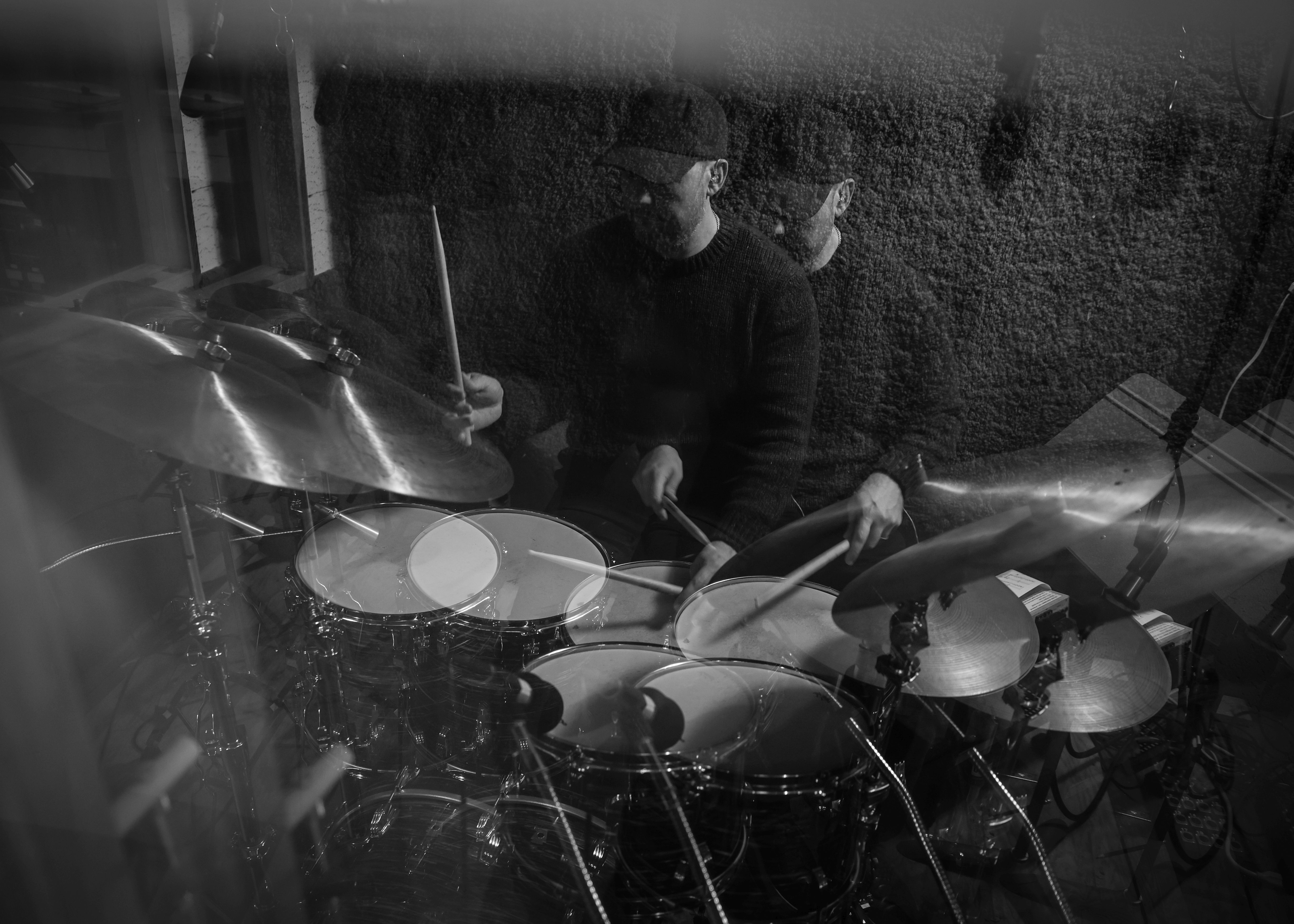 Willy Rodriguez Interview Image (c) the artist
"Being able to use all my limbs opened up a world where rhythm became three-dimensional. The drum set felt like an entire rhythmic ecosystem I could navigate in real time."
Video