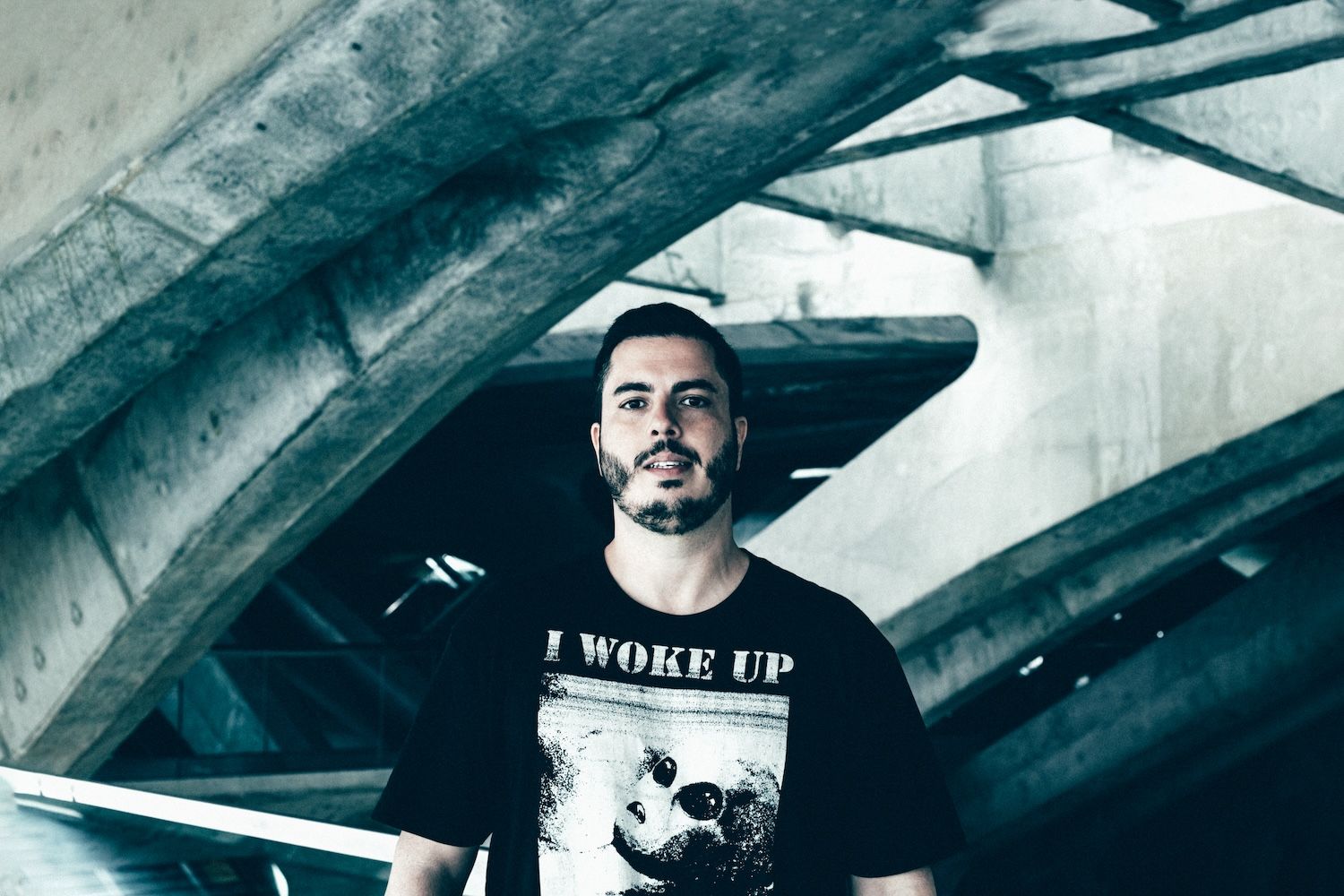


Name: Rodolfo Wehbba aka Wehbba
Nationality: Brazilian
Occupation: Producer, DJ
Current release: Wehbba's new Awaken’ EP is out via Drumcode.
Recommendations: I’ve been in love with Death With Interruptions, by Jose Sarramago, a crazy book that hooks you from the get-go. The original Portuguese title is As Intermitências da Morte.
I can also definitely recommend an incredible artist I met by chance in a jazz club in Paris recently, as soon as I got in and heard his saxophone sounding like a synth I knew I was in for a treat. His name is Tivon Pennicott, and his latest album Roots To Branches sounds to me like what would be a modern day continuation of the stuff Stevie Wonder did in the 70s with Innervisions, Songs In The Key Of Life and Talking Book.
If you enjoyed this Webhba interview and would like to know more about his music and recent tour dates, visit him on Instagram, Soundcloud, and Facebook.
For a deeper dive, visit our earlier Wehbba interview or his feature about the Behringer 2600 Gray Meanie.
What was the first time you were consciously impressed by technology – in and outside of music?
I think when I was like 5 years old and my father got a walkman. It was a novelty then (yeah I’m an 80s child), and strangely enough I actually remember the day he brought it home and hooked it up.
He told me when I really showed him I could appreciate music he would let me play with it.
Tell me about one or two of your early pieces that you're still proud of (or satisfied with) in terms of production – and why you're content with them.
I’m proud of most anything I’ve ever done, one way or another, they got me here. I’ve recently found and posted on my Soundcloud my very first tracks, and even though the more club ones are pretty rough there’s still a lot of ideas in them that I still apply to this day.
I think the element that makes me proud of any piece I do is the idea, sometimes I’ll let my rational mind overtake the idea, and those are the tracks I end up not caring much about.
When it comes to arranging, sound design, performing, composing, etc – what are currently concrete topics and aspects that interest you and where you want to improve or simply challenge yourself?
I am pretty devoted to learning new sound design and mastering concepts, as recently in the past couple of years I’ve decided to master all of my tracks and remixes myself.
The sound designing part, as well as helping my mixes become easier to master, also keeps my ears fresh for new techniques and sound aesthetics that may not come naturally to me, i.e. using wavetables or additive synthesis as opposed to subtractive or FM synthesis.
And as for mastering, I’ve been obsessing over mid-side processing in various applications, such as saturation and compression.
Do you keep up with recent developments in terms of gear and software? If not, why not? If so, what are you looking for?
I keep my ears up, and check most of what comes out, also like to nerd out with friends often and check if they found something new.
But I am very selective nowadays as to what I try to use, since it involves so much time and effort, and I already have so much stuff when it comes to hardware and software. At some point it stops being inspiring and becomes a kind of limitation.
How and for what reasons has your music set-up evolved over the years and what are currently some of the most important pieces of gear and software for you?
My setup has evolved over the years as I gather knowledge, experience and money, so I kept adding stuff and selling stuff until I got where I am right now, and to be honest I am pretty satisfied with my studio’s equipment.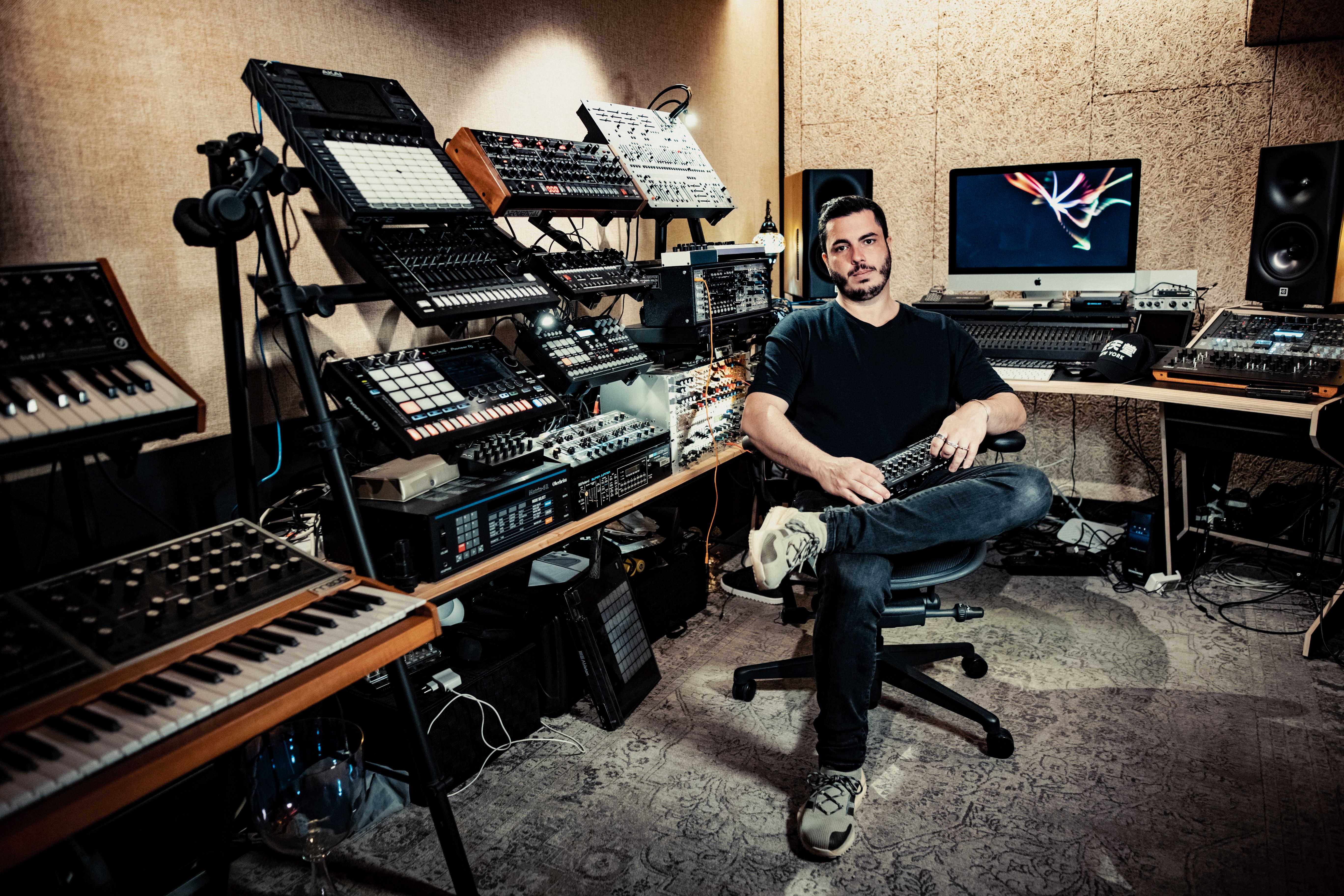
Wehbba Studio Image (c) the artist
I just really hope I can find a bigger space at the moment. It feels quite cramped and there’s a lot of stuff I would have liked to have in there which just doesn’t fit.
Jean-Michel Jarre maintained that, despite the advances in virtual technology, we are still "analogue animals made out of blood and bones who need buttons and knobs to touch.” In how far is this statement true or false for your own music?
It’s pretty true for me, I get a lot more inspired when working with actual instruments than with my computer. And usually controllers and plugins don’t give me the same level of interactive feedback an instrument would.
What are examples of production tools/instruments that you bought for a specific purpose?
The Elektron Octatrack, which I bought specifically to be the “brains" of my Live Station setup, the rig that I use for my live performances. I needed a performance oriented sampler that could handle a lot of data in a single project and that had a fast workflow.
From the earliest sketches to the finished piece, tell me about the production process for your current release, please.
My latest release on Drumcode, “Awaken”, was born out of me going mindlessly through presets on Native Instruments’ Massive X.
Once I stumbled onto that huge lead sound, the riff kinda played itself, then it gave me the idea for the bassline sound and progression, and from then it was just adding drums until I had the main groove done. On a second session I’ve added a lot of sound design elements and the vocals, and then it was time to build the arragement.
“Revelation”, the b-side, was born out of a jam with my Behringer Arp 2600 clone and the Roland MKS-80. I came up with a sort of oriental riff that felt kinda trippy so from that point it was just adding drums and some ravey elements like the hoover and acid stabs.
What does your own way of working with sound look like? Do you find using presets lazy?
Not really, but I find it really uninspiring most of the time going through presets. It can be very time consuming.
I prefer to move fast while making music, and it’s usually faster for me to come up with sounds on my own than growing presets. Especially when using my hardware instruments.
Richie Hawtin, speaking about semi-modular equipment, has stated that a deeper understanding of sound synthesis can lead to “life lessons that go beyond what we can hear.” Can you relate to that statement?
100%. De-constructing what makes up a sound, especially real-life sounds from nature, gives you a sense of awareness and presence that is in itself a spiritual experience, and kinda automatically leads you into approaching anything with a much more advanced level of sensitivity.
It’s crazy to think that paying attention to sounds can lead you on a path like that, but it really does.
What were some of your most positive collaboration experiences? How did this "human element" enhance your solo approach? Did you record via filesharing or in the same room and if so, what did the recording process look like?
I’ve had many really amazing collabs over the years. I usually prefer to do that in person, exactly so that I can have the experience of getting the vibe from someone else and get inspired from that, and to share the control over the decisions. It’s a completely different dynamic than working solo.
View this post on Instagram
I’ve done a few collabs online as well and I’m pretty happy with them, as well as in-person collabs that started that way but were finished off online exchanging projects.
From my more recent collabs I can definitely mention Victor Ruiz, Adam Beyer, Push, BK and Hertz.
[Read our Victor Ruiz interview]
To some, the advent of AI and 'intelligent' composing tools offers potential for machines to contribute to the creative process. What are your hopes, fears, expectations and possible concrete plans in this regard?
I believe it’s something we can definitely extract a lot from. I am definitely not afraid of it and sure have been exploring it in different ways. I would like to rely on it to handle time consuming and uninspiring tasks, as well as become a reliable tool for real time feedback on technical issues while working with music.
Like any sort of technology, it can have its pros and cons, and it might disrupt the way things are done currently, but will eventually settle into something trivial, like the Internet for example.
Have you used AI or generative music tools for your own productions? If so, in which way and what did they add?
Yes, I have used AI to create the artwork for the first EP of my own label HIFN, which I’ve started in March of 2024, as well as trained a voice model with my own voice to recite a poem that is featured in that same release.