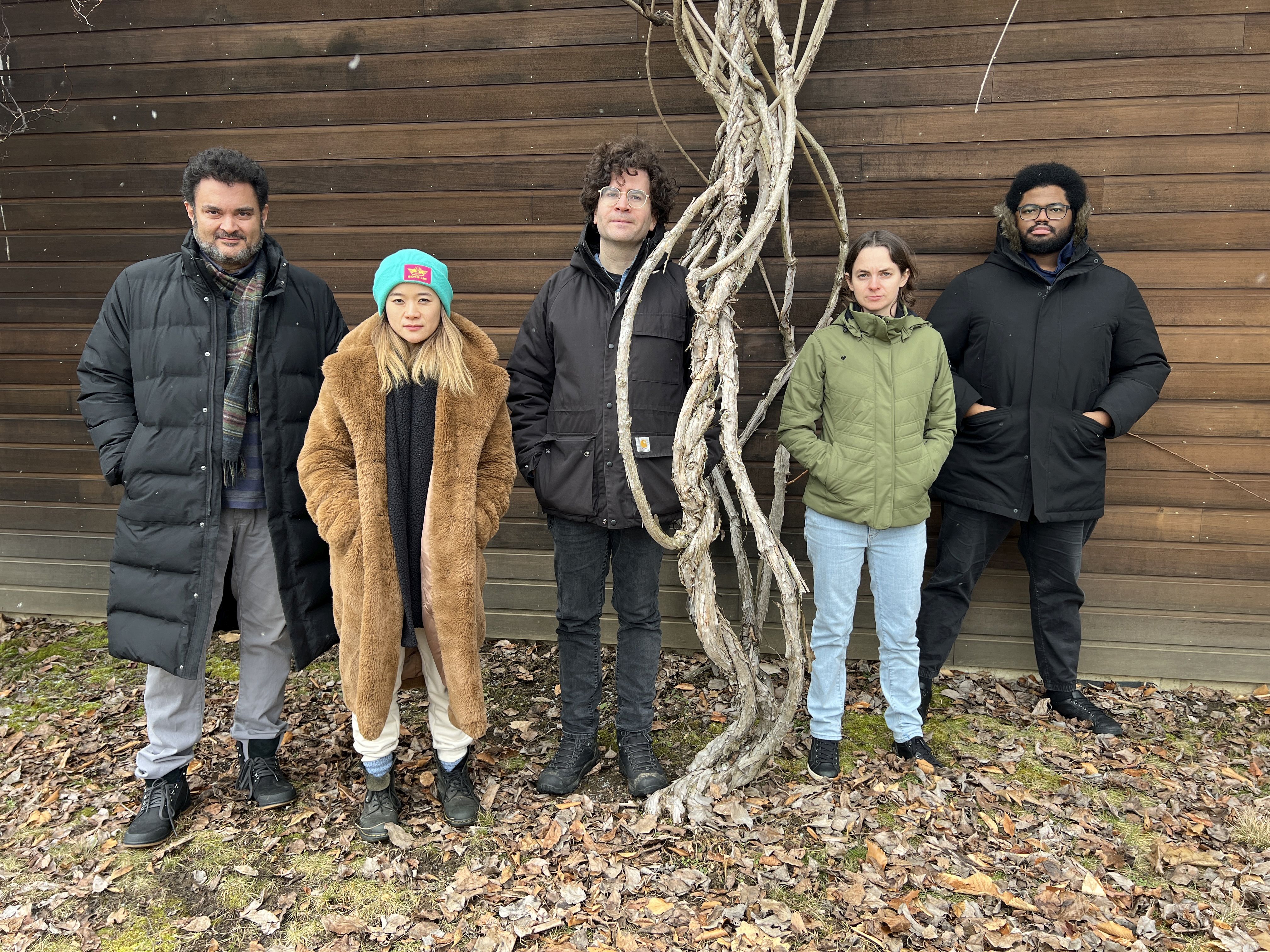


Published
Name: Travis Laplante
Nationality: American
Occupation: Saxophonist, composer, improviser
Current Release: Travis Laplante's new LP, The Golden Lock, is out September 27th 2024 via New Focus. It features Erika Dohi (piano), Charles Overton (harp), Lizzie Burns (double bass), and Eduardo Leandro (percussion).
Recommendations: Two of my favorite books by great musicians: The Shrine Thief - W.A Mathieu; Who Owns Music? - William Parker
If you enjoyed this Travis Laplante interview and would like to know more about his music, visit his official homepage. He is also on Instagram.
Over the course of his career, Travis Laplante has worked with a wide range of artists, including Jason Nazary, Gerald Cleaver, Trevor Dunn, Wendy Eisenberg, Nate Wooley, Darius Jones, and Ches Smith.
[Read our Jason Nazary interview]
[Read our Gerald Cleaver interview]
[Read our Gerald Cleaver interview about Griots, Ghost Orbits and Modular Synthesis]
[Read our Trevor Dunn interview]
[Read our Trevor Dunn interview about improvisation]
[Read our Wendy Eisenberg interview]
[Read our Nate Wooley interview]
[Read our Darius Jones interview]
[Read our Ches Smith interview]
Where does the impulse to create something come from for you? What role do often-quoted sources of inspiration like dreams, other forms of art, personal relationships, politics etc play?
The impulse to create feels like a combination of a need and responsibility to praise life and to communicate gratitude for being human: all the aspects of it– the beauty and the suffering. For me it’s always a love letter to the divine.
Dreams and experiences/visions while in meditation or in waking life have been major inspirations of my work.
One example of this is the composition entitled “Inner Garden” that I composed for the awesome two piano/two percussionist ensemble Yarn/Wire and myself. The piece was inspired by a waking-vision that I had shortly after receiving the invitation to compose the piece. In the vision, the members of Yarn/Wire and I descend, by way of falling, into the center of the Earth. Instead of being taken to a place filled with iron or metal, we land in the most beautiful and generous garden, beyond anything I could have imagined. It is as if every single flower contains all colors imaginable, and the air is saturated with the substance of Love.
I can literally breathe it in and feel all fears and imbalances in myself being completely washed away with unspeakable gentleness. I am filled with so much joy, but also the pain and sorrow of having lived my life up until this point having forgotten the true nature of where we live. The piece attempts to share this journey and arrival to the center with the listener.
My saxophone quartet Battle Trance was formed essentially from a vision that I had one day while working my day job at the time in 2012. All of a sudden I had a very strong feeling that I should start a band with Patrick, Jeremy, and Matt, even though I had little relationship with them or experience of their music.
I guess it was more of a feeling than a vision, but one of these moments where there is a strange clarity that doesn’t line up with being reasonable. I’m so happy that I followed the feeling that I had that day!
As far as personal relationships, my teacher Laura and my wife Sarah are both permanent artistic inspirations for me, people who I can connect to internally and feel love. If I can feel love, then I am inspired.
For you to get started, do there need to be concrete ideas – or what some have called a 'visualisation' of the finished work? What does the balance between planning and chance look like for you?
Sometimes I’ll have an initial vision, experience, dream etc. (as described in the previous answer) and the composition process begins with the orientation of translating this experience into music. This often allows for an overall structure of the music to take shape. However, even with a preconceived structure things always transform during the compositional process and it’s always a surprise.
Much of the time when composing I feel like I’m inside a mystery, with not much to say about where I am or what is happening. It feels like I am following the sound without knowing what it means or represents, or what is going to come next. Most of the time it feels like a process of a revelation, whereas in a sense the composition is the teacher, teaching me how to unveil what it truly is.
I rarely compose from beginning to end, because throughout the process different parts of the piece begin to communicate with each other and often material starts to cross-pollinate between the various sections. Unless there is an initial vision, I often don’t know the titles of my pieces until after they are finished. I enjoy both seemingly opposing approaches: having a vision from the beginning and attempting to translate it into sound, but I also enjoy having no vision and letting the music teach me.
On a slightly more concrete level, I find that commonly a composition’s harmonic map is the first thing that emerges for me: a basic skeleton of chords and how the music shifts harmonically. Melodies commonly emerge from the harmony. This was the primary process when composing The Golden Lock.
I played the harmonic/chordal parts over and over, and then when I was too tired, I played a recording of them on repeat, so I was living inside of them for many hours at a time. As I lived inside of the various harmonic motions, I waited for the melodies to arrive. Sometimes this arrival literally happened in a moment with seemingly no effort, and at other times I waited many months, just listening to the harmony, trusting that there is a melody in the air somewhere but it has yet to be heard despite my best efforts
Another aspect of the process that has been important to me is having ample time with the band or ensemble during the compositional process to hear the sounds in real life (as opposed to notation software playback) and respond/revise the piece based on what I’m hearing. This is one reason why being in bands and composing music for myself also as a performer has always been appealing.
When Battle Trance first formed, it was an auspicious time, as the other three members (Jeremy, Matt, and Patrick) and myself all had flexible schedules. We rehearsed Palace of Wind three or four times per week for six months before our first performance and everyone in the band was super generous with their time and the piece continued to transform the more we rehearsed. It was all done without a written score so the music was internalized. The music would have never been as good as it was without their generosity in embracing the compositional process that involved us all.
These days I find myself more commonly in musical situations where there is a much shorter amount of time to rehearse. This has been positive for me insofar as it’s forced me to become better at precise and clear musical notation and fully committing to what I am writing. However, I’d like to get back to a place with other people where time is zoomed out and there isn’t an impending deadline so we can engage in a more organic creative process together.
Do you have certain rituals to get you into the right mindset for creating? What role do certain foods or stimulants like coffee, lighting, scents, exercise or reading poetry play?
I generally enjoy composing in the mornings. My ideal work day consists of waking up, meditating, practicing Qigong, and then diving into composing with some coffee, all before going onto the internet. This feels like my best shot at avoiding distractions in my mind and allows me to focus better than trying to compose in the middle of the day.
This being said, as a musician my daily schedule is rarely consistent so I do my best to be flexible in this way. My mind naturally is kind of a “one thing at a time” mind. I sense that I need more time than most people to compose and have been working the past few years at improving my ability to enter and exit the creative current more quickly so I can compose within shorter time windows and not go crazy.
In general night time is a time to rest my mind and imagination, but once in a while I’ll be so inspired that I need to compose right away, regardless of time of day.
Often, while writing, new ideas and alternative roads will open themselves up, pulling and pushing the creator in a different direction. Does this happen to you, too, and how do you deal with it? What do you do with these ideas?
Yes, It’s a common occurrence when composing that I feel like I am at a crossroads. The music could theoretically go in many different directions and I have to make a decision as to which road to follow and commit to it.
I used to commit to the path forward and tried to not spend time wondering about what could have been if I had followed a different road. Nowadays I am often returning to these musical crossroads in different contexts and taking a different road for inspiration into a new piece.
The music doesn’t always have to arise out of thin air. Sometimes yes, but often there are musical “locations” that have so many more dimensions to them that sometimes only engaging with that location in a single piece feels like a missed opportunity. I’ve been enjoying the return to familiar sonic locations and engaging with them in new ways.
There are many descriptions of the creative state. How would you describe it for you personally? Is there an element of spirituality to what you do?
I don’t think I can concretely describe my own creative state because it is so multi-dimensional, dynamic, and mysterious.
Sometimes composing music can feel like love-making, and sometimes it can feel like I’m bashing my head into a brick wall over and over, but in a way they are both part of the creative state. Sometimes the music that comes out of a time when I feel like everything is dead turns out to be the most beautiful music and sometimes the music that was made when I was in a state of ecstasy sounds dead the next day.
All this is to say that my personal state when composing sometimes doesn’t match what the music sounds like once I have a little more perspective. I can’t understand this but it’s true. I believe that everything is spiritual so certainly music is spiritual.
After finishing a piece or album and releasing something into the world, there can be a sense of emptiness. Can you relate to this – and how do you return to the state of creativity after experiencing it?
Yes, I can relate to this. I often feel like I poured my whole heart into a project and when it’s complete I can feel like there is nothing left in me, as if I have been hollowed out. It’s not uncommon for me to enter into a state of depression after completing a work. It’s also not uncommon for me to become physically sick in a way that I have to stay in bed for days. I don’t tell people about this as it sounds overly dramatic but for better or worse it happens.
I usually return to a state of creativity by doing my best to respect this barren-feeling time after a project and simply wait for a new moment of inspiration. This is not always possible when working with deadlines etc. So sometimes I have to jump back in and arrive where I am.
For example, I recently composed a piece of music that was “inspired” by how little physical strength I had at that time.
Music is a language, but like any language, it can lead to misunderstandings. In which way has your own work – or perhaps the work of artists you like or admire - been misunderstood? How do you deal with this?
I used to have a difficult time after concerts when immediately people would come up to me and tell me what they think my music means, often describing the music in ways that I couldn’t relate to. I also often felt sad when people spoke to me exclusively about the impressiveness of instrumental technique, or the artists whom I must be influenced by (often mistakenly).
With responses like this I felt like only a superficial layer of the music was received. I used to wonder if this was a failure on my part, that the music isn’t clear enough or maybe I’m just in my own world.
It’s been helpful to remember that one of music’s purposes is that it can act as a reflection pool where the listener can see themselves. This is one of the most beautiful parts of music; that we can all have different experiences of the same music and that it can all be honest. I try to remember this when people are saying things to me about my music that make me feel bad, that people are often actually speaking about what they are seeing within themselves. I also try and zoom out and remember that most of the time people are just trying to connect.
Regardless, these days I feel like I’ve been misunderstood so much that it doesn’t really affect me in the same way it used to because my focus is less on external approval.
Creativity can reach many different corners of our lives. Do you personally feel as though writing a piece of music is inherently different from something like making a great cup of coffee? What do you express through music that you couldn't or wouldn't in more 'mundane' tasks?
I’m at a place in my life where my musical practice and the rest of life are more or less in harmony and part of each other. I’ve had experiences recently when talking with someone that I can feel a similar level of love being communicated as to when I play music. We are the music.
I’m realizing that what I’ve been trying to communicate through music for so many years is to simply reveal what is inside of us all.