Name: Topher Horn
Occupation: Composer
Nationality: American
Recent release: Topher Horn's score to Joshua Woodcock's new movie One Night on Tokyo is out now. The movie will be available digitally / VOD on February 14th 2025.
Recommendations for his hometown of Detroit: I came up in Detroit and every time I’m back I visit Motor City Wine and Temple Bar. Now I’m in the Hudson Valley outside of NYC and there’s this wild pizza place unlike any other I’ve found—Lucoli.
Shoutout: Wajeed’s Underground Music Academy is doing amazing things for young artists in Detroit.
Topic I rarely get to talk about: Sauna building and trancendental meditation.
If you enjoyed this interview with Topher Horn and would like to find out more about his work, visit his official website. He is also on Instagram.
Do you think that some of your earliest musical experiences planted a seed for your interest in film music as well?
Music was omnipresent in my childhood though my parents aren’t musicians.
My dad curated the soundtrack for our house—dinner music, music for watching the fire, and my favorite: watching American football on mute with 80s pop as the soundtrack. The juxtaposition of Annie Lennox against the brutality of that sport still fascinates me now.
I think being immersed in music as ambiance as a child enabled later collaborations with choreographers and filmmakers and seeded my interest in DJing.
Which composers, or soundtracks captured your imagination in the beginning? What scenes or movies drew you in through their use of music?
Amelie was a big one for me when I was young. The intimacy of that score really struck me and contrasted the big orchestral scores I was more familiar with growing up.
That drew me to other indie films with sparse but poignant soundtracks like Eternal Sunshine Of The Spotless Mind and The Science of Sleep.
What were your very first active steps writing film music and how would you rate the gains made through experience - can one train/learn being an artist?
I started by focusing on the craft of composing—harmony, scales, orchestration, how to work with computers, how to work with musicians—so that as soon as I had the chance to work on a film I knew where to start.
My first few projects were student films, and I learned so much working in that capacity. I discovered just how little I knew and just how difficult it would be to realize the music I imagined. One can definitely learn to be a craftsperson, and that’s valuable in film scoring and probably helpful in being an artist.
As far as training to be an artist, for me that is more of a practice of unlearning and getting in touch with the subconscious and ephemeral. I practice a lot of piano so that when I sit down to play I’m able to forget I’m even playing piano and there’s a possibility of something cool happening. Cool things just don’t happen for me when I’m trying to make them happen.
I view my role in films as constantly oscillating between audience member experiencing the film and film maker creating the film.
For your own creativity and approach to writing for film, what were some of the most important things you learned from teachers/tutorials, other composers, or personal experience?
I took an amazing course with Milica Paranosic where she insisted that film music could be anything by anyone—there are no boundaries or right ways or wrong ways.
She led us through some lines of questioning—how much does the music know relative to the characters and audience? How big is the music—can the ensemble fit in the space on screen or not? Why is the ensemble the size that it is? Should you hear a whole orchestra when the scene is set in a bedroom, and what does that feel like? Or a solo piano or guitar as a soundtrack to a vast and open shot?
How would you rate the importance of soundtracks and film music for the movie as a whole? How do you see the relationship between image and sound in a movie?
There are great films that don’t include any music, but in many films the soundtrack is incredibly important. I especially like when the score is a little removed from what’s happening on screen, like in “Evil Does Not Exist.”
That music “knows” so much about the film that the audience doesn’t and that contrast makes what might otherwise be extended shots of leafless trees so compelling.
There are dedicated scores, sound tracks, temp tracks that ended up staying in the finished movie, and even scores that were written without the composer seeing the movie first. How do these different premises affect the finished movie, do you feel?
I recently scored One Night In Tokyo, and practically all of that music was composed before shooting, just based on conversations with Josh Woodcock, the director. I wrote so many sketches based on the emotions and situations we had discussed, and some really resonated with him and others didn’t.
He works insanely fast and I got a rough cut a week or two after the shoot “temped” with the sketches I sent him but put in places I couldn’t have imagined. The result was really organic and the placement of the tracks was more inventive than I would have chosen.
As creative goals and technical abilities change, so does the need for different tools of expression, be it instruments, software tools or recording equipment. Can you describe this path for you, starting from your first studio/first instrument? What motivated some of the choices you made in terms of instruments/tools/equipment over the years?
I was fortunate that my high school had primitive midi/computer workstations. Around that same time a neighbor took me to meet his friend, Joe LoDuca, the composer of the Evil Dead movies and many more.
Seeing his studio was transformative—it had versions of the tools I was familiar with but bigger and better. A whole variety of computers, synths, and instruments he had collected. This really resonated with my DIY approach to most things and I started collecting whatever I could get my hands on—old stereos, guitars, amps, tape machines, microphones and so on. I spent a while recording only with a reel to reel which was so much fun, and that’s how I met Josh in the first place.
Now nearly everything I work on requires recall and working quickly, and those are things computers excel at.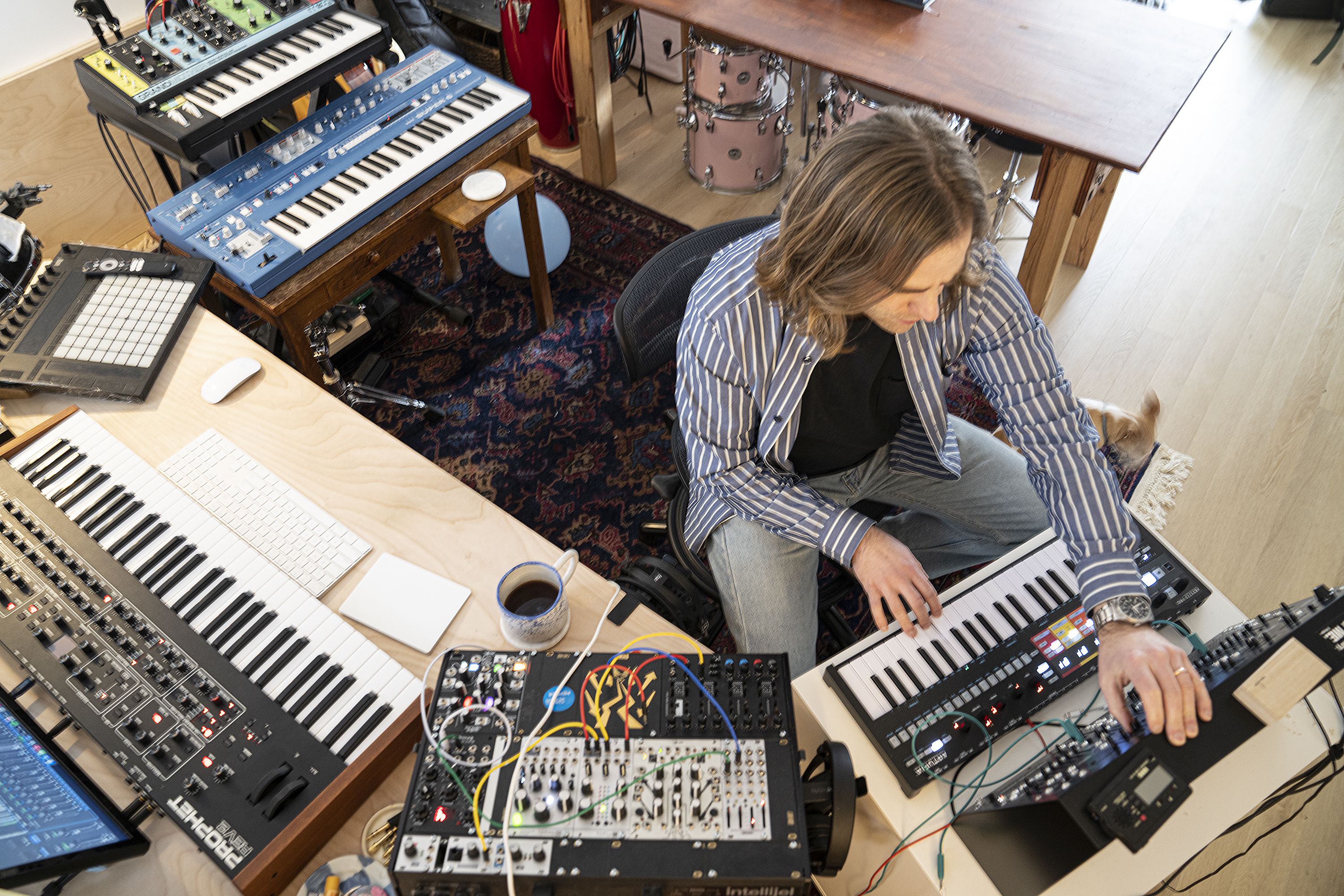
Topher Horn Interview Image by Sara J. Winston
Can you take me through your process of composing a soundtrack on the basis of a movie that's particularly dear to you, please?
When I started on One Night In Tokyo Josh, the director, and I talked a lot about having a jazz score in the vein of some of our favorite French new wave films that inspired aspects of this score.
Musically I wanted to highlight the similarities and differences between American and Japanese expressions of Jazz, though they don’t necessarily tie in one-to-one with the characters. I also wanted to bring in something special to reflect Sam, one of the lead characters, being Iranian American.
There’s a beautiful Persian instrument called a barat that is plucked sort of like a guitar. The closest instrument readily available in the US is a mandolin, so I used that to add depth to Sam’s themes.
I would assume that a major part of composing for film is the ability to interpret the images and the narrative at play. Tell me about how this works for you and how these interpretations in turn lead to sounds and compositions.
I think a lot about one of the perspectives I mentioned that I learned from Milica Paranosic: how much does the music know about the plot? Does the music know as much as the characters in the scene? Does it know the ending?
The interplay is one of the things that can help to make a film compelling. The music can play on the dramatic irony and tie situations together across the arc of a film that aren’t obviously connected with visuals alone: If the audience knows more about what’s happening than the characters then they’ll have certain expectations, and if the music “knows” more than the characters and audience, things can really get interesting in terms of tying the narrative together or hinting at things.
This can also lead to interesting instrument choices by bringing instrumentation from later in a film when more is fleshed out to the beginning when there is less story to go on.
What, from your experience and perspective, does the ideal collaboration between you and a director look like?
Working with Josh Woodcock is really a dream situation. He has this brilliant sense for storytelling and assembling collaborators to tell that story, and music is really valuable to him. I’m brought on because I do a certain thing and I’m given a lot of room to do that thing.
It’s also cool that he’s thinking about music from the beginning so he tends to bring me in really early on and we can figure out what I’m going to do together.
How do the other aspects of a movie's sound stage – such as foley and effects – influence your creative decisions?
I tend to include a lot of field recordings in my work, like The Detroit Jazz Sessions Vol. 1. I love the dimension they can bring to a track and how they can take electronic music especially out of sounding like it was made in a vacuum.
I’ve never had a very soundproof studio to work in, so I’d be writing with bird and insect sounds, traffic, church bells, voices, etc. Sometimes it feels wrong not to have some ambient sounds after working on a piece with them present in the studio.
In films it’s the same thing but I’m working with what was captured during the shoot or added in post. A lot of times those sounds can help to “score” the action on screen so I’m able to focus more on getting the moods right than scoring detailed events on screen.
The balance between visuals, fx and film music is delicate. What, from your point of view, determines whether or not it is a successful one?
If, as a viewer, you’re totally immersed in the story and not noticing any of those distinct disciplines.
Different composers could potentially approach the same scene with strikingly different music. Would you say there can be 'wrong' and 'right' musical decisions for some scenes? In which way can some film music be considered 'definitive'?
This is why I like working with directors. They’ve spent so much time immersed in the project they develop a really acute sense of the world of the project.
They’ll know instinctively if something works with their vision or not even if they’re not able to articulate exactly what they’re looking for.
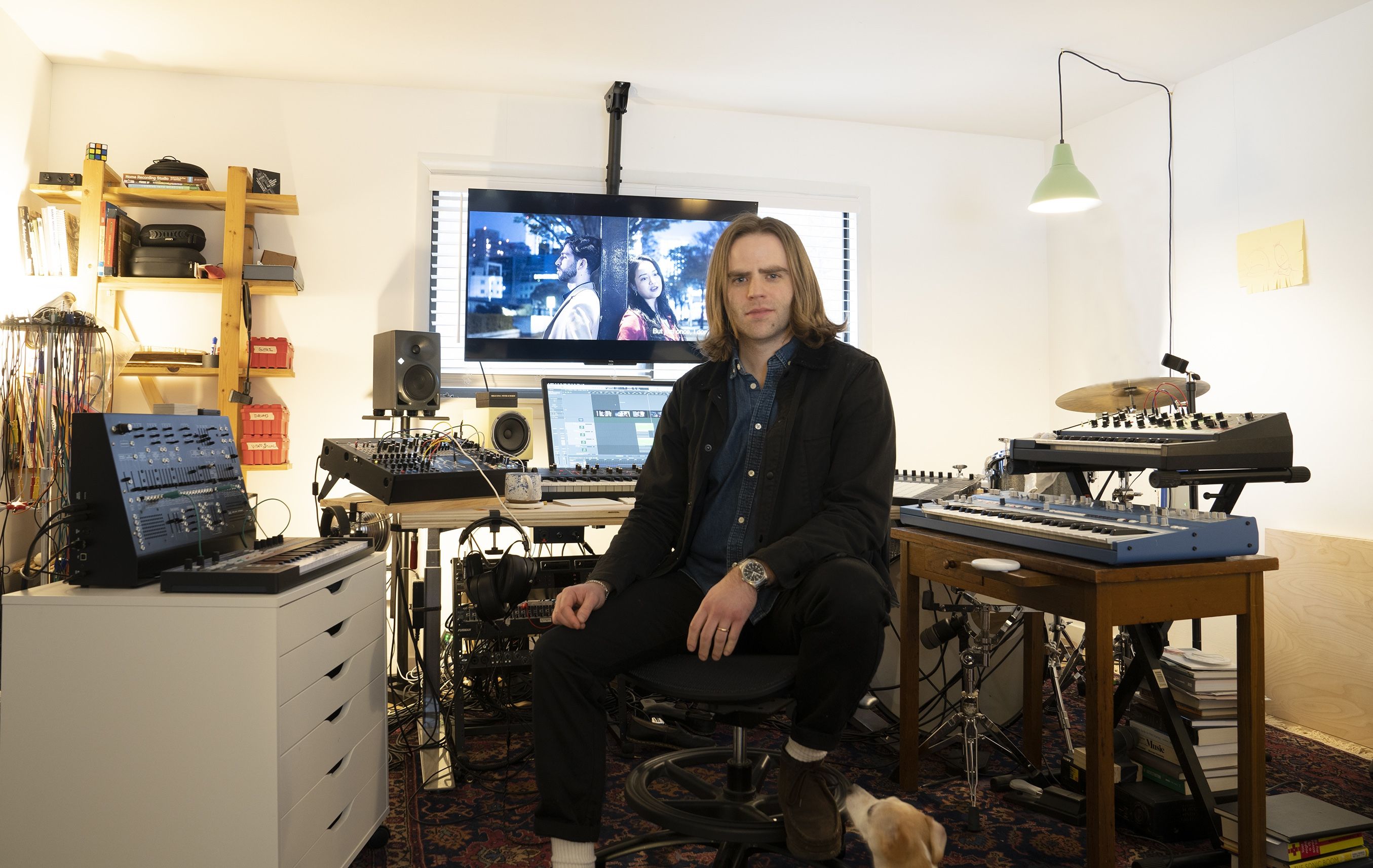 Topher Horn Interview Image by Sara J. Winston
"I view my role in films as constantly oscillating between audience member and film maker."
Video