Name: Seckou Keita
Nationality: Senegalese
Occupation: Griot, praise singer, composer, djembe master, virtuoso, kora player
Current release: Seckou Keita's new album Homeland (Chapter 1) is out via Hudson. Order via Seckou's official webstore.
Tool of Creation: The Kora
Type of Tool: Stringed instrument
Country of origin: Senegambia
Became available: c. 14th century or earlier
If you enjoyed this Seckou Keita interview and would like to know more about his music, visit his official homepage. He is also on Instagram, and Facebook.
For a deeper dive, we recommend our Seckou Keita interview.
What was your first encounter with the Kora? What was it about it that drew you in?
I am a griot,(from my mother’s side the Cissokho family) so music and the kora in particular, has been passed down through generations of my family. It has been a constant throughout my life.
My more formal training started at around the age of 7. Not all griots become kora players. You still have to feel a connection with the instrument to decide to take it further and to make it part of your daily life.
I don’t know why but I have always felt the attraction. I simply fell in love with the instrument and what it can do. My grandfather Dialy Kemo Cissokho saw the potential in me and encouraged me.
Just like any other instrument, the Kora has a rich history. What are some of the key points from this history for you personally?
The griot tradition is about lineage. There is a direct line that connects me to the great kora players from the past. When I play I feel their presence, their legacy and the responsibility that has been passed on to me.
The griot and kora player are also traditionally storytellers and historians. Through the traditional repertoire of the kora, you learn the story of the Mandinka people and the legends of West Africa.
What, to you, are some of the most interesting Kora recordings and -performances by other artists in terms of your personal development? Which other Kora players did and do you find inspiring?
My uncle, Solo Cissokho was a key mentor for me. He inspired me to travel and to collaborate and to push the boundaries of the instrument. He was one of the first to put straps on the kora and play standing up for example. This gives an opportunity to move around the stage and inspires us to play music that people can dance to.
Other great players are Toumani Diabate who was a great inspiration and a dear friend. Both are dearly missed
Tell me about the process of learning to play the instrument and your own explorations with it.
It’s played with just the thumbs and the forefingers of both hands. The thumbs play the melody and the bass line whilst the forefingers improvise at the same time.
Learning starts with simple patterns of (Kéléfa Ba) and lots of practice just with the bass line first getting that down, before adding the melody and then of course the improvisation. There are lots of technicalities as well.
I suppose the key thing you notice quite quickly with any musician is whether they are playing from their heart or their head. There is a technique of course that people can learn, but deep inside the strings is connection with that lineage, with spirituality and with the heart.
In terms of my explorations I have played around a lot with tunings to be able to extend the range and scope of the instrument and to be able to collaborate with other musicians. I developed a double-necked kora for example so I can play with chromatic instruments. The kora is not chromatic so I have had to adapt.
What are specific challenges in terms of playing the Kora?
Like any instrument, the first years of practice can be intense and overwhelming. The traditional repertoire is also very large with many variations and different styles across the regions.
The music is passed down orally and is not written in books so you need to learn everything by heart and be able to adapt and play everything by ear. But once you start doing it, it becomes easier.
How would you describe your personal style of playing the Kora?
I guess that I like to explore all the infinite tonalities of the instrument. I love to play with tunings because it gives me so much freedom and possibilities in terms of music-making or composition. There is a some music I have written where the tuning has never been done on the kora before.
I am a kora player but also a percussionist so I also like to add groovy and rhythmic techniques sometimes in my playing.
What does playing your instrument feel like, what do you enjoy about it, what are your own physical limits and strengths?
It feels like home. When I have the kora with me, then I feel complete. Without it I am a bit lost - I am just Seckou. With it, I am Seckou Keita!
I love the joy it brings to people. Still there are so many people I meet who have never seen the kora before and I enjoy watching the joy it brings others. At one level it is just a calabash, animal skin, some fishing line and some wood! Bring those things together and merge them with ancestry, secret techniques and storytelling and you have something very unique and special.
I am not sure about limits or strength but I play differently depending on whether I am sitting down or standing up. When you sit down, you don’t have any weight on your hands and then can be more versatile with your fingers. But I have developed techniques over the years because I also love playing standing up and making people dance!
I also used to have some limits because of the tuning. This is an instrument which is very sensitive to heat and humidity. You could spend hours tuning the instrument; So, I have worked very closely with my cousin Aliou Gassama, a kora maker, to work on this and create a kora where I can easily shift from one tuning to the next.

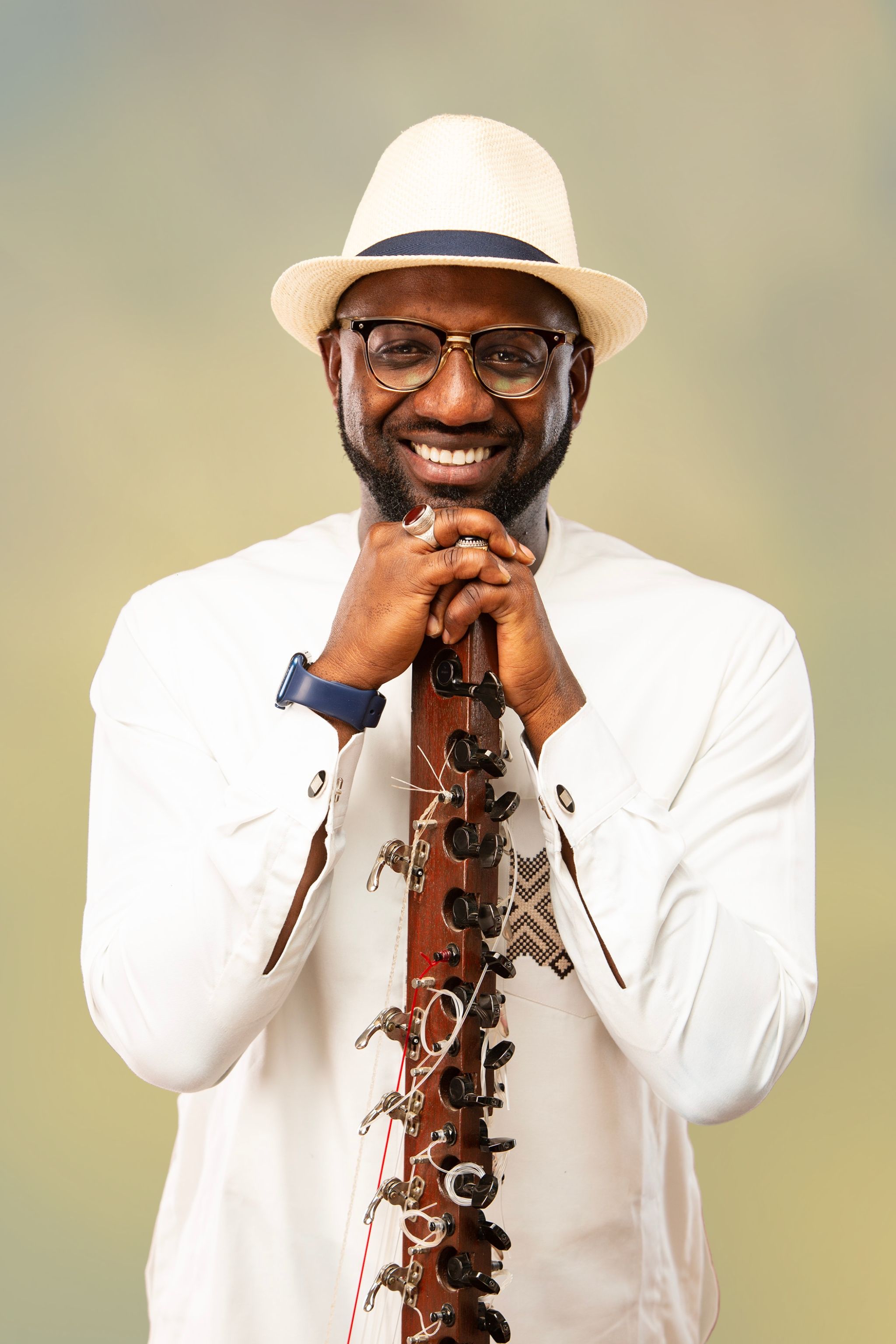 Seckou Keita Interview Image by Pape Photoma
“There is a direct line that connects me to the great kora players from the past.“
Video