Name: Resolution 88
Members: Tom O’Grady (Rhodes Electric Piano, Hohner Clavinet D6, ARP Odyssey, Oberheim Four Voice Polyphonic Synthesizer, Solina String Ensemble, Mellotron M400, Streetly Electronics Novatron, Roland CompuRhythm CR-78, Maestro Echoplex EP-3, Fender Fuzz-Wah, Maestro Phaser), Ric Elsworth (Drums), Tiago Coimbra (1978 Fender Jazz Bass, Anaconda Ultra J4E-elite Bass), Oli Blake (Percussion, samples and effects)
Interviewee: Tom O’Grady
Nationality: British
Recent release: Resolution 88's new album Vortex, featuring guest contributions by Tom Smith and Vanessa Haynes is out now. Buy physical copies at the Resolution 88 bandcamp store. Stream the music here.
Tool of Creation: Fender Rhodes
Type of Tool: Electric piano
Designed by: Harold Rhodes
Country of origin: America
Manufactured: 1965-1984
If you enjoyed this interview with Tom O’Grady of Resolution 88 about the Fender Rhodes and would like to stay up to date with the band and their music, visit Resolution 88 on Instagram, and Facebook.
What was your first encounter with the Rhodes? What was it about it that drew you in?
My first two encounters with the Rhodes were hearing ‘Headhunters’ and then the whole-tone scale opening of ‘Just Another Story’ by Jamiroquai.
I was blown away by the sound - it was beautifully mellow but at the same time had an attitude and bark to it. I’m not sure we even had internet at the time but once I’d found out that what I’d heard was a Rhodes, I found my first (stage) Rhodes in a classified ad in the local paper. My Dad drove me to pick it up and I played that one for several years.
As I learned more I realised that still wasn’t quite the sound I was looking for and in fact what I needed was a suitcase Rhodes (one that has the speaker cabinet and stereo tremolo). Both Herbie and Toby Smith played a suitcase Rhodes. I found one on eBay that was absolutely pristine and imported it from the US. Now I have three!
[Read our Stuart Zender of Jamiroquai interview]
Just like any other instrument, the Rhodes has a rich history. What are some of the key points from this history for you personally?
I always think the starting point of the Rhodes is beautiful; its inception was rooted in Harold Rhodes’ status as an educator (the Rhodes piano method) and effectively a musical therapist, when he developed the Army Air Corps Lap Piano from aluminium tubing left over from B17 bombers.
Another key point in terms of musical history would probably be when Miles Davis insisted on his keyboard players working with the Rhodes (and the RMI Electrapiano).
[Read our Lonnie Liston Smith interview which deals with his time with Miles Davis and electric pianos]
The Rhodes then had its heyday in the later 60s and 70s, before the sound of the DX7 took over in the 80s. The Rhodes then had a resurgence with Acid Jazz and Hip Hop from the 90s onwards and now it’s prevalent again across a wide range of genres.
What, to you, are some of the most interesting Rhodes recordings and -performances by other artists in terms of your personal development?
Without sounding like a broken record, Herbie Hancock is the ultimate reference - as far as I’m concerned, everything came together perfectly; Herbie’s playing style, harmonic choices, compositional style etc all mean that his records from Head Hunters up to Magic Windows basically document the perfection of how to play, record and mix a Rhodes piano.
I also love the first three Jamiroquai albums for Toby Smith’s Rhodes playing, the sound of his suitcase Rhodes and his compositions. They’re definitely a huge influence on me.
When talking about electronic devices, we often think about their “features”. But the Rhodes is a complex device, too. What are some of its stand-out features from your point of view? How would you describe its sonic potential?
Underneath the hood, a Rhodes is not particularly complex. Their actions were less sophisticated than a Wurlitzer electric piano and even the active (suitcase) models didn’t do much more than offer a basic treble and bass boost and a stereo tremolo with adjustable speed and intensity.
Its stand out features lie more in its ability to adapt. It’s such a beautiful, mellow sound that it can blend with all sorts of other instruments. It can be totally transformed through effects pedals too (echoplex, phaser and fuzz-wah being personal favourites).
Its sonic potential is therefore remarkably wide!
Resolution88 Interview Image (c) the artists
Instrument design is an ongoing process. Are you interested in recent developments for the Rhodes in this respect?
I’m very impressed with the Rhodes mk8 and how they’ve refined the action and also incorporated fuller featured analogue effects.
Tell me about the process of learning to play the instrument and your own explorations with it.
I learned the piano classically so I really felt at home with reading notation.
But in the case of the Rhodes, I cut straight to playing along with my favourite records to figure out different chord voicing and lines.
What are specific challenges in terms of playing the Rhodes?
They are extremely variable in quality and sound!
If I turn up for a concert and there’s a hire Rhodes, I can tune and voice it as long as I have a spare hour and a few basic tools. I can change a tine if there are any broken ones - but if I turn up and the action is really sluggish, there isn’t the time in a soundcheck to take the thing apart and sort that sort of thing out, so you have to live with it!
What interests you about the Rhodes in terms of it contributing to your creative ideals? How do you see the relationship between your instrument and the music you make?
It’s as simple as that I love the sound of a suitcase Rhodes and hearing it makes me happy. So it underpins all the music I tend to write!
It does have the wonderful characteristic of making ideas sound convincing, so it’s a great songwriting instrument.
Some see instruments merely as tools towards creativity, others feel they go hand in hand. What's your take on that?
My take is that they are ultimately just tools towards creativity but there is also a beauty in the connection between a well-crafted instrument and musician that transcends that of of a simple tool and workman.
There are many scenarios as a professional musician where one has to cope with substandard instruments and in those cases it’s the musician’s responsibility to make the most of those ‘tools’. There are some cases (like Keith Jarrett’s Köln Concert) where a musician finds inspiration in the inadequacy of an instrument. And there are other cases where the instrument itself is hugely inspiring to play and helps to conjure a magical performance.
One of the things I’m most moved by is the sound/timbre of instruments and I love the sound of the Rhodes - if I asked myself whether I’d compose the same music if I sat at a different keyboard instead of my Rhodes, I’m sure that the results would be similar but not the same.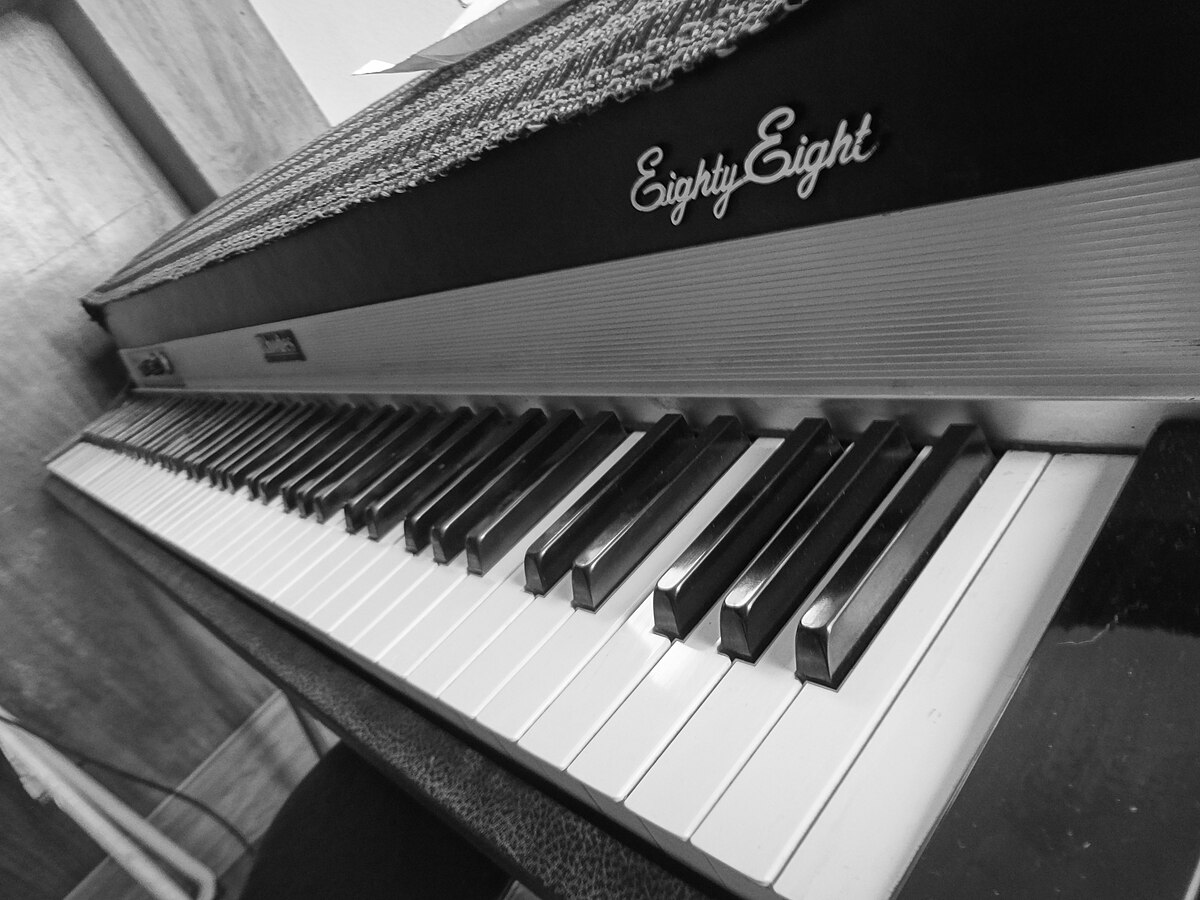
Fender Rhodes Image by David Adam Kess
How would you describe your personal style of playing the Rhodes?
I wish I had a better explanation or description but I would like to think my style is a mixture of all my favourite influences, players and composers such as Herbie, Toby Smith, Ravel, Debussy, Liszt etc
Are there other Rhodesists whose work with their instrument you find inspiring? What do you appreciate about their take on it?
I tend to admire players whose rhythmic feel and timing I would love to have or develop.
Some immediate (and current) names that come to mind are: Dan Goldman, Simon Grey, Matti Klein, Carl Hudson, Eric Legnini, Phil Peskett and Matt Johns.
What does playing your instrument feel like, what do you enjoy about it, what are your own physical limits and strengths?
Playing the Rhodes feels like a musical hug! Sitting at a suitcase Rhodes, you get the tremolo effect between the speakers bouncing back at you so it’s quite a physical feeling when you play.
In terms of physical limits, I suppose I might lock up or tense a bit more than I would like, especially since Rhodes actions are often much heavier and slower than a good grand piano.
In terms of strengths, I would like to think I’m able to use my perfect pitch to comp sensitively in a way that follows a soloist harmonically.
In the light of picking your instrument, how would you describe your views on topics like originality and innovation vs perfection and timelessness in music? Are you interested in a “music of the future” or “continuing a tradition”?
Obviously a lot of originality and innovation actually stems from imitation and people’s assimilation of ideas. For somebody like Herbie, he listened to George Shearing records (among others) and tried to pick out what he heard.
What I think was particularly important about that process was that it might have begun as imitation but because it’s hard work to skip back a stylus and listen repeatedly to a bit of a record, the imitation already introduces variations. These days, things are so much easier with apps available to separate stems, change keys, loop sections, slow down the tempo - as a result, I think there’s a real danger of lots of people ending up sounding like identikit musicians.
Another thing that’s really important for originality is communities of musicians. The best example I can think of is the Bay Area scene in the late 60s and 70s. Drummers such as Mike Clark, Gaylord Birch and Dave Garibaldi all had immediately distinctive styles and they would shed together and bounce ideas off each other without copying verbatim.
As much as I’d love to be responsible for some ‘music of the future’, I’m most interested in making music that sounds like me and like us as a band. Our influences are obvious but I would like to think that we have a recognisable style we can call our own as well.
Could you describe working with the Rhodes on the basis of one of your pieces, live performances or albums that's particularly dear to you, please?
I drove my suitcase Rhodes all the way to Paris to play at New Morning (they have a suitcase Rhodes anyway so that tells you how obsessed I am) and we played the entire Head Hunters album as a tribute to Herbie.
We had to battle through snow even to get to Paris and when we got there. I injured a finger loading our equipment into the venue so it felt very hard work at the time but the crowd were incredible and I will never ever forget their reaction to our performance and playing Herbie’s music on the Rhodes.
We played the entire album version of “Chameleon” (16min) for a second time as an encore and everybody loved it!
How, would you say, does the Rhodes interact with other instruments from ensembles/groups you're part of?
I would say it’s the biggest musical team player there is! The Rhodes elevates everything it accompanies!

 Fender Rhodes Image (c) Tom O’Grady
 “The Rhodes stands out for its ability to adapt. Its beautiful, mellow sound can blend with all sorts of other instruments.“
Video