Name: Tineke Postma
Nationality: Dutch
Occupation: Saxophonist, composer, improviser
Current release: Tineke Postma's new album Voya is out via Clap Your Hands. Alongside Tineke herself on alto and soprano saxophone, it features Theo Bleckmann (vocals), David Dorůžka (guitar), Robert Landfermann (double bass), and Tristan Renfrow (drums).
Recommendations for The Hague, the Netherlands: I love to go to the beach and stroll in the dunes with my family and dog! I teach at the Royal conservatory and the new building, a huge artistic centre called Amare is really worth checking out. It also houses the Nederlands Dans Theatre and they perform the most beautiful modern dance ballet shows in this magnificent building.
Topic I am passionate about but rarely get to talk about: I love being a mom. My son is 11 years old, and it’s a huge privilege to raise a child. It doesn’t matter that I’m a musician — to him, I’m just his mom, and that grounds me every day.
[Read our Theo Bleckmann interview]
If you enjoyed this Tineke Postma interview and would like to stay up to date with her music and current live dates, visit her official homepage. She is also on Instagram, Facebook, and bandcamp
For a deeper dive, read our conversation with one of Tineke's collaborators in our Andrew Moreno interview.
When it comes to experiencing strong emotions as a listener, which albums, performances, and artists come to mind?
The music that impressed me as a kid runs very deep and has had a lasting influence on my own music.
I remember listening to Puccini’s Tosca, Chopin’s Preludes, Bach’s Cello Suites, but also to Miles Davis’s ‘Round About Midnight, Cannonball Adderley’s Something Else, and the album he did with Nancy Wilson.
I must have been eight or nine when I became immersed in these musicians and composers. I’ve always loved a beautiful, recognizable melody and how it can move people.
I also am thinking of the beautiful album of Guillermo Klein and Rebecca Martin Upstate. And Heitor Villa Lobos’ string quartet music. These musicians and composers trigger emotions such as happiness, melancholia, love and hope. I feel inspired to continue making music.
The late Wayne Shorter has been my mentor, and I love all his albums — they evoke so many emotions. And not only emotions like happiness or sadness but hope and possibilities. I love his later album Alegria and his symphonic work.
When he plays with Joni Mitchell on Both Sides Now, it cuts through everything.
There can be many different kinds of emotions in art – soft, harsh, healing, aggressive, uplifting, and many more. Which do you tend to feel drawn to most?
Soft, healing emotions — but also aggressive, intense, and raw ones. Actually, I’m drawn to any emotion as long as it feels authentic, real, and not fabricated for fast, instant gratification. I don’t like theatrical emotions if the underlying energy doesn’t feel honest. If it’s pure, I can be moved by all kinds of feelings.
Some weeks ago, I was playing in a duo with my husband, Marc van Roon, and he’s one of the few musicians who can make me cry … like, through his sound, musical language and feel when we play together. He wrote a ballad that just hit me really hard.
So I guess I’m a romantic when it comes to beautiful, lyrical music — but that’s just one side of me.
I’ve had a hard time explaining that listening to death metal calms me down. When you listen to a song or composition, does it tend to fill you with the same emotions – or are there “paradoxical” effects?
Totally. I can feel very calm when listening to improvising musicians playing intense or dense music.
I’m thinking of Henry Threadgill, Greg Osby, John Coltrane, Kris Davis, Esperanza Spalding and many others. I’m also thinking of improvising musicians and composers from the Brooklyn or Berlin jazz scenes. The focus, power, and storytelling in their music feel incredibly inspiring — and yes, even calming.
My 11-year-old son is the same way: heavy, distorted techno, house, or phonk music (which usually isn’t my kind of thing, haha) really calms him down.
As far as it plays a role in the music you like listening to or making, what role do words and the voice of a vocalist play in transmitting emotions?
I LOVE playing with and listening to vocalists. I had the huge privilege to work with Esperanza Spalding, Dianne Reeves, and Lizz Wright in projects of Terri Lyne Carrington. I have this (for many people, surprising) love for Maria Callas.
I love blending with a vocalist — and when it comes to emotions, if I love their artistry, sound, and spirit, nothing moves me more deeply than playing with them. I consider my saxophone as a voice and always have singers in mind when I play.
Playing with Theo Bleckmann on my new album Voya was a dream. His voice and way of singing hits me hard emotionally. Playing with singers helps me move away from mechanical playing or focusing too much on technical or intellectual aspects — which happens easily.
When it comes to experiencing emotions as a creator, how would you describe the physical sensation?
It first affects my breathing — I feel tension in my chest, and I often want to move my body (that’s usually when the music gives me a lot of energy).
I can cry when music touches me deeply, which closes my throat — not always ideal when you’re playing saxophone, haha.
When it comes to composing or songwriting, do spontaneity and a few takes capture emotions best, or does refining a piece bring you closer to that goal?
I’m very much about spontaneity in music — but within a framework, a clear intention. Depending on how complex the music is, I might do a few extra takes to get the composed parts right so I can try to stand “above” the music.
But when the vibe, emotion, and energy are clear and resonate with my band members, we usually don’t do many takes. I often play best in the first or second take. I’m also careful not to copy myself or try to recreate a “successful” emotional moment — and the musicians in my group are very aware of that too, so every take feels different.
I’ve struggled in the past to balance playing with strong emotion and keeping it cool — there’s a fine line between sounding too heated and too restrained. I’m learning to stop overthinking during recordings and just forget everything I’ve practiced.
How much of the emotion in your music would you say is part of the composition itself, and how much emerges during the recording process?
I usually have a clear emotional sound or direction in mind and the music kind of speak for itself; my musicians know what to do with it also because I wrote the music with them in mind, but my musicians always bring something new.
The music grows with them.
For your current release, what kind of emotions were you looking to express?
Lyrical, melancholic, raw, and edgy at the same time — with a sense of adventure, mystery and tension, both released and unreleased.
How do you capture the emotions you want to express in the studio?
By staying close to myself — tuning into my underlying energy, as Esperanza calls it “life force”.
I try to stay calm but alert, I’m leading while giving the band space to respond, come up with their own interpretations of my music and create a dialogue.
What role do factors like volume, effects, distortion, amplification, and production play in creating the emotions and energies you want?
I’ve become increasingly aware of these aspects. I used to focus only on melody, harmony, and rhythm, but I’m realizing more and more that volume, space, (pre- and post)production, and mixing can make or break the music.
I love playing with David Dorůžka on guitar — he plays so elegantly, yet he can also bring out a strong, distorted sound that adds deep emotional weight or intensity. The same goes for bassist Robert Landfermann and drummer Tristan Renfrow — they both work with a wide variety of textures.
Their willingness to stay with one idea or variation for a long time brings incredible depth.
In terms of emotions, what changes when you’re performing live compared to in the studio?
Playing for an audience is beautiful and helps the music resonate, but I also love recording — being in our own world.
In the past, I’ve sometimes felt overwhelmed by live circumstances, and that doesn’t happen in the studio. I need to remind myself before a gig- like a mantra- to stay close to myself, listen deeply to my musicians, focus on the band to not get carried away by emotions such as trying to prove myself, overplaying (I do that a lot at times) and just make the most beautiful music I can.
I also love rehearsals — no pressure, no need to talk between songs. After shows, I can sometimes feel emotionally overwhelmed, and it’s not always easy to interact with the crowd after a concert though I do it because I’m deeply grateful to everyone who comes to listen.
What kind of feedback have you received from listeners about the emotional impact of your music?
People often tell me, “I’m not sure what you’re doing — it sounds complex, but I feel the emotions, the interaction, the dialogue between you and your band members, and it really touched me.” That’s such a beautiful compliment.
When listeners realize they don’t need to understand what’s going on — but to try to just let it happen and sink in — that’s when they start to feel something. They also seem to like to adventurous - risk taking part of my performances.
Would you say you prefer to stay in control to shape emotions, or do you surrender and let the music take over? Who ultimately has control during a live performance?
I like to stay somewhat in control because I know my tendencies when I get overexcited. If I lose focus, then I don’t breathe well — and that affects my musical choices, my sound, timing, and phrasing.
I’m also allergic to overly theatrical, exaggerated performances. I love detail, focus, subtlety, and craftsmanship — that moves me more than trying to force the audience to feel something. And anyway, I don’t have control over anyone else’s emotions. When I play more “wild” or intense, it should be an artistic choice and not a way to impress or a result of not knowing what to play because then I prefer to not play in that moment and wait for another idea.
At the same time, I don’t want to control my musicians — that would mean I don’t trust them or that I’m not open to discovery. Real music happens in the moment.
When I play, I love thinking in narratives — trying to evoke emotions and translate them into sound.
The emotions that music generates can be extremely powerful. How can artists use that power to bring about change in the world?
I don’t pretend to be able to change the world but when we perform or record — when we live the life of a musician, constantly developing, growing, and striving to be true to ourselves — it takes dedication, courage, and persistence.
On stage, I try to give space to my musicians, to let everyone express themselves and tell a story together. We don’t even need to speak the same language or share the same beliefs. We listen, we support, we make each other sound good. All these elements and aspects of musicianship can be an inspiration for non-musicians too.
Ban Ki-moon once said during International Jazz Day that world leaders could learn a lot from these jazz musicians’ values and dedication. I believe that’s true — it’s powerful and courageous that we keep playing, using our small, humble stages to remind people of what matters to us and to connect us.
It’s easy to disconnect or lose hope and feel numb, but I find inspiration in people who embody those values, and I let that inspire my music. I often talk about them during shows, and I feel that audiences connect more deeply when they understand where my way of writing and playing music comes from.
Of course, music should speak for itself — but the narrative helps people connect.
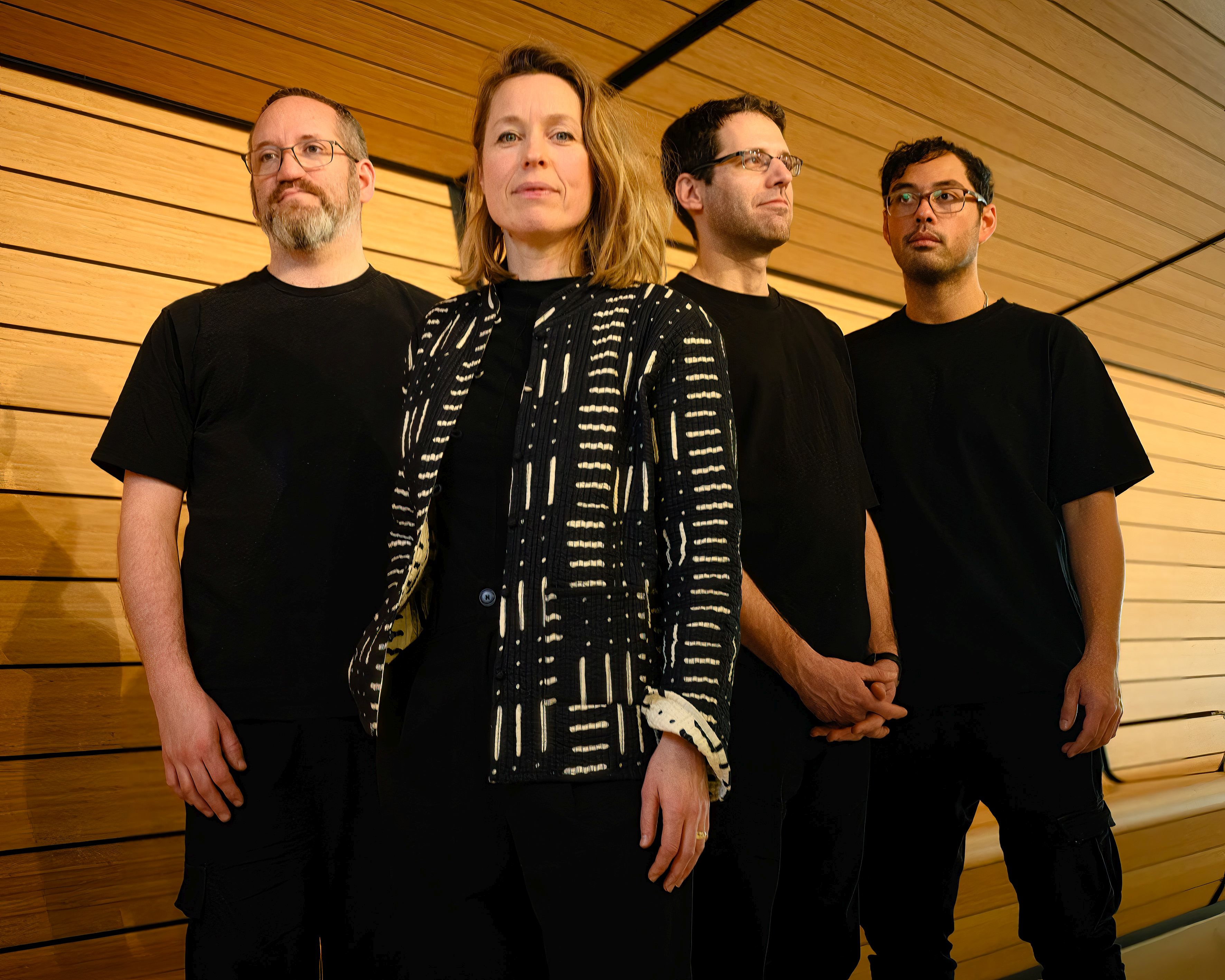 Tineke Postma Group Interview Image by Roy Beusker
“I can cry when music touches me deeply, which closes my throat — not always ideal when you’re playing saxophone.”
Video