Name: Nicola Giunta aka The Thugs
Nationality: Italian
Occupation: Producer
Current Release: The Thugs' new album Mighty Tiger Dubs, co-written and performed by Andrea Davi, is out via Aagoo.
If you enjoyed this The Thugs interview and would like to find out more about his music and upcoming live dates, visit him on Instagram.
Are there examples of minimalism in music – and outside of music – that impressed you early on?
I have a degree in Musicology and Music History. During my university years, I studied and delved into American minimalism, starting with Reich, Young, Riley, and Glass, and the English minimalism of Gavin Bryars and Cornelius Cardew among others.
These sonic structures fascinated me immediately. Bryars' work "Jesus Blood Never Failed Me Yet" was the first to strike me.
[Read our Gavin Bryars interview]
Were you ever interested in minimalism as a style – from the Philip-Glass-variety to solo instrumental work to minimal techno? If so, tell me a bit about your interest in this.
The concept of minimalism in music has always fascinated me.
My academic studies have led me to reconsider many musical genres—such as punk, dub, folk, psychedelia, drone music, pop, kraut rock, techno, and others—and look at them from a different perspective. These are all genres that have exploited a lack of tools, both technical and compositional, to create something completely new, creative, and bizarre.
When I started producing my own music over 25 years ago, all these influences were fundamental to me. At the time, it was very comforting to know that you didn't necessarily need a lot of chords and instrumentation to create interesting music.
Do you tend to find that, as many claim, “less is more?” Are the notes you don’t play really as important as the ones you do play?
"Less" isn't necessarily "more." For me, "less" is "interesting."
Creating something original by playing, for example, just one chord or a single loop is a truly stimulating creative activity for me.
Do you feel as that making music is a process of adding elements until it is done – or one where you chisel away pieces from something that is already there?
I think both processes are present.
I mean, when I start creating a musical track, the final sound I want to achieve is already in my mind. At that point begins the process of adding and subtracting that leads to the final mix.
Obviously, ultimately, it's a matter of personal choice.
Many artists are becoming more minimalist in their music as the years go on, focusing on the “essence.” How is that for yourself and how would you describe your development in this regard?
In general, and not just in music, I believe the act of "removing" is always an excellent spiritual exercise.
By my side, I've always focused on the sounds I need, whether many or few. I've never created music dogmatically.
What were some of the starting points for Mighty Tiger Dubs?
All the tracks on the Mighty Tiger Dubs album started with rhythmic loops—drum machines or vinyl samples. Since it's dub-oriented music, I usually add bass and then all the other sounds I need.
But the starting point always remains an initial rhythmic cell. This, too, is minimalism for me.
How did a minimalist mindset possibly inform the creative process?
I think the best answer ever to this question comes from CAN bassist Holger Czukay with this quote:
"Inability is the mother of limitation, and limitation is the great mother of the creative act."
Do you like to set yourself limitations? If so, which were some of those limitations for the new pieces?
I don't impose limits on myself a priori. But, in my case, the limits impose themselves on me. I mean, I have a tiny studio in my basement, just a few old instruments, a sound card, a mixer, a couple of microphones ... I already start with limitations.
The challenge is to create something interesting from these limits.
Thanks to sampling and digital synthesis, there are endless possibilities for sculpting the sounds and overall sound design of a piece or album. What are your considerations in this regard?
True. And that's a positive thing overall.
It's also true that if you don't have a clear idea in your head and a strong motivation, no software or AI will help you find one.
Would you say that you approach your creative tools with a minimalist mindset? Or do you need a wide choice of instruments and tools to make music?
As I said before, I've never had many musical instruments at my disposal for making music. I always try to make the most of these few and meagre tools.
What were some of the most important pieces of gear or instruments for this release?
Space Echo Boss pedal, 1975 Fender Jazz Bass, my record collection and turntable, a couple of old drum machines.
Reducing one’s options and techniques often implies a different way of working with the materials. Tell me about yours, please.
I believe that having few options puts you in a position to find and invent solutions where none seem to exist.
Perhaps having so many options puts you in the opposite position: it presents you with all those options, and you have to choose which ones to use. It’s up to you.
French producer Guillaume Duchastel told me: “Minimalism is about more than owning fewer things. It’s about focusing on what truly matters“. What are some of your strategies for separating what matters from that which doesn’t?
What matters to me is what sounds good to me. Nothing more.
With so much incredible music instantly available, are you finding that you want to take it all in – or that you need to be more selective? How do you pick the music you really want to invest in?
That's a really interesting question for me, as I'm a compulsive music listener, in all formats: digital, vinyl, CD, tape.
Over the years, I've learned to be selective while remaining curious about discovering new music. It's a process I've slowly refined over the last thirty years or so.
Would you say that minimalism extends into other parts of your life as well?
It depends.
If it's buying clothes, shoes, or high-tech gear, I'm a minimalist. If it's buying books, records, movies, or artwork, I'm a sort of maximalist.
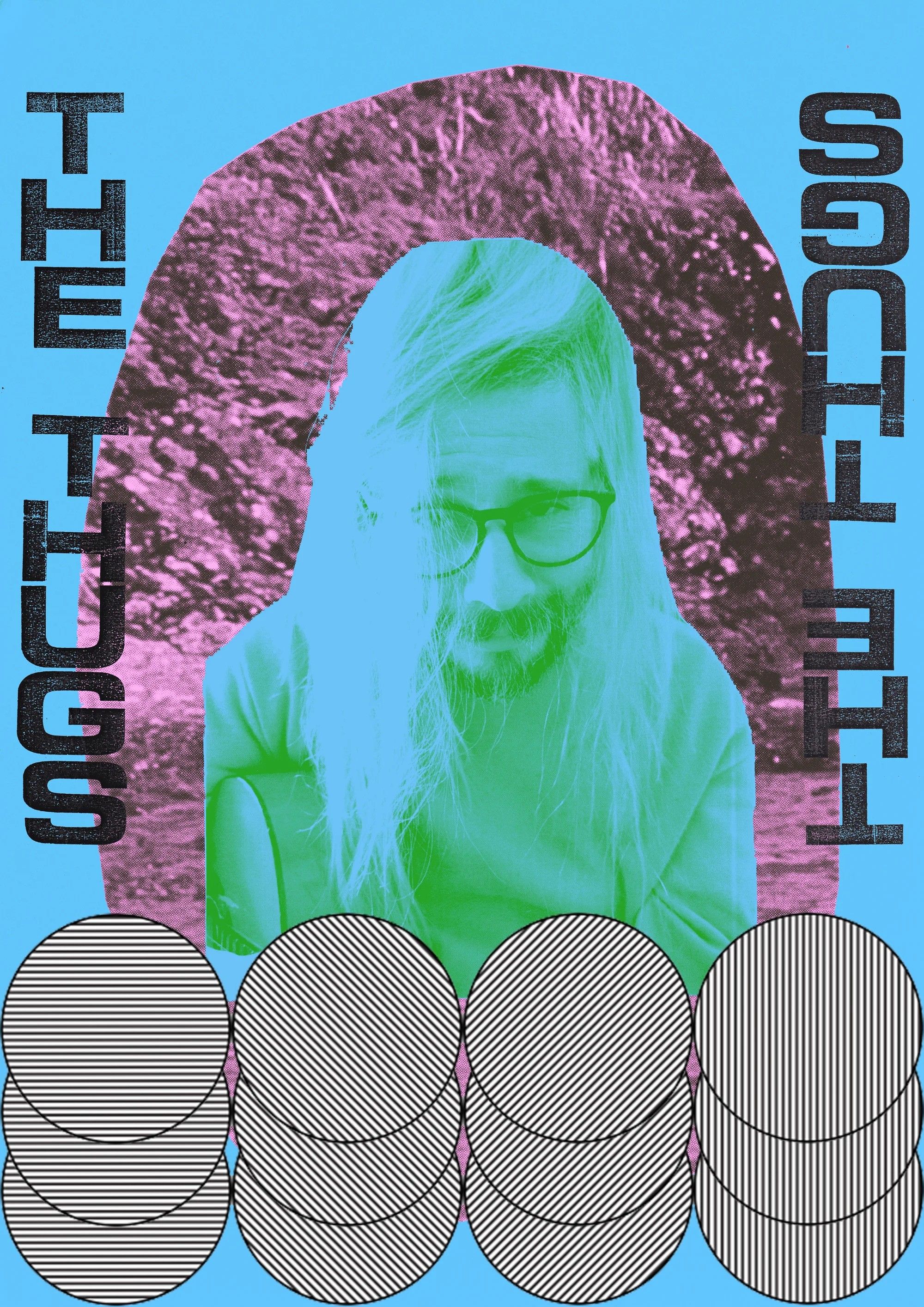 The Thugs Interview Image (c) the artist
"Less isn't necessarily more. For me, less is interesting."
Video