Name: Simone Dinnerstein
Occupation: Pianist
Nationality: American
Current release: Simone Dinnerstein's new album Hourglass, recorded with Baroklyn and featuring Philip Glass’s Suite from The Hours and his Tirol Concerto for Piano and Orchestra (Piano Concerto No. 1) is out via Naïve.
Local recommendation: I am extremely fond of Green-wood Cemetery in Brooklyn. It is a gorgeously landscaped space with so many unusual stories. Oddly, walking around it gives one the most vivid feeling of being alive.
If you enjoyed this Simone Dinnerstein interview and would like to stay up to date with her music, visit her official homepage. She is also on Instagram, and Facebook.
When did you first start getting interested in musical interpretation?
I started playing the piano when I was seven years old, and I don’t think I ever differentiated between playing written pieces of music and musical interpretation.
I have a very early memory of playing John Thompson’s Swans on a Lake. I remember thinking about how the music so clearly showed the image of the water and the swans, and that I could show it through how I played the music.
Which artists, approaches, albums or performances captured your imagination in the beginning when it comes to the art of interpretation?
My very earliest influences were Wilhelm Kempff’s recording of Beethoven sonatas and Alfred Brendel’s recordings of Beethoven and Liszt, as well as his live performances which I attended at Carnegie Hall.
I was completely captivated by his performance of Liszt’s Années de pèlerinage, which I found to be charismatic, inspiring, and deep.
My parents took me to many piano recitals at Carnegie Hall and the sound of the piano in that space had a profound influence on my sound world.
Are there examples for interpretations that were entirely surprising to you personally and yet completely convincing?
As a teenager, I became obsessed with Glenn Gould’s recordings. They were always completely unexpected and original, with his distinctive voice.
I never wanted to imitate him, because his interpretations were so clearly only belonging to him. But I found all of his recordings, even the ones that seemed comically argumentative, to be riveting and thought provoking and often deeply touching.
What do you personally enjoy about the act of interpretation? Are you finding that this sense of enjoyment is changing over time?
Interpretation is both an absorbing focus on a work outside of oneself and also the most honest and true connection with one’s innermost voice. By focusing on the music and listening to what it is telling you, you inevitably reveal your own self.
When I was a child, I did this unselfconsciously. As I grew older, the process became much more complex. I became swayed by teachers and the projections that I made onto the ears of the audience.
My continuing process is to attempt to ignore that outside noise and to focus on the most direct connection between the musical score and my inner ear. This is tremendously difficult, and it is probably impossible to ignore the world around me, which also created my inner ear. But every day, this is what I try to do.
How much creativity is there in the act of interpretation? How much of your own personality enters the process?
There is only creativity in this process. It is all about our own personality. Nothing else is real.
We can study style, historical context, performance practice, but it is all being digested by our individual personalities. There’s no getting away from it.
Could you describe your approach to interpretation on the basis of a piece, live performance or album that's particularly dear to you, please?
In my most recent recording, Hourglass, I was both playing the piano and directing my ensemble, Baroklyn, in works by Philip Glass.
It’s so interesting and broadening to direct a group of amazing musicians. It forces me to articulate my musical ideas both to myself and to them in a way that I sometimes don’t consciously do when I’m just playing by myself.
In this case, I wanted us to have a highly polyphonic approach to the music where each voice was feeling their own rhythmic pulse in a slightly different way than the voices around them. I wanted it to be a conversation between voices that was fluid and not completely in sync.
What was your own learning curve/creative development like when it comes to interpretation - what were challenges and breakthroughs?
My teacher, Maria Curcio, used to talk about the inner ear, which envisioned the music, and the outer ear, which made sure that this vision was realized. I’ve always had a very strong inner ear, though I couldn’t tell you why that is. I have strong instincts about music, which are sometimes supported by my learning around the text and sometimes simply because something strongly feels right to me.
But aligning that with my outer ear has always been a challenge for me. Sometimes it’s a challenge because I am afraid of how listeners will receive it, because I know that it will sound different than current practice. Other times, it’s a challenge because I can’t figure out how to achieve it physically on the instrument. My own thoughts and fears are my biggest obstacles.
The first time that I completely united my inner and outer ears truly fearlessly was when I recorded the Goldberg Variations. In those three days of recording, I thought of nothing but the music and what it was saying to me, and I tuned out all of the other nonsense.
It was a completely remarkable experience for me that I will never forget.
In many cases, the score will be the first and foremost resource for an interpretation. Can you explain about how “reading” a score works for you?
I really love the process of digesting a score. It’s like being a detective looking for clues, or a psychoanalyst uncovering layer after layer of associations.
Each discovery leads to other discoveries being unlocked. It’s tremendously exciting and without end.
One of the key phrases often used with regards to interpretation are the “composer's intentions”. What is your own perspective on this topic and its relevance for your own interpretations?
I find this phrase somewhat ridiculous. The music has a much greater life than the vision of its first creator. It only lives when we play it, and every musician is bringing the context of their own life and hearing to the music.
A better question is why we are so obsessed with the question of some type of fidelity to the composer’s intentions. What does that say about our society today?
I am infinitely fascinated by radically different or even “wrong” interpretations – the tempi of Toscanini, Kempff's Goldberg Variations. Are there extreme interpretations that you enjoy as well? Do you personally draw a line – and if so, what happens when we cross it?
I don’t think an interpretation can be right or wrong. I’m fascinated by the variety of approaches that are contained within the same piece of music.
The interpretations that bother me are the ones where I feel that decisions have been made purely to demonstrate some attribute of the performer. When I don’t hear an authentic connection between the music being played and the person playing it, but instead I am only aware of the physical skill of the performer, I can really lose interest in listening.
When you have the score in front of you, what's your take on taking things literally, correcting possible mistakes, taking into account historical aspects etc?
Musical notation has always seemed to me to be an almost primitive way of transcribing a musical thought. A musical term like forte can mean a million different things.
I like to find what is odd and compelling in the musical score and think about how to bring out those qualities. Sometimes the markings in the music don’t seem to help that to happen, in which case I follow my own instincts.
With regards to the live situation, what role do the audience and the performance space play for your interpretation?
The acoustical space and the particular piano at the venue play vital roles in the live act of interpretation. They bring out unexpected aspects of the music that can be wonderful or sometimes detrimental.
The focus of the audience can be a very exciting way of collectively listening to the music. A concert is all about intentional listening, which is so rarely part of our everyday musical experiences. We are all there for the purpose of sharing a musical experience.
Some works seem to attract more artists to add their interpretation to it than others; some seem to even encourage wildly different interpretations. From your experience, what is it about these works that gives them this magnetic pull?
Music that has the most depth and richness holds the widest range of interpretation. Whereas music that lives in a more superficial space contains fewer interpretations.
Artists can return to a work several times throughout the course of their career, with different results. Tell me about a work where this has been the case for you, please.
I first played Schumann’s Kinderszenen when I was thirteen. I was highly emotional in my reading of it at that time, and experienced the music as a description of my own being then.
Over the years, I’ve become more understated in my approach, and feel that the poignancy of the music is connected with its memory of the experience of childhood. It’s about something that was lost.
I’m sure it will continue to evolve for me as I grow older.
Part of the intrigue of interpretations is that the process is usually endless. Are there, vice versa, interpretations that feel definitive to you?
There are some recordings that I love so much that I would never want to play the music myself, as it would ruin my experience of listening to the recordings.
For instance, Gould’s recording of Byrd and Gibbons. I know that if I studied the music myself, it would lead me down a very different path, and once I went down that path I wouldn’t be able to innocently love his recording in the same way.
I want to love recordings like that in an uncomplicated way, to treasure them.

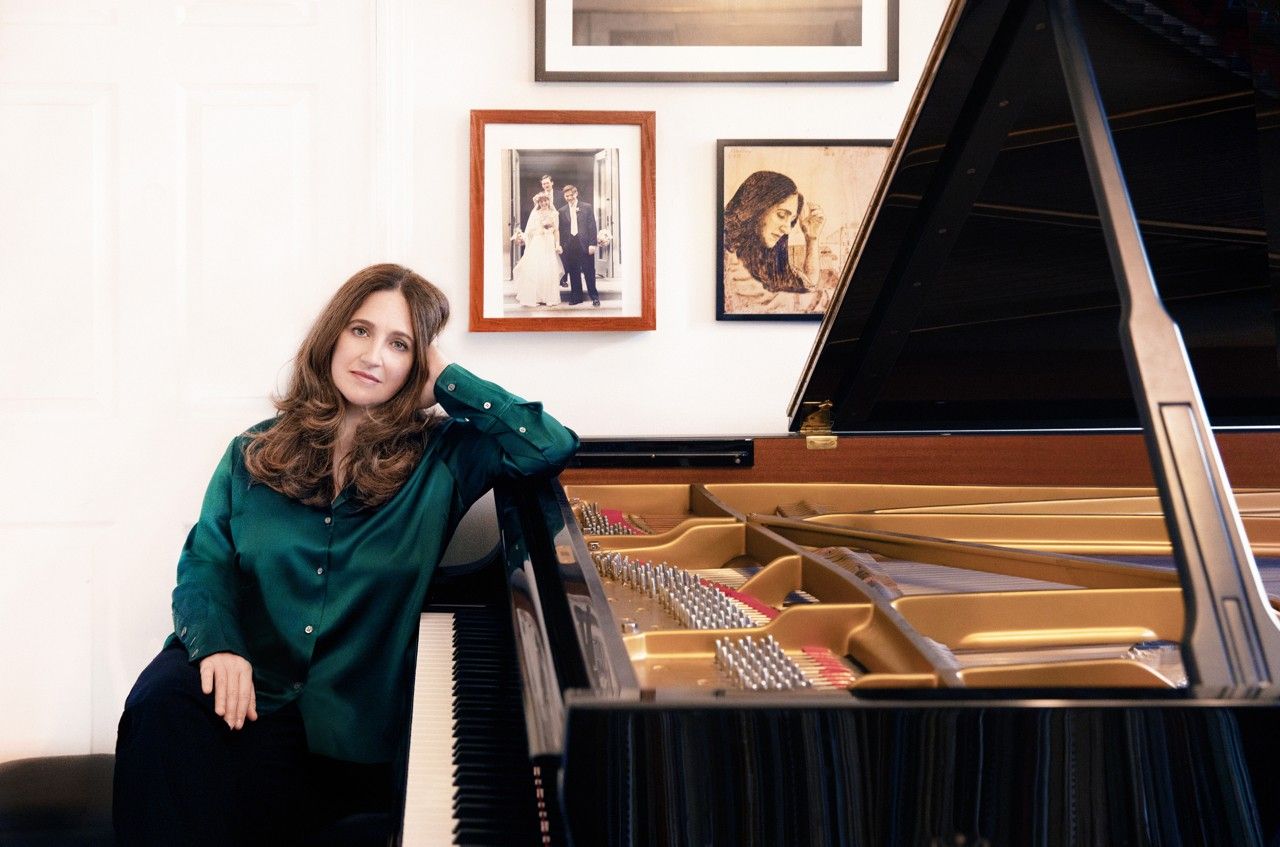 Simone Dinnerstein Interview Image by Lisa-Marie Mazzucco
“My continuing process is to attempt to ignore outside noise and to focus on the most direct connection between the musical score and my inner ear.“
Video