Name: Salome Voegelin
Nationality: Swiss
Occupation: Artist, writer, researcher, practitioner
Current release: Salome Voegelin's compilation release Cassette Album (tape score compilation) is out via Flaming Pines.
Recommendations on the topic of sound: There are so many exciting books and texts, podcasts and audio papers, and so on now, thinking with and from sound. And while some are more scholarly others are more accessible and general: so there is something for anybody.
This is an interesting podcast series on books in sound studies.
A book that I immensely appreciate is Listening after Nature by Mark Peter Wright. I also find Hungry Listening by Dylan Robinson a very demanding and ground breaking book in relation to a decolonial ear. I appreciate very much the writing of Anahid Kassabian on Ubquititous Listening. and would also like to recommend Jennifer Stoever’s Sounding Out blog for all sorts of interesting debates, texts and issues with and on sound.
If you enjoyed this Salome Voegelin interview and would like to stay up to date with her work, visit her official website.
When I listen to music, I see shapes, objects and colours. What happens in your body when you're listening? Do you listen with your eyes open or closed?
I do not have a general rule for listening but rarely close my eyes. Or rather I never close my eyes for listening, but sometimes close them for the particular situation I am listening in.
For me listening is a multi-sensory action. It is about making connections, hearing the connections that are there, visibly and invisibly. Therefore it is not about reducing the experience to hear more but seeing and sensing more because of hearing.
How do listening with headphones and listening through a stereo system change your experience of sound and music?
I only really listen on headphones when I am in the gym or on a train or a plane, or in some other public space where the sounds I chose to listen to would bother others.
Otherwise, I try to avoid headphones. Not for moral reasons. I think headphone listening is fine, and I have no fear of people isolating themselves or an increasingly isolationist society generated or expressed by an ubiquitous use of headphones. I think that instead listening on headphones creates new connections and a different sociality rather than none at all.
However, I do like listening on a speaker system because everything else starts to sound with the played. That to me is interesting, the spatiality of a work and how it vibrates with its environment rather than as a work. For this reason I also like live music, and listening to live music, to be part of the vibrations, to hear as in sense the power and fragility of it.
Tell me about some of the albums or artists that you love specifically for their sound, please.
I do not really have favourite album per se, it all depends on context and time. However, I do remember listening to particular artist’s works in particular settings, live or playback, that for me created great sounds.
Among them for example would be Annea Lockwood’s ‘Jitterbug’ played by Apartment House at the Southbank centre in London in 2024.
There was something about how the performance was mixed and diffused with the space, which created a sound that was heard and felt in an extremely physical and at the same time cerebral way.
I have also recently heard two works by Joanne Baillie, Artificial Environment No.8, Babel, Artificial Environment No.3, composed sometime between 2011 and 2013.
Both pieces are ostensibly trying to play a sound without time, something which of course is impossible but the attempt of which creates an amazing stoppage of time in a moving space. Simply great.
[Read our Joanne Baillie interview]
There can be sounds which feel highly irritating to us and then there are others we could gladly listen to for hours. Do you have examples for either one or both of these?
I think the irritation factor of a sound depends largely on the context we hear it in. On their own, as a recording, say, I find most sounds deeply intriguing and beautiful, and even when difficult they can be strong and gripping.
In certain contexts the irritation can even be great. Recently I tried to fall asleep but heard a small tap-like sound, a sort of scratching and moving. I switched the light on to find what ever made this sound. Irritated and afraid of what it might be I could not find it, gave up, fell asleep.
But later that night I was woken up by a massive, motorbike like sound. The scratching and moving sounds had been made by a stag beetle that was now flying through the bedroom. In hindsight that was one of the most beautiful and strong sounds, very physical, present, low, but at that moment it was sheer terror and irritation.
Are there everyday places, spaces, or devices which intrigue you by the way they sound? Which are these?
I like the sound of fixing tram tracks at night. Or a heavy thunder storm.
Have you ever been in spaces with extreme sonic characteristics, such as anechoic chambers or caves? What was the experience like?
I have been to a couple of anechoic chambers and what I sensed most was how it was not at all like what John Cage said about it in his hyperbolic description of hearing his nervous system. If he really even said that.
Instead, the main impression was one of dryness, not only dryness of tone as a separate sensation, but a physical sensation of dryness of everything.
What are among your favourite spaces to record and play your music?
I love to listen to music in the bathroom, or in a comfortable bed.
Do music and sound feel “material” to you? Does working with sound feel like you're sculpting or shaping something?
Definitively, a composition or musical / sonic work does not create a piece but a time and space configuration, a viscous expanse, that is formless but material.
Therefore, I think musical and sonic works should be heard and discussed more in terms of this unconventional dimensionality, rather than in relation to a harmonic, horizontal and quasi linguistic development of music.
How important is sound for our overall well-being and in how far do you feel the "acoustic health" of a society or environment is reflective of its overall health?
Sound is extremely important for mental as well as physical wellbeing. Certain sounds can make us feel better, calm us down, lower blood pressure and influence all sorts of things, but they can also make us feel ill and even be used to torture us.
What I mean to say is that sound is not per se benevolent or healing. But it has a powerful influence on our body. And that can also be abused.
That is one of the reasons why we need sonic literacy: an understanding of sound and its relational materiality, and we also need intelligent sound lead design to create a responsible sonic environment and responsible sonic politics.
Many animals communicate through sound. Based either on experience or intuition, do you feel as though interspecies communication is possible and important? Is there a creative element to it, would you say?
The problem with interspecies communication is that humans might want it but animals probably less so - or at least we cannot know whether they want to communicate with us, as we do not understand them.
Tinnitus and developing hyperacusis are very real risks for anyone working with sound. Do you take precautions in this regard and if you're suffering from these or similar issues – how do you cope with them?
I often talk to students about not to working at too high volumes, and warn them about how hearing loss due to overtly loud levels is irreversible. This is important.
I also see another growing development that is misophonia or hyperacusis, an extreme response and intense dislike of certain sounds, like somebody eating an apple, even if those sounds are not particularly loud.
While hyperacusis is considered to be physiological, misophonia has a strong emotional and psychological dimension and therefore its increasing appearance is very interesting as an indicator of other social hyper-sensitivities.
We can surround us with sound every second of the day. The great pianist Glenn Gould even considered this the ultimate delight. How do you see that yourself and what importance does silence hold?
Silence does not not sound, it is just a particularly described sound. Even in an anechoic chamber there is sound. In that sense we are always with sound and also always sounding.
The issue for Gleen Gould I guess is whose sound he is hearing all day. He was famously interested in super controlled sounds. The perfect performances of Bach. A performance of Bach that was not really one performance anymore as it included so many technological changes and edits to make it appear perfect.
I am not interested in creating a world of perfect sounds according to a musical system. But I am interested in being aware of all the sounds I hear and am part of everyday as a signifier of an extremely complex, relational and imperfect world.
Seth S. Horowitz called hearing the “universal sense” and emphasised that it was more precise and faster than any of our other senses, including vision. How would our world be different if we paid less attention to looks and listened more instead?
I do not like the word universal at all, and definitively not when it is used in relation to music or sound. It is a strange assumption that there is a universal anything, which is heightened in sound because we cannot see it.
The idea of music or sound as a universal thing is to my mind a very colonial idea. A Western misunderstanding of its own provincial harmonic system as global. Rather than liberating or connecting, the notion of universality becomes an imperative which ignores differences.
Having said that, I do believe that a sonic sensibility, that is a sensibility towards the invisible and indivisible dimensionality of the world, its existence as encounters and happenstance, could positively influence how we live with the world. The relational and reciprocal logic of sound, the fact that we do not hear individual things but how they sound together gives access to a very different thinking about the world, its social, political, ideological organisation.
In turn it generates a different imaginary how else these connections could be performed. That is powerful and useful, particularly at this juncture were a rising fascism depends and heightenes separation and hate, and demands we listen differently and make other sounds.

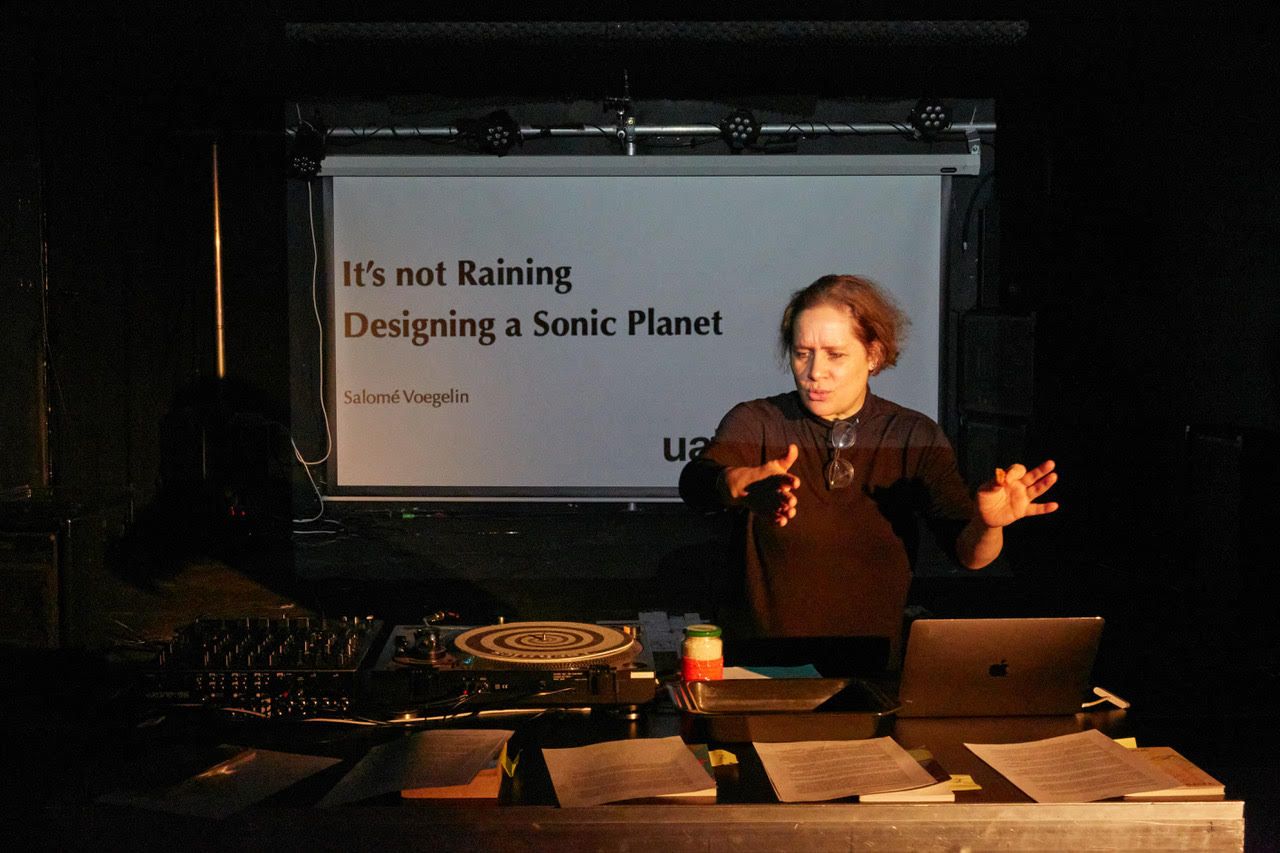 Salome Voegelin Interview Image by Kai Niggemann
“A composition does not create a piece. It creates a time and space configuration.“
Video