

Published
Name: Yellowjackets
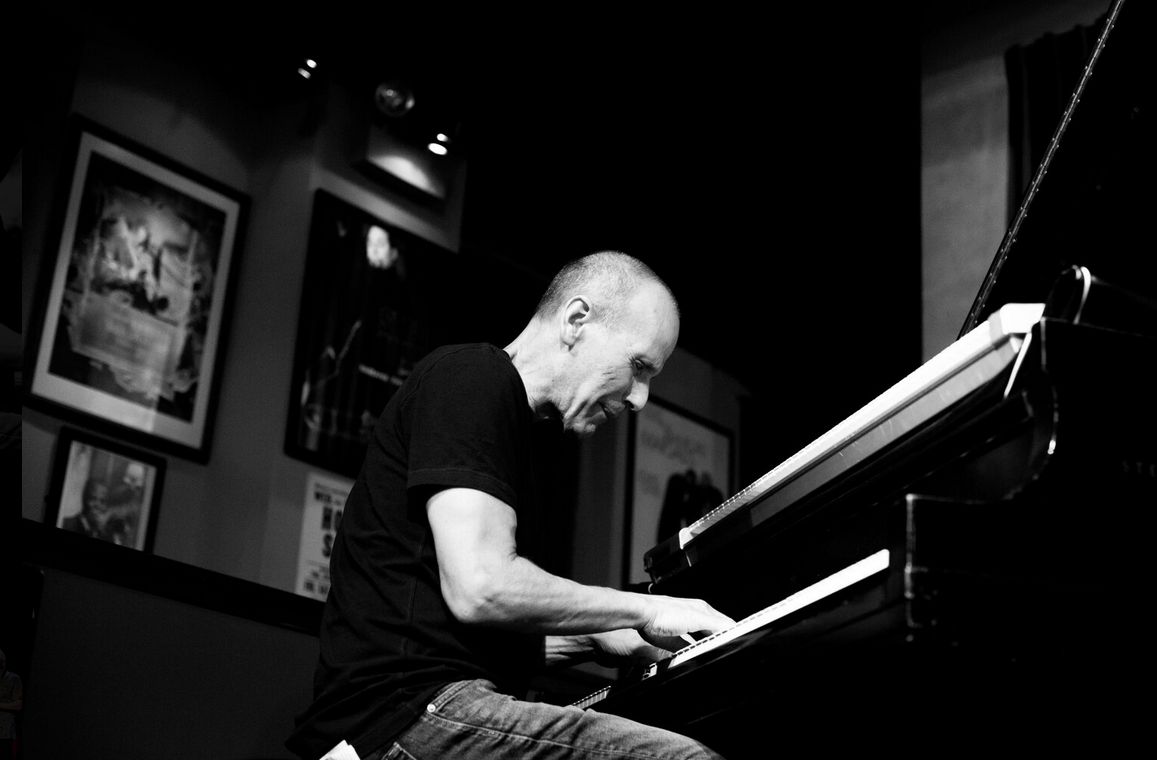
Members: Russell Ferrante (piano, synthesizers), Bob Mintzer (woodwinds, EWI), Will Kennedy (drums), Dane Alderson (bass)
Interviewee: Russell Ferrante
Nationality: American, Australian (Dane)
Current release: Yellowjackets' new album Fasten Up is out via Mack Avenue.
Global Recommendation: In the town where I currently live, Descanso Gardens in La Canada, CA.
Topic I rarely get to talk about: I’m passionate about treating one another with respect and showing kindness in every interaction. I’m passionate about leaving a liveable world to my 7 year old granddaughter and her generation. I’m passionate about leaving a legacy of music that will inspire those who came after us.
If you enjoyed this Yellowjackets interview and would like to know more about the band and their music, visit their official homepage. They are also on Soundcloud.
What were some of the musical experiences which planted a seed for your interest in jazz?
Two high school friends, both drummers were the first to kindle my interest in jazz.
One, Rich Stahl was a close friend who I knew from our shared love of basketball and the other, Ray Fink, was a classmate who I saw play at a school assembly. I was later invited to jam with Ray at his home. He introduced me to Miles Davis, John Coltrane, Eddie Harris, and Les McCann among others.
Though I had little understanding of what I was hearing, I was immediately drawn to the music and was relentless in my pursuit to understand more about jazz.
What does the term jazz mean today, would you say?
Jazz is an art form. Like every art form, there’s a historical underpinning for its development. To play jazz, then, is to have an understanding of its origins.
Those would include African American slave songs, gospel music, and blues. These musical forms were later fused with European musical sensibilities and that development continues to this day with jazz incorporating musical styles from all over the world.
Jazz embodies open-mindedness, freedom, improvisation, respect for its history and innovators, and a willingness to break (or bend) the rules and find one’s own voice.
As of today, what kind of materials, ideas, and technologies are particularly stimulating for you?
I still love acoustic instruments. There’s a warmth, resonance, and timelessness to working with natural materials.
There’s no end to the ideas that stimulate me. Presently we’re in a time of rapid change and the upending of norms. I’m looking to history to see how people in the past dealt with these challenges. At the moment, I’m reading John Meacham’s biography of Lincoln And There was Light to try to understand how seemingly irreconcilable differences play out.
I’m also searching for ways to create connection in our communities. Music has enormous power. It can inspire, console, and bridge the ethnic, religious, and political divides. As a musician and a composer, I want this to be my focus.
Where do most of your inspirations to create come from – rather from internal impulses or external ones? Which current social / political / ecological or other developments make you feel like you need to respond as an artist?
My inspiration comes from both. I’m inspired by the things we all share in common, family, friends, community, art, sports, politics, religion, and the news of the day. I’m always searching for new ideas in a quest to expand my knowledge and continue to find fresh avenues of expression. To do this, one must simultaneously imagine the future but also be informed by what has come before.
The place I most often find this intersection is alone at the piano. I will improvise and record or notate ideas that bubble up. I later return to these “seeds” and use the compositional tools at my disposal to develop these seeds. When you experience a moment of inspiration, it feels like you have stumbled upon a truth! That’s what I was trying to say with the song title “The Truth of You”.
One current development I feel I want to respond to is our disunity. As previously mentioned music can bring us together. Yellowjackets is a leaderless band with each member contributing equally. We have different cultural, religious, and political views but we have prioritized respect for one another and pooling our talents in an effort to create a unified whole. I hope our live performance and recorded music communicate that.
As the saying goes, “If you want to travel fast, go alone, but if you want to travel far, go together.”
Music has become a lot more global, and incorporating elements from other parts of the world or the musical spectrum is commonplace. Do you still think there are city scenes with a distinct, unique sound? How does your local scene influence your work?
I grew up in the San Francisco Bay Area where there was a distinctive Bay Area sound.
It combined East Bay funk (Tower of Power, Sly and the Family Stone) rock, jazz, and Latin music. That eclectic approach certainly influenced my musical taste and that of Yellowjackets as several of our current and former members grew up or spent considerable time in the bay area. (Robben Ford, Jimmy Haslip, William Kennedy, Marc Russo, and myself)
When I later moved to Los Angeles, I encountered a different music scene. In Los Angeles, the recording industry and other music business opportunities influenced the music making. Where there was a freedom and more of a “devil may care” attitude in the Bay Area, the Los Angeles aesthetic revolved more around commercial considerations.
That translated into musicians being very skilled but one might sometimes question to what end those skills were employed!
What role do electronic tools and instruments play for your creative process?
Electronic tolls play an important but primarily utilitarian role for me.
Using digital sequencers allows me to sketch my ideas. Notation software allows me to more easily notate arrangements for large ensembles. DAW’s allow me to remotely overdub on other people’s recordings. Software instruments allow me to travel with only a laptop and a small keyboard for live performance instead of bringing literally tons of equipment on the road.
Thanks to technological advances, collaboration has become a lot easier. What have been some of the most fruitful collaborations for you recently and what approaches to and modes of collaboration currently seem best to you?
On the last two Yellowjackets recordings, we’ve been able to collaborate with musicians who lived across the country from us via digital tools.
Our current recording Fasten Up features vocalist-guitarist Raul Midon on the tune “The Lion.” We sent him the band track and he recorded himself at his home studio.
Likewise Jean Baylor recorded her exquisite vocal on the tune “If You Believe” from our previous recording Parallel Motion.
All of the members of Yellowjackets are frequently asked to overdub on other musician’s recordings. Modern technology makes it easy and commonplace.
As a side note, I was teaching fulltime at The University of Southern California during the pandemic. The emergence of tools like Zoom made interactive music instruction possible. Even music ensembles were able to compose and record music with each student adding their part from their dorm room!
Jazz has always had an interesting relationship between honouring its roots and exploring the unknown. What does the balance between these two poles look like in your music?
I think Yellowjackets is a great example of honoring the past while exploring the future. In particular, Bob Mintzer is firmly rooted in the jazz tradition and his composition “Swingmeister General” from Fasten Up illustrates that.
Another song from Fasten Up, “Nov 8th,” illustrates exploring less travelled territory with the shifting and meters and subtle harmonic shifts.
Also a song like Dane Alderson’s “Xemeris” combines jazz and electronica.
How much potential for something “new” is there still in jazz? What could this “new” look like?
There is always the potential for something new! That’s what drives and inspires creative individuals.
There are only 12 notes but listen to the breath of music mankind has created. There are only 26 letters in the English language but look at the multitude of literary masterpieces that have been written!
For many artists, life-changing musical experiences take place live. How do you see that yourself?
There’s a special exhilaration playing live when the collective energy between the musicians on stage connects with the audience.
You experience time standing still and are completely absorbed in the moment. What a high! You feel an intense connection to everyone assembled.
In speaking with audience members after our performances, they describe similar feelings.
How, would you say are your live performances and your recording projects connected at the moment? How do they mutually influence and feed off each other?
The recorded performances often capture a song in its infancy. That can be very charming.
As you perform and explore a song though, you become more intimately aware of its potential and the songs can take on more dimensions.
Ímprovisation is obviously an essential element of jazz, but I would assume that just like composition, it is transforming. How do you feel has the role of improvisation changed in jazz?
I feel there is a new generation of young jazz musicians creating new song forms and improvising over much more complex and challenging forms.
A great example would be saxophonist, Immanual Wilkins and his talented band members. Or the composition “Resfeber” by Noam Wiesenberg.
What, would you say, are the key ideas behind your approach to improvisation?
I want to tell a story. I want to utilize motivic development. To do this I need to have an intimate knowledge of the song’s melody, harmony, and character.
As importantly, I want to be in conversation with my bandmates and play in such a way that leaves room for that conversation. That means not filling up all the space so that conversation can take place.
Are there approaches, artists, festivals, labels, spaces or anyone/-thing else out there who you feel deserve a shout out for taking jazz into the future?
I already mentioned a couple musicians, Immanuel Wilkins and Noam Weisenberg and the musicians in their bands.
I might also mention the SF Jazz Collective and any number of European Jazz Festivals that are championing new music.
The Montreux Festival intends to preserve its archive of recordings for future generations. Do you personally feels it's important that everything should remain available forever - or is there something to be said for letting beautiful moments pass and linger in the memories of those that experienced them?
I’m in favor of archiving performances. It’s an invaluable educational tool and serves to give historical perspective.
You think you’re playing some stuff, here’s Miles Davis from 1964!