Name: Rob Luft
Nationality: British
Occupation: Composer, guitarist, improviser
Current Release: Rob Luft teams up with Elina Duni for Reaching for the Moon, out April 24th 2026 via ECM.
Hometown Recommendation: I’m a native of London, England, and would say that the long running Monday night jam session at Soho’s legendary Ronnie Scott’s Jazz Club is a must see. Proceedings generally kick off just before midnight and there you have the chance to see some of London’s jazz veterans onstage with younger, up-and-coming talent. Also, the cocktails made by the bar staff are absolutely fantastic, especially if you don’t have to get up early the next morning!
Shoutouts: Over the past 18 months I have started teaching in the jazz department at The Royal Academy of Music in London, and I must say that there’s a young Swiss accordionist who just graduated last year named Anatole Muster. The way in which he blends influences from an incredibly diverse range of musical sources on his debut album “hopecore” is very impressive & makes for compelling listening.
Things I am passionate about but rarely get to talk about: Over the past year or so, I’ve been on a bit of an epic quest travelling around Europe attempting to see all 10 of Gustav Mahler’s symphonies performed live by different orchestras & different conductors in some of the continent’s great concert halls. It has been one of the most transformative & rewarding musical experiences of my life, listening to such majestic symphonic music in a live context. So far, my favourite moment has been seeing Paavo Järvi conducting the 1st Movement of the 10th Symphony at the Tonhalle in Zürich, Switzerland. I can heartily recommend the spectacle of seeing any of Mahler’s gorgeous symphonies live to anyone and everyone!
If you enjoyed this Rob Luft interview and would like to know more about his music and upcoming live dates, visit his official homepage. He is also on Instagram, Soundcloud, Facebook, and bandcamp.
What were some of the musical experiences which planted a seed for your interest in jazz?
For me, jazz music peaked my interest when I got the chance to experience the music live for the first time.
The pure electricity and boundless energy of the Allan Holdsworth Trio live at the Mick Jagger Centre in southeast London back in 2008 was a kind of “Road to Damascus” moment for me! The astonishing interplay between Holdsworth and his bandmates, Chad Wackerman on drums & Ernest Tibbs on bass, was so striking to me as an impressionable young 15 year old.
Jazz fusion really acted as a gateway for me into discovering the origins of the music, and I’ll always have a soft spot for 70s jazz legends like John McLaughlin, Herbie Hancock, Chick Corea, and many others of that epoch.
What does the term jazz mean today, would you say?
For me, jazz music in the 21st century is a very broad church indeed. It generally refers to music which encompasses one or more of the following elements:
1) Some form of improvisation contained within the music.
2) Swing feel, also known as swung eighth notes.
3) A nod of adulation to one or more of the African-American forefathers of this beautiful art form.
On a wider note, jazz music is one of the forces in this world that truly has the power to change society for the better, with openness, inclusivity & love built into the ethos of the genre.
Great jazz albums like Kind Of Blue or A Love Supreme give life to our emotions, whilst the very real, human experience of a group of jazz musicians standing onstage in front of a live audience, all improvising together in the moment is such a life-affirming thing to feel!
As of today, what kind of materials, ideas, and technologies are particularly stimulating for you?
Ever since I saw Pat Metheny perform his incredible Orchestrion project live at London’s Barbican Centre in 2010, I’ve been fascinated with the idea of live looping in a jazz context, as well as the seemingly limitless possibilities of augmenting the sonic palette of the electric guitar.
As a result, what you hear on this latest album with Elina Duni is a layered tapestry of electric and acoustic guitars, much of which was done live ‘in the moment’ in an attempt to stay true to the improvisatory nature of this music.
Where do most of your inspirations to create come from – rather from internal impulses or external ones? Which current social / political / ecological or other developments make you feel like you need to respond as an artist?
The vast majority of my inspiration comes from hearing beautiful music created by other artists, either in a recorded format or ideally in the sphere of live performance. I have seen guitar genius Bill Frisell perform live more times than I’d care to admit, and each time I seem to walk away with a bottomless well of musical inspiration from the concert.
Such experiences leave an indelible mark and they fill me with the desire to continue studying, to continue composing & to continue with the arduous lifestyle of constant touring!
Tell me a bit about the sounds & creative directions, artists & communities, as well as the colleagues & creative hotspots of your current hometown, please. How do they influence your music?
There is a wonderfully quirky jazz club in east London called The Vortex, a place I often refer to as my spiritual home!
The club has been running well over 30 years and I have been lucky enough to see many pillars of London’s jazz community perform there over the past decade and a half. To name but a few, gigs by the likes of Evan Parker, Django Bates & Kenny Wheeler have influenced me greatly.
The programming is so diverse at the club that you never quite know what you’re going to get as an audience member, and perhaps it is this freewheeling spirit that leaves the greatest mark on me, not just as a musician but also as a human being!
What role do electronic tools and instruments play for your creative process?
As alluded to above, I use a loop station (the Boss RC-500, to be specific) for many of my live performances, especially when I appear in duo with Elina Duni. This allows me to record my accompaniments before layering up swathes of overdubbed guitars in order to create more orchestral textures.
I also generally play in stereo with two guitar amplifiers which, when used in combination with live looping devices, creates the impression that there are two or more guitarists onstage at any one time.
Thanks to technological advances, collaboration has become a lot easier. What have been some of the most fruitful collaborations for you recently and what approaches to and modes of collaboration currently seem best to you?
I feel very fortunate to have been collaborating with British jazz legend John Surman over the past four years. John was one of my earliest inspirations on John McLaughlin’s debut album release Extrapolation, where his baritone saxophone playing acts as such a wonderful musical counterpart to McLaughlin’s virtuosic guitar playing.
We released an album together on ECM Records in mid-2024 called Words Unspoken which also features the great Thomas Strønen on drums & Rob Waring on vibraphone …
... and we’ve also just collaborated on the latest release of 88 year old Norwegian jazz vocalist Karin Krog which came out in February of this year.
To have had the chance to spend some time in the company of such a distinguished artist as John Surman is one which I will always hold very dear. I count my lucky stars every time I get to stand next to him onstage - it’s like hearing the whole history of jazz in every phrase he plays …
For many artists, life-changing musical experiences take place live. How do you see that yourself?
I’m a firm believer in the age-old cliché that jazz music flourishes best in dimly-lit basements hosting informal live performances that run into the early hours of the morning! These intimate spaces, where musicians and audiences come together for a brief moment in time never to be repeated, seem to act as the perfect catalyst for creativity and spontaneity onstage.
I have personally been leading my own quartet in London since 2016, and considering that my bandmates are so busy with various other musical endeavours, much of our development as a group has taken place on the bandstand, where we take familiar material to different places each time.
To share the stage with these guys is both life-changing and life-affirming for me, every single time!
What, would you say, are the key ideas behind your approach to improvisation?
A couple of my favourite albums as a teenager came from the golden era of ‘Modal Jazz’ in the late 1950s, namely Milestones & Kind Of Blue by the Miles Davis sextet.
I then discovered that two other musicians in this particular group also made huge marks on the Modal Jazz sound, namely Bill Evans with his trio album Sunday At The Village Vanguard & John Coltrane with his revered album My Favourite Things.
The hallmarks of this musical style have stayed with me ever since, and I find this approach to improvisation (where the musicians sit and luxuriate on a particular scale sound for some time, rather than moving through rapidly changing chord progressions) to be well-suited to my own playing.
I would also add that I’m very influenced by different schools of improvisation from around the world, whether that be some of the techniques of improvisation in both Hindustani or Carnatic classical music from India, or ideas derived from the melodic system of Maqam in traditional Arabic music.
I think these influences are fairly clear for all to see on my three album releases as a bandleader on British independent label Edition Records.
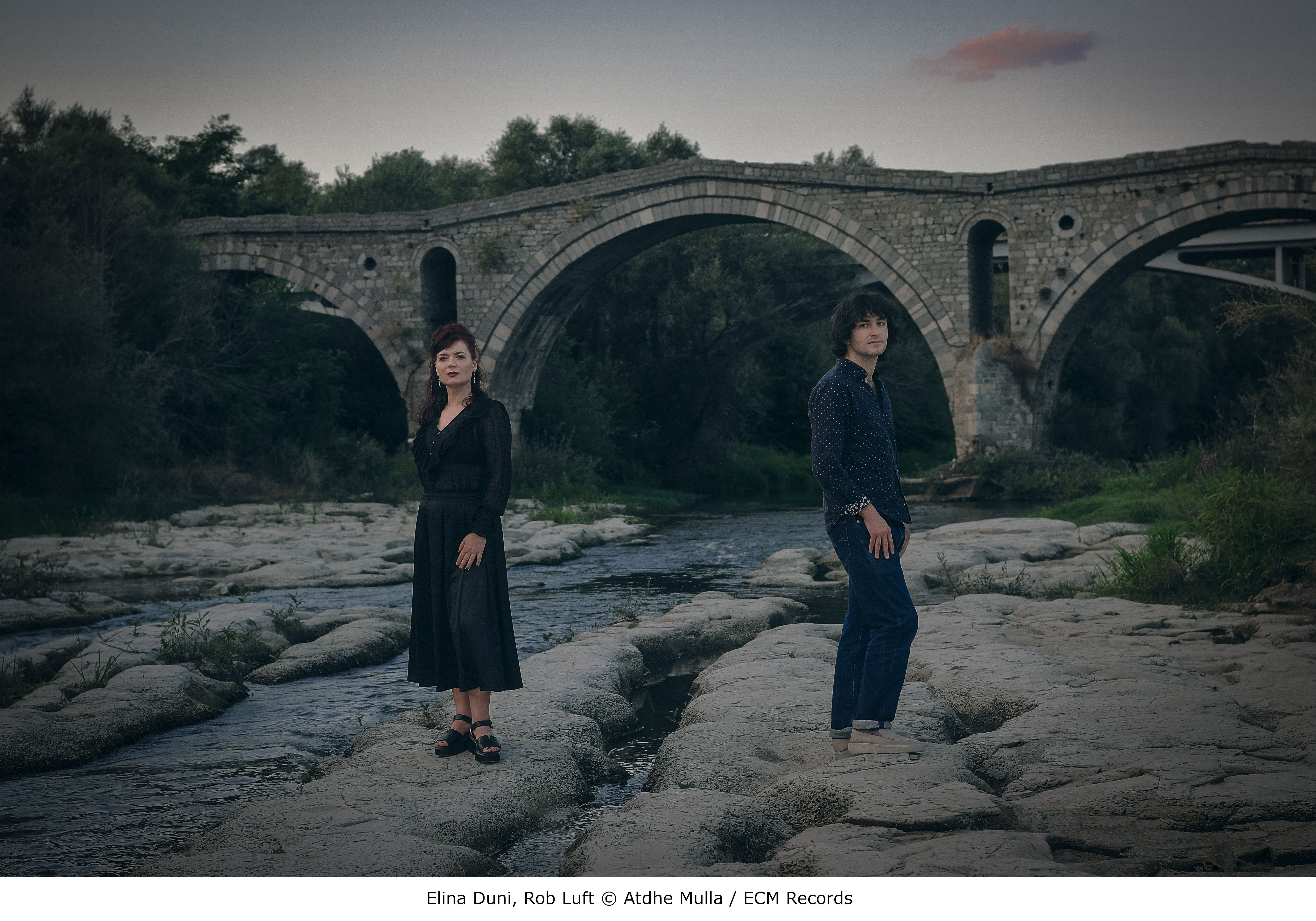 Elina Duni and Rob Luft Interview Image by Atdhe Mulla / ECM Records
"The vast majority of my inspiration comes from hearing beautiful music created by other artists."
Video