Name: Reinier Zonneveld
Nationality: Dutch
Occupation: DJ, producer, performer, label founder at Filth on Acid.
Current Release: Reinier Zonneveld teams up with Alok and K1LO for their collaborative single “Just Wanna Dance,” out via Filth on Acid.
Recommendations for the city of Amsterdam, the Netherlands: Definitely go to one of the many electronic festivals in and around Amsterdam - if you’re in to modern techno try for sure Free Your Mind, Awakenings and Verknipt!
If you enjoyed these thoughts by Reinier Zonneveld and would like to know more about his music, upcoming live dates and new releases, visit him on Instagram, Soundcloud, and Facebook.
Over the course of his career, Reinier has collaborated with or remixed a wide range of artists, including Tiga, Hannah Laing, Carl Cox, and Stephan Bodzin.
[Read our Tiga interview]
[Read our Hannah Laing interview]
[Read our Carl Cox interview]
[Read our Stephan Bodzin interview]
What were some of the musical experiences which planted a seed for your interest in electronic music?
My dad had a big vinyl collection, which included a lot of early electronic music.
One of the records that caught my interest early was “Radio Aktivität” by Kraftwerk. The sounds, the feel and the particular atmosphere in this track still stand out even today in my opinion.
Later on, one of the first albums I bought myself was Moby – Play. Still listen to it today from time to time!
Most genres of music make use of electronic production means. What does the term “electronic music” mean today, would you say?
It is true that basically all music today involves some kind of electronically generated sounds. Obviously recorded music has been electronic since the start, as you need to record audio and get it down on a medium to replay it.
I would define “electronic music” as a style of music that relies heavily on electronic synthesized sounds as the main elements of the music.
I grew up mainly listening to electronic music but have of lately, along with others I've spoken to, been somewhat disappointed by most new releases. I'd be curious about your own view on this, the “creative health” of the scene and potential reasons for the disappointment.
There is still a lot of amazing music being made in my opinion.
The problem to me is, it seems, that because of technological advances in the last 20 years the costs of making music, as well as the costs of releasing music are lower than ever. This results in a lot of generic / low quality music oversaturating the market.
Techno - the genre I operate in as a performer and producer - has seen actually a complete revolution in the last few years with very personal and different approaches. But it gets harder and harder to weed through all the copycat and generic music.
What kind of musical/sonic materials, and ideas are particularly stimulating for your work right now?
In January of each year I take a full month off from touring to immerse myself in the studio every day. To be in my own closed of environment and finally have the time to experiment with my synths and effects instead of working from a plane on headphones is always a big creativity boost.
Next to that I’m diving into a lot of collabs with artists I like but are not per se close to my sound. This generates a lot if unexpected twists and is very inspirational to me.
Where do most of your inspirations to create come from – rather from internal impulses or external ones? Which current social / political / ecological or other developments make you feel like you need to respond as an artist?
Ever since I was a kid, I always naturally wanted (and did) compose music. Whether this was on the piano or on a drum computer. Today this is still the case.
I feel that inspiration comes from everything I experience in my life. If we’re talking just techno, the inspiration comes from my live performances mostly. I can adjust, improvise and create music on the spot with my setup.
When I’m in the zone I tend to create things I would never come up with in the studio. These moments of improvisation I take back with me in the studio and use them to create full tracks out of them.
Music has become a lot more global, and incorporating elements from other parts of the world or the musical spectrum is commonplace. Do you still think there are city scenes with a distinct, unique sound? How does your local scene influence your work?
I play my shows all around the world, and when performing in remote places I always love to feel the atmosphere and energy. From my experience, different grooves and vibes work differently from city to city. It might be more global for sure, but local influences are for sure still there.
For example, in Brazil I tend to make my beats way heavier on the percussion side, in China I have a feeling the clap is the most important part in the groove and not the kick, in Germany and Holland they like it faster and straight, in the UK breakbeat elements tend to get people moving more and so on and so on. It’s really fun to try and adjust my style of techno a bit to the setting and the people.
The Netherlands, where I’m from, is a really small country geographically speaking. Still I find that in Amsterdam there is a slightly different scene than in Rotterdam.
Today, electronic music has an interesting relationship between honouring its roots and exploring the unknown. What does the balance between these two poles look like in your music?
90s oldskool rave, hardcore and gabber are all things I've loved for a long time. It is great to see these influences getting back more and more in a modern jacket in techno.
Since the start of my label Filth on Acid in 2016 we did a lot of remakes from classics to honour them and make them suitable for a new generation on the dancefloor (Bart Skils take on "Universal Nation", my remix of Edward Artemiev’s “Resurrection”, new takes on Dutch hardcore by Angerfist and DJ Promo).
When I’m in the studio I just makes what comes to me in that moment. Sometimes I build ideas around something futuristic that I can’t place in a timeframe, sometimes I start with a classic Juno sound.
In my live shows I actually use 3 pieces of old gear: Roland TB-303, Roland SH-101, Roland TR-909.
The sound of these classics is still unsurpassed in dance music.
How much potential for something “new” is there still in electronic music? What could this “new” look like?
This is what we have to shape as the new generation of artists. Electronic music used to be a novelty, now it’s a maturing genre. Like with every type of music there is a lifespan and cycle to this.
I expect AI will open up doors to sounds and atmospheres never heard before and revolutionize electronic music in a way the introduction of the mass produced synthesizers did.
What were some of the recent tools you bought, used, or saw/read about which changed your perspective about production, performing, and making music?
A friend of me works in finance with AI since 2019. He showed me a bit about how machine learning worked during a random evening when we had some beers.
We started to play with the idea of building an AI based on my own music. I’ve been keeping my recordings since I was young and have a huge collection of original music (over 80 days). Although a lot of it is not good or finished, we found that we could train an AI on it nevertheless. Last year in 2024 we finished a complete model that is based on all the music I ever did. It can generate music using prompts, create something random and continue music where it stops.
We used the last iteration of the system to create an AI that can play back to back with me. During summer in August I showcased it at my own festival “R²“ in Amsterdam. We had a computer with a lot of processing power behind the stage in a container, and my friend there to make sure the system didn’t crash during the show. While playing live, I could press a button and the AI would generate music on a channel on the mixer, listening still to what I was doing.
So I could play together with the AI, without knowing what it would create, but somehow it still sounds like something I could have done myself. It was a very special experience and actually very inspiring to do this - a bit in the same was as it is to play b2b with a human and not knowing what he will play next.
Do you think that there is a limit to what can be done in sound design – and what defines these limits?
The limit in sound design has not been reached as of yet. AI will open a whole new world of possibilities in sound design. Next to that, we have increasing processing power of computers that drive the capabilities of plugins.
Furthermore, and maybe most importantly, the demand for consumer and prosumer audio plugins and hardware has been increasing for decades now, creating a bigger market with more incentives for companies to invest in new technology to give them a competitive advantage over their peers.
Generally speaking - sound design is limited by the capabilities of the medium used for playback. At the moment we all still use traditional speakers in one way or another. There might be a huge revolution in sound design when this medium shifts to for example neural transmission of audio impulses.
In as far as it is applicable to your work, how would you describe the interaction between your music and DJing/DJ culture and clubs?
In general I like and do produce a lot of different genres, film music, hip-hop, pop, but my main focus as a performer and producer is techno made for the dance floors.
“Reinier Zonneveld” stands for highly energetic and impactful dance music - for me it is very important to make people move.
How, would you say are your live performances and your recording projects connected at the moment? How do they mutually influence and feed off each other?
When I improvise during my live shows, I take parts from it back to the studio.
During my shows, when I use studio recordings, when I adjust them on the fly to make them work better, I save what I did and take it to the studio to finish the track accordingly. It’s one of the main reasons I play live, it’s so exciting to have interaction and feedback on music you made in real time.
Even if AI will not entirely replace human composition, it looks set to have a significant impact on it. What does the terms composing/producing mean in the era of AI, do you feel?
A general mistake regarding AI in my opinion is the focus of companies to show off the quality of their AI-model by showing which job you can replace with it. I think this is to invoke a bigger social impact and subsequent emotional reaction of people to go “viral” and get more people to know about their product.
I think the focus should (and will) shift towards promoting how AI can empower people to do more, to create more, to get better at what they do instead of focusing on how to replace them.

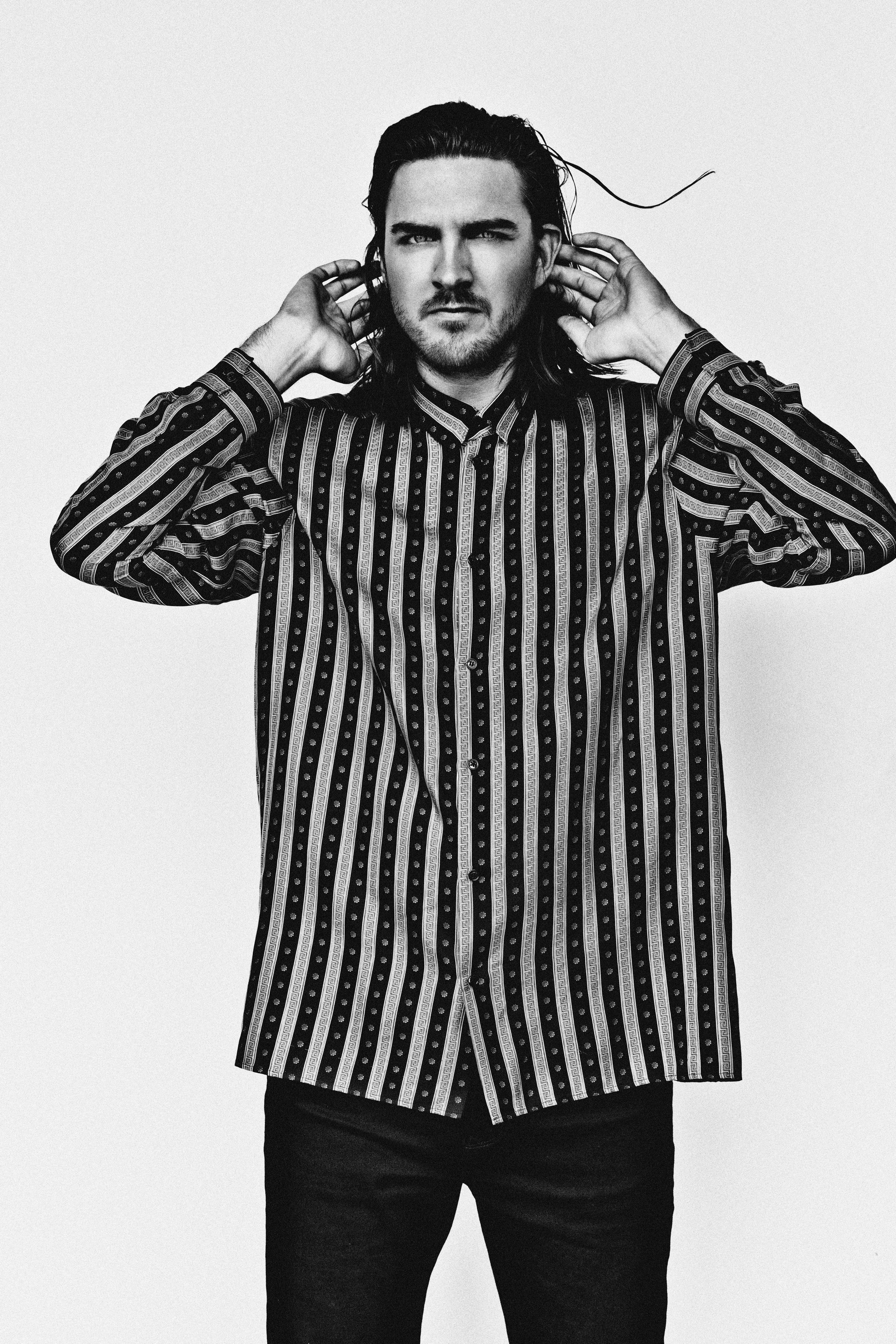 Reinier Zonneveld Interview Image by Cooper Seykens
“Electronic music used to be a novelty, now it’s a maturing genre. As the current generation of artists, we have to shape something new.“
Video