Name: Pieter "Perquisite" Perquin
Nationality: Dutch
Occupation: Producer, songwriter, composer
Current release: The new Pete Philly & Perquisite album EON is out via Unexpected. Catch Pete Philly & Perquisite live in London on 30th May at Camden Assembly. Tickets here.
Recommendations: The book Guns, Germs and Steel by Jared Diamond: this fascinating book gave me a lot of inside in how the world works and how the simple fact of geography shaped the current state of affairs.
Midnight Marauders (1993) by A Tribe Called Quest; I could say this album made me fall in love with Hip Hop.
If you enjoyed this interview with Perq of Pete Philly & Perquisite and would like to stay up to date with the band and their music, visit their official homepage. Pete is also on Instagram, and Facebook.
For a deeper dive, read our Pete Philly interview.
Do you think that some of your earliest musical experiences planted a seed for your interest in production and technology?
When I was in primary school, about 9 years old, I remember that once we had music lessons about ‘Danse Macabre’, a famous piece by the French composer Saint-Saëns.
The piece told an entire story of the rooster crowing three times at midnight, death raising from his grave, playing the violin and waking up the other dead people in the graveyard and dancing with them. The whole story and the way you could hear everything being told in the music fascinated me.
When it was my birthday I got my first CD from my parents and it was a CD with the highlights of the music of Saint-Saëns, among which was ‘Danse Macabre’ and ‘Le Carnaval des Animaux’.
I played that CD many many times and I definitely think it inspired me to make my own music later on; maybe it also explains why I like to compose film music so much.
What were your very first active steps with music technology and how would you rate the gains made through experience?
I wouldn’t say I’m in ‘music technology’ as I’m a composer / producer first and a mix engineer second. But when I was fourteen years old I started to make my own Hip Hop beats on my Mom’s computer.
I basically sampled my parents' CD collection, took small samples of the intros and outros of songs and with that started to create my own beats. This resulted in me ‘releasing’ my first instrumental Hip Hop CD two years later, when I burned 50 CDs at a friends’ house and sold them at school for 10,- guilders a piece. This was 1998 :)
Two and a half years later, in March of 2001, I established my own record company Unexpected Records, which I’m still running today.
Were/are you interested in the history of production and recording? If so, which events, albums, artists, or insights stand out for you?
I’m very much interested in history but not specifically in production/recording history.
Of course it interests me but I tend to rather use technology for what I want to achieve musically then the other way around.
Making music, in the beginning, is often playful and about discovery. How do you retain a sense of playfulness and how do you still draw surprises from tools, approaches, and musical forms you may be very familiar with?
With almost every project or song I work on, I start somewhere else. Sometimes I start with a drum beat, the next time I start with a bassline, and another time I start with the chords first. Because I start somewhere else I also tend to end up somewhere else. The way I work with different people also differs a lot.
With Pete for instance we always start with the beat/groove. Because I made my beats back in 2005-2009 in a program called Fasttracker/Renoise, for our new album Eon, I decided to work in that program again.
To create beats for our new album I went a couple of days to a remote house in the Dutch countryside. I created the beats for what became our songs ‘Eon’, ‘My Stereo’ and ‘Wake Up’ all over there.
For your own creativity, what is the balance and relative importance between what you learned from teachers, tutorials and other producers on the one hand – and what you discovered, understood, and achieved yourself? What are examples for both of these?
For me it’s a combination. I learned how to make my first beats from a friend in school for instance. But once I got a grip on it, I became much more serious than him :)
I’ve been playing cello since I was 7 years old and would never have learned that without my cello teacher. On the piano I took lessons for about a year and from there on further developed it myself; the same with bass guitar.
In the end my goal was never to become a virtuoso cellist, pianist or bassist; I rather use these instruments in my compositions and productions.
How and for what reasons has your music set-up evolved over the years and what are currently some of the most important pieces of gear and software for you?
When I started, I worked with Fasttracker to create my beats and CoolEdit Pro to record vocals and instruments etc. I actually made the first two Pete Philly & Perquisite albums with that setup :)
In 2010 I made the switch to Apple. Since then I have been working in Logic Pro mainly, sometimes in combination with Renoise (which is a succesor of Fasttracker). For the new Pete & Perq album I used this setup in which I slaved Renoise to Logic; so I made the beats in Renoise and recorded and mixed the vocals and instruments in Logic.
In my recording chain I use the Rooster 2 by Thermionic Culture as pre-amp/eq and the Avalon 737 as compressor. My favorite vocal mics are my Brauner Valvet and my Neumann UA87Ai; these are also the two mics I used to record Pete for our new album Eon.
For recording instruments I also like my set of Sennheiser mics a lot.
Have there been technologies which have profoundly influenced, changed or questioned the way you make music?
Sampling. Without sampling I guess I would never even have started to make music. The way I define sampling is making new music out of existing music and sounds. It always brings you to new exciting places in my opinion, especially when you combine different samples from totally different eras and genres.
And I think in a broader sense it’s something that’s present in a lot of other artforms as well. For instance, Michelangelo would never have been able to make his great sculptures without the Romans and Greeks coming before him and without studying / sampling what they did.
Late producer SOPHIE said: “You have the possibility with electronic music to generate any texture, and any sound. So why would any musician want to limit themselves?” What's your take on that and the relevance of limitations in your set-up and process?
I agree and disagree. Because sometimes limiting yourself actually gives a great result. When you limit yourself for a certain project it also makes you creative in your search for solutions.
For instance, when I composed the music for the film Niemand In De Stad, I decided not to work with any session musicians for the entire score this time and to play everything myself. Because of that decision the score became really personal and distinctive in the end.
For instance, because I don’t really play the guitar myself, I still used guitar in the score but in a rather strange way; using it more as an ambient instrument.
From the earliest sketches to the finished piece, what does your current production workflow/process look like?
It depends for each project. For my new album with Pete we always started with the beat – only ‘Mayhem’ is an exception to that.
Usually Pete picked one of my beats that inspired him at that moment, he started to write his lyrics and in the meantime I would take a variation in the beat; something that could become the chorus or the verse and making a first draft of the arrangement.
Then we would let these come together and from there on would further build it into a song.
Rhythm, sound design, melody/harmony, something else – when do the different elements of a piece come into play for you?
All at the same time; in my opinion it feels unnatural to separate these different elements too much from each other. The moment I put down my first bass drum I’m already working on the sound of that particular bass drum and I am also already thinking about the bass patern or harmony that I could later add on top.
For me it’s all a back and forth process; kneading everything as long as is needed until it falls into place.
In relation to sound, one often reads words like “material”, “sculpting”, and “design”. How does your own way of working with sound look like? Do you find using presets lazy?
I don’t think presets are lazy but still I don’t use them that much. I like it better to give each song its own custom made sound. Even though I still have a few ‘go to’ plugins of course when I produce/mix.
What, to you, are the respective benefits of solo work and collaborations and do you often feel lonely in the studio? Can machines act as collaborators to you?
I never feel lonely in the studio to be honest. I enjoy working alone as much as I like working with others.
In the end it’s always the music that keeps you company so you’re never really alone :)
To some, the advent of AI and 'intelligent' composing tools offers potential for machines to contribute to the creative process. What are your hopes, fears, expectations and possible concrete plans in this regard?
I think AI is a blessing and a curse at the same time; like basically all new technologies. On the one hand I think it could really help in the creative process; on the other hand I think some jobs will become obsolete because of it; just like the dawn of cars made farriers obsolete.
It’s how the development of mankind works I guess; as new technology develops jobs come and go.

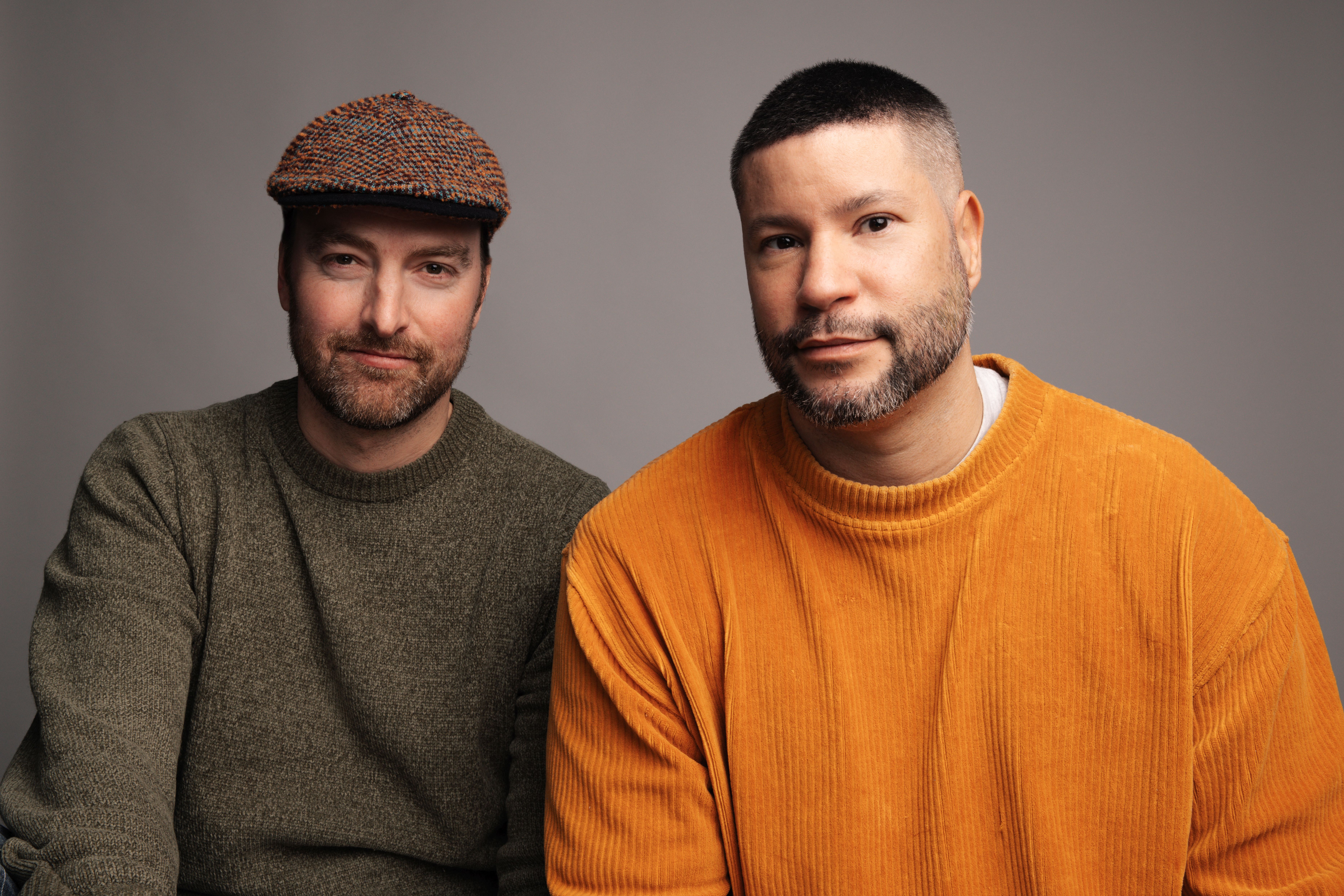 Pete Philly & Perquisite Interview Image by Roeltje van de Sande Bakhuyzen (Perq pictured left)
"Because I start somewhere else with almost every project, I also tend to end up somewhere else."
Video