Name: Ok Cowgirl
Members: Leah Lavigne (vocals, guitar, keys), Jacob Sabinsky (guitar), John Miller (guitar, keys), Alex Farrar (guitar), Ryan Work (guitar, bass), Matthew Birkenholz (drums)
Interviewee: Leah Lavigne
Nationality: American
Current release: Ok Cowgirl's new album Rhinestone Cowgirl is out via Easy Does it.
If you enjoyed this Ok Cowgirl interview and would like to stay up to date with the band and their music, visit their official homepage. They are also on Instagram, Facebook, and bandcamp.
Where does the impulse to create something come from for you? What role do often-quoted sources of inspiration like dreams, other forms of art, personal relationships, politics etc play?
The impulse to create something, for me, is often excess energy. It feels like a surge of pressure in my chest, that if I don’t heed spreads to my head and barrels me towards feelings of agitation and distance from myself.
Creating is a very important part of my maintaining balance and feeling grounded in life. It’s a process for regulating– emotions, thoughts, sure, but beyond that, energy.
I find inspiration in dreams, conversations, books, podcasts, and other music sometimes very directly. But, also, life is always washing over us like the tide on the beach leaving behind little treasures, and I try to make time to go for walks in my mind and collect those.
For you to get started, do there need to be concrete ideas – or what some have called a 'visualisation' of the finished work? What does the balance between planning and chance look like for you?
I rarely ever know where I am going when I begin a song.
When I was first writing music as a teenager I would give myself a prompt such as “let me write a song about being heart-broken” and then dutifully complete the exercise. But these days the joy in creating, for me, comes from not knowing where I am going. It comes from taking one step at a time– one lyric, one melody, one section, one revision at a time without thinking too much about the larger picture.
Only to later step back and begin to ask myself, “now, where am I, where did all of those small decisions take me, and what has been created in its wake”.
Is there a preparation phase for your process? Do you require your tools to be laid out in a particular way, for example, do you need to do 'research' or create 'early versions'?
I feel very lucky to practice an art in which I require very little tools.
I most often write music on my acoustic guitar or sitting at the piano. It can be fun and inspiring to introduce new musical tools to the creative process such as a guitar pedal that allows me to modify my guitar’s sound or a synth rather than the piano so I can play around with different textures. This is a strategy I turn to when I am feeling stuck or a bit uninspired.
But as a very lyric and melody driven writer I often do my best writing when I have no tools at hand, for instance when I’m driving or in the shower. And then I’m pulling over on the side of the road to scribble things down. Or reaching one hand out of the shower for my phone and singing into my Voice Memos app while I’m covered in suds.
I’m always writing and rewriting and ideating; it is woven into my life in a most inextricable way.
For Rhinestone Cowgirl, what did you start with? If there were conceptual considerations, what were they?
When I wrote the songs featured on Rhinestone Cowgirl I was not thinking much about them as a collection. Each song is a world in itself to me. Birthed and raised in a way specific to its needs. It makes me think of my mother’s child rearing philosophies and how she has justified using tough love on me and being more gentle towards my brother. Of course, that’s a conversation for another day.
But all to say some songs come about in 30 minutes and you feel that if you picked up a pen and attempted to tinker with some hope of “making it better,” it would just completely fall apart and end up being not better, but just different, and most likely a confusing mess.
Some songs know what they are from the beginning and enter into existence rather seamlessly. And even if you don’t understand what the song is about, or believe parts of it to be simple or plain, or some other unnecessary judgment, some songs’ potency and identity lie in the fact that they seemingly fell from the sky fully formed. This is how I think of our song “Coffee and Conversations”.
Meanwhile, our song “Prepared To Lose” required much wrestling and wrangling to get to where it is.
This is a song that I wrote and then became fascinated with the message and themes I was trying to convey. I felt I could do a better job, and I ended up rewriting the song probably 7 or 8 times. Cutting whole sections, making the chorus the bridge, extending it into a two-part epic, deleting one of those halves. I wrote and rewrote this song in quite dramatic ways because I just felt there was a better way for it to say what it was trying to say.
When it was time to go into the studio I began combing through my notebooks and my voice memo recordings to sort of audit what I had written in the past year or so and decide what I wanted to share.
It wasn’t until this stage that I started to connect the dots and see common themes, and understand how my life experiences and the state of the world over the past year had shaped my songwriting. Almost like bingeing a season of television– I could see the conflict and the resolution, the character development, the strong feelings that ended up fading with time or new information, the emerging perspectives, lessons learned, and feelings digested. I can’t even begin to explain how I decided which songs belonged on the record.
“Suspended Disbelief” - a song about being there as my boyfriend’s mother was in hospice and grappling with the fragility of life and our sheer lack of power in these situations.
“Cruise The Town” - a song about how exhausting it is to white knuckle your life, and trying to find balance and ease.
“Coffee and Conversations” - a song about bliss and the little domestic routines that bring pleasure and comfort.
“Rock N Roll Ruined My Life” - a song about questioning the path you’ve chosen and dissecting your disappointment to understand whose expectations you have fallen short of and how much weight you want to give that. “Prepared To Lose” - a song about how life is just fundamentally not fair, how feeling down on your luck can be isolating, and about finding the resilience to carry on despite all that.
“God Made A Farmer”- a song about how we’re living in an unjust overcomplicated society, where division is seeded amongst working people, while we share many of the same common struggles and dreams.
“Fun Girl” - a song about mental load, being misunderstood, and wanting to be appreciated not just on your good days but in your entirety as a complex human being.
I’m tempted to keep going because there are only a few songs I didn’t touch on, but I’d like to keep some mystery alive.
Overall, the record is about pretty big things– how and why do we choose our paths in life, and how do we cope with the inevitable tragedy, injustice, and lack of control along the way?
What makes lyrics good in your opinion? What are your own ambitions and challenges in this regard?
What makes lyrics good is if there is truth in them. They can be straight forward or poetic, long-winded or concise.
For me, it’s a gut thing. There is no checklist to let you know whether a lyric is good. It’s just a feeling, and of course, it’s largely subjective.
What are areas/themes/topics that you keep returning to in your lyrics?
One thing I return to in my lyrics is self-doubt. Outwardly I am a pretty confident person. But like all people I question myself.
“Rock n Roll Ruined My Life” is about questioning my decisions and trying to find confidence and resolve. “Wished I Could Be” is about questioning my worthiness in a new romantic relationship. I wrote these songs for myself. They were extremely cathartic to write. They helped me work out my thoughts and make space for feelings I was ashamed of.
Music is a safe space for me. Sometimes I feel that the songs that are most raw and vulnerable are ironically the easiest to share because you can’t argue with a feeling.
Many writers have claimed that as soon as they enter into the process, certain aspects of the narrative are out of their hands. Do you like to keep strict control or is there a sense of following things where they lead you?
Writing is a balance of leading and following. It is not something that can be controlled, but it is something that must still be guided.
Writing is play. It’s letting your constructions and your discoveries inform each other. But, ultimately, it is just a series of creative decisions and, thus, you are in control … just not in an all-knowing or powerful way. It’s as if your song is a sailboat and you are a sailor. You are doing what you can to keep your boat afloat and moving in the direction you please amidst a giant ocean of ideas, feelings, and energy.
It would be foolish to think that you are in control, and yet if you do not step up and take control of what can be controlled, the boat will sink or you’ll be lost at sea.
There are many descriptions of the creative state. How would you describe it for you personally? Is there an element of spirituality to what you do?
The creative state to me is like being on vacation. It’s like staring out at the ocean. It’s like staring into a fire. It’s calm, yet exhilarating. It makes me feel free. It makes me feel cozy.
It’s like having a middle school sleepover with your best friend and feeling like the world doesn’t exist outside of your basement. You’re just lost in the movies, and the makeovers, and the candy, and the joy of feeling close to someone.
Except here you are as an adult, and the “basement” is a creative project you are mentally occupying and the “best friend” that you’re excited to feel close to is actually yourself.
Once a piece is finished, how important is it for you to let it lie and evaluate it later on? How much improvement and refinement do you personally allow until you're satisfied with a piece?
Every piece is different. Knowing when to stop is important, but knowing when to keep going is equally important. I generally know when I’m forcing something and nothing fruitful will come of it, and this is a feeling I can identify just from years of taking different approaches and observing the results.
There is a healthy level of frustration and an unhealthy one, and it’s very hard to put into words how to distinguish between the two. But writing music should only ever frustrate you the way a puzzle does when you’ve been looking at it for the past 20 minutes. If the frustration is more serious or existential than that, then it’s time to step away.
I am very diligent about recording the revisions I make to my songs, that way nothing feels too high stakes or permanent. I can always revert or undo or redo. One of the best parts of having a longstanding songwriting practice, to me, is that I get to co-write with past versions of myself. Some of my best work has come about that way.
You cannot always capture a meaningful bite of life from one vantage point. Sometimes stepping away and coming back on a different day, season, or year with different energies and ideas brimming inside of you is what it takes to flesh something out in a way that feels both honest and like it honors the complexity of life and humanness.
How do you think the meaning, or effect of an individual piece is enhanced, clarified or possibly contrasted by the EPs, or albums it is part of? Does each piece, for example, need to be consistent with the larger whole?
I don’t think there is a right or wrong way for individual pieces to relate to or contrast from each other or their larger whole. But, being thoughtful and intentional about these relationships is a powerful tool.
Everything is about context. So, it is useful to think about things relationally, since that is how they will be perceived consciously or not.
In terms of what they contribute to a song, what is the balance between the composition and the arrangement (including production, mixing and mastering)?
In my mind a composition is just the chord progression underlying the song. I believe there is infinite power in an arrangement. So many different versions of a song can be unlocked through different instrumentation and production.
This is something I enjoy exploring and I view it as a great opportunity for collaboration. I feel quite particular about the writing of the song itself. But when it comes to preparing for a live performance or recording a song, I enjoy hearing other people’s interpretations and ideas, and working collaboratively to build a sonic vessel to carry the song.
After finishing a piece or album and releasing something into the world, there can be a sense of emptiness. Can you relate to this – and how do you return to the state of creativity after experiencing it?
I don’t really relate to this because I make an effort to never stop writing. I have seasons when I am more prolific or focused on writing than others. But as I said earlier, writing is really integrated into my everyday life.
If anything, releasing a piece of music or an album feels freeing. It can take a lot of work to do all the little things involved in promoting a record release. And I am usually relieved to have those things off of my plate and to be able to dedicate more time back to the music itself.
I would love to know a little about the feedback you've received from listeners or critics about what they thought some of your songs are about or the impact it had on them – have there been “misunderstandings” or did you perhaps even gain new “insights?”
I love to hear about my songs resonating with others. Even though my songs come from a very personal place, I really try to view myself as separate from them. There are pieces of me and my true feelings and thoughts woven throughout my lyrics.
But I am not the protagonist or main character in these songs. The songs are less reflections of who I am and more just explorations and vignettes of humanity, in which I am often using myself and my lived experience as a jumping off point.
Creativity can reach many different corners of our lives. Do you personally feel as though writing a piece of music is inherently different from something like making a great cup of coffee? What do you express through music that you couldn't or wouldn't in more 'mundane' tasks?
Writing a piece of music feels different from other practices of creativity in my life. I think because lyric-driven songs are able to communicate so specifically, there is a level of complex storytelling you can achieve that is hard to replicate.
However, I greatly appreciate the experience of doing mundane things with care and presence. Things such as making a cup of coffee, plating my food for a meal, even assembling an outfit. There are so many opportunities to be in conversation with ourselves through the process of making. It is a beautiful thing that I think is a bit of a lost art in our hectic world.
But I am trying to nurture this way of being in my daily life. I think there is much fulfillment, pleasure, joy, and closeness to ourselves to be found in these little pockets of our day.
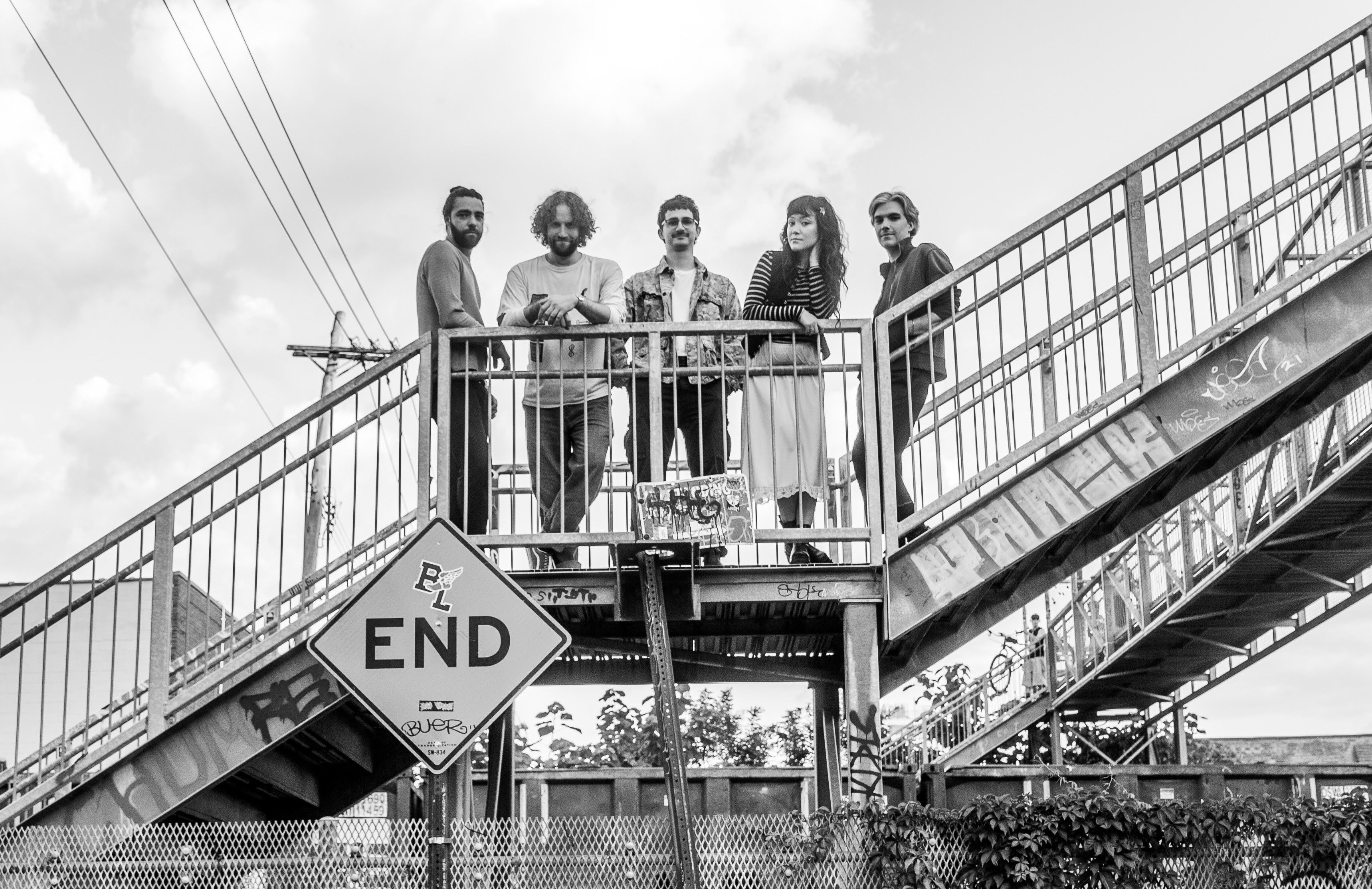 Ok Cowgirl Interview Image by Justin Buschardt
"I feel very lucky to practice an art in which I require very little tools."
Video