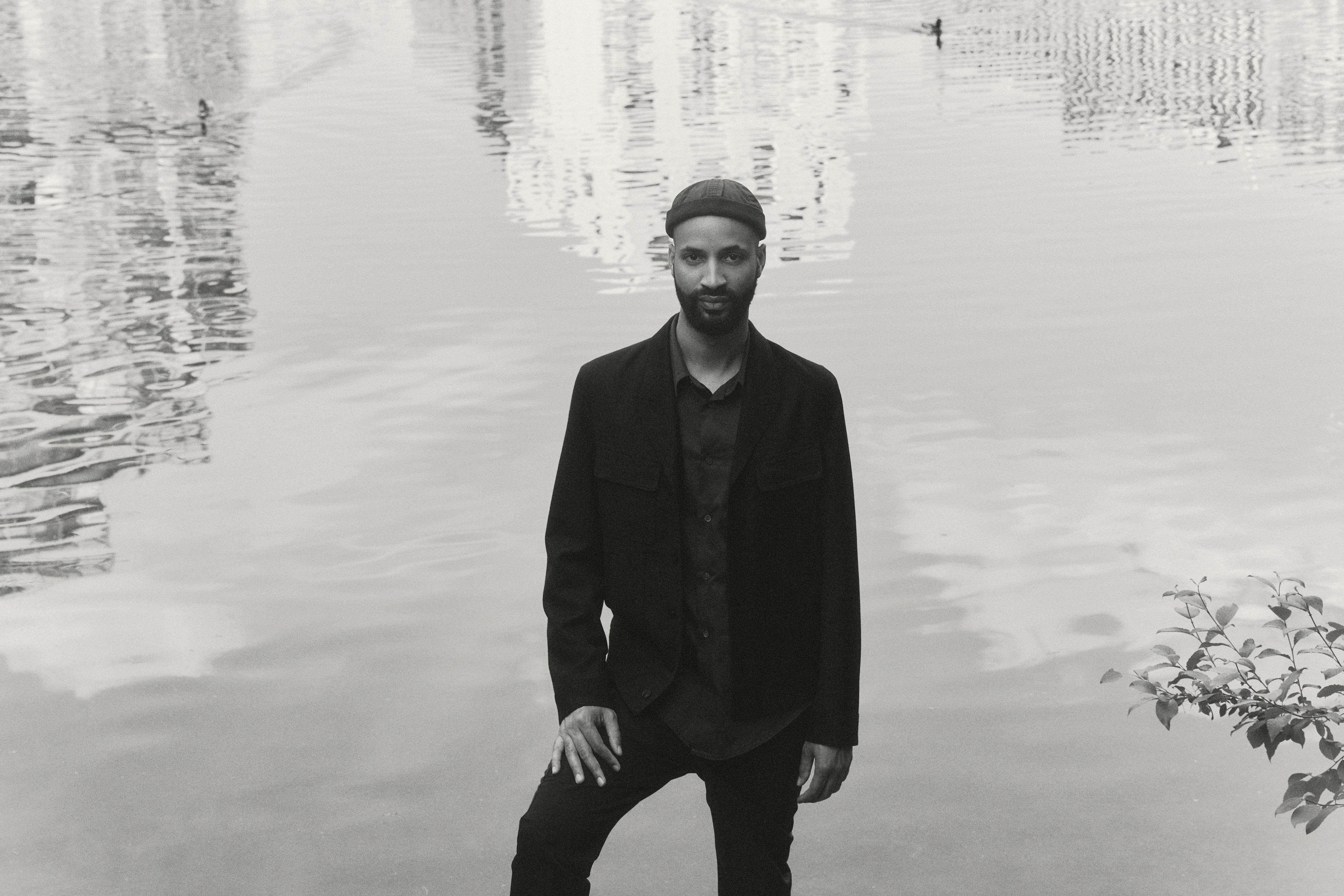


Name: Musina Ebobissé aka Blendreed
Occupation: Saxophonist, composer, producer, educator
Nationality: French
Recent release: Blendreed's Tales Of Tides is out March 28th 2025 via Tenorio Cotobade. His more jazz-oriented ensemble album Abstract Narratives is also still available.
If you enjoyed this Blendreed interview and would like to know more about Musina Ebobissé and his music, visit his official homepage. He is also on Instagram.
When I listen to music, I see shapes, objects and colours. What happens in your body when you're listening? Do you listen with your eyes open or closed?
That really depends on the context, the type of music I’m listening to, and the initial position of my body at that moment. Most of the time, I listen to music while walking or sitting, either in public transport or on a sofa.
I can feel a lot of movement in the music without necessarily expressing it physically. I move relatively little for a musician, and I think that has to do with the fact that I don’t listen to much dance music and I don’t play much of it either. However, this doesn’t make my attention or listening pleasure any less intense. And of course, the more engaging and rhythmic the music is, the more I will naturally move.
Most of the time, my eyes are open, but I also like to close them to better focus on the sound itself.
How do headphones vs. stereo systems affect your experience?
I think I’m far too influenced by listening to music through headphones.
or practical and logistical reasons, it’s my preferred way of listening. I love it—it’s really comfortable, the sound envelops our ears, and it creates a very intimate and precise listening experience. It’s also a more flexible way to listen and doesn’t require being positioned correctly in the room.
However, some of the strengths of headphone listening are also weaknesses: it’s so convenient that we end up doing multiple things at the same time, which reduces the quality of our listening experience.
Forcing yourself to be in the right position in front of speakers for a certain amount of time also reduces the temptation to multitask and improves listening quality. I mostly experience this in the studio—so, too rarely. Sometimes, you just need to take the time.
Tell me about some of the albums or artists that you love specifically for their sound, please.
Hard to pick, here’s a very short list
A fragile Geography - Rafael Anton Irissari
Lathe of Heaven - Mark Turner
Hotel Vast Horizon - Chris Whitley
I have the room above her - Paul Motian
Junk Magik - Craig Taborn
[Read our Rafael Anton Irissari interview]
[Read our Rafael Anton Irissari interview about the Magic of Sound]
Do you experience strong emotional responses to certain sounds?
I don’t know—it’s hard to say outside of a specific context. Nothing in particular comes to mind.
In a very general way, I would say that a sublime musical moment or a noise associated with danger provokes strong emotional reactions—but I think that’s true for everyone.
A sound tied to our past can also bring back powerful memories. But in that case, it’s less the sound itself and more its specific significance in relation to our personal history that triggers a strong emotional response.
Do you have examples of sounds you find pleasant or irritating?
I hate the sound of nails scraping or squeaking on a metal surface.
I could listen to the sound of a river, a waterfall, or the crackling of a fireplace for hours.
Are there everyday sounds that intrigue you?
Often, when we like the function of an object or what it’s associated with, we like its sound. I love the sound of my coffee maker, my dishwasher; I like the sound of my vacuum cleaner much less.
As for the washing machine, it’s more complicated—it depends on the washing cycle.
What are some of the most moving non-human sounds you've experienced?
The sound of the tropical rainforest at the base of Mount Cameroon.
The sound of the wind across the Siberian plains.
The sound of ocean waves in general—when you listen to them long enough.
Do music and sound feel material to you?
Yes, as a saxophonist, I have a very material, physical experience of sound. I blow air, I feel the reed vibrating in my jaw, I am constantly in contact with my instrument. The production of sound is physical, bodily. The instrument is an extension of my body.
The same goes for the effects pedals I use with my saxophone—I prefer pedals over plugins. I love the tactile sensation and the feeling of sculpting a sound.
How important is sound for our well-being and society?
This is a fascinating but vast and complex question. I’ve always lived in cities and in Europe, and that’s the perspective I’m speaking from, even though my travels have taken me elsewhere. Our Western world functions fast and, consequently, is noisy. Paradoxically, it creates its own problems and temporary solutions in a kind of vicious cycle.
The faster technological advancements accelerate, the noisier it becomes, and the more we create antidotes—noise-canceling walls, noise-canceling headphones, quiet spaces on trains, double-glazed windows, weekend getaways in remote areas, etc. The search for solutions often relies on material accumulation (new objects, new protections, etc.) rather than on reducing the primary causes of increasing noise (rural exodus, working hours, transport linked to trade, etc.).
As for music, its use has become commonplace—sometimes for the worse. The most uninspired music is present in all stores, accompanying mass consumption, and contributing to the over-saturation of our already overstimulated senses. The acoustic health of a society probably depends, in part, on the level of accessible silence available to its people. And, in fact, silence is often a privilege that must be paid for.
On the other hand, quieter social contexts are not necessarily more liberating for individuals—it’s more complex than that. Other sociological and anthropological factors need to be considered.
How do you perceive the importance of silence in your life?
I think we generally consume more and more things, and communication is becoming more intense and faster. Even though I naturally love silence and am very sensitive to it, I often have to force myself to do nothing, to not listen to anything, to give my ears a real break.
The temptation to listen to a podcast, a show, another album—not to mention social media—is obviously very strong. This is tied to a constant need for external stimulation, a kind of unconscious escape from boredom and true pauses. Just as genuine boredom has become rarer with the arrival of smartphones, silence has become increasingly scarce due to growing traffic, background noise, etc.
I try to take real moments of silence whenever possible.
How would the world change if we listened more and paid less attention to appearances?
I don’t know if hearing is more powerful and precise than vision—they are two different ways of perceiving our environment. It seems that human beings rely heavily on both senses together. Both are powerful and deceptive at the same time. In music, hearing can help free us from visual biases.
Ultimately, beyond the senses, it’s critical thinking that we need to develop. Even though I love speculation and abstract debates, I have no idea what a society like that would look like. But I’m sure science fiction has come up with some interesting ideas on the subject.