Name: Andrew Field-Pickering aka Max D, Matt Papich
Nationality: American
Occupation: Producers
Current release: Max D & Matt Papich team up for their duo project Lifted again for a new album. Trellis is out via Peak Oil.
Recommendations: Andrew: I recommend the children’s books written and illustrated by Donald Crews. Those have been blowing my family’s mind lately. Also the Meltdown album The Map.
Where does the impulse to create something come from for you? What role do often-quoted sources of inspiration like dreams, other forms of art, personal relationships, politics etc play?
Matt: A lot of times with Lifted the creation comes around improvisation and the group of people gathered in a studio. It’s kind of in real time, unexpected.
We also pull in any other kind of material that has the right quality to it, field recordings from life or snippets from movies.
For you to get started, do there need to be concrete ideas – or what some have called a 'visualisation' of the finished work? What does the balance between planning and chance look like for you?
Andrew: Its actually pretty rare that a tune comes from an initial place, as opposed to getting improvised into existence. It has happened before, sometimes songs that start on just one of our computers will be sort of a framework to play more of a song on top of.
For albums, we always visualize things after the audio is finished. We listen after it's done to see what the art should look like.
Is there a preparation phase for your process? Do you require your tools to be laid out in a particular way, for example, do you need to do 'research' or create 'early versions'?
Matt: Our process is really linear, things get worked on and worked on and we don’t necessarily look back, or track versions.
Preparing is more like bringing the right ingredients, whether that’s a drum kit or a synthesizer or a field recording from life.
For your latest release, what did you start with? If there were conceptual considerations, what were they?
This release was partly from a long session in 2022 in Baltimore, at Tempo House studios. We improvised with Dustin Wong, Jeremy Hyman, Benny Boeldt (Mezey) and Andrew and me. In some cases those recordings stayed pretty true to form, but mostly we took things through our typical process of editing, deleting, adding, sending files back and forth.
There’s always more material than could fit on an album, and so at some point it becomes about sensing the gravity of songs together …
[Read our Dustin Wong interview]
Tell me a bit about the way the new material developed and gradually took its final form, please.
Matt: Some of these songs, like “Specials” and “Warmer than Cooler” started as files I worked up in Ableton.
We’ll send sketches to start things out, and kind of to confirm it’s something we want to consider a Lifted track, instead of something else. We’ve become really good at working lightly separately, leaving room for undoing until Andrew and me are together at a mixing desk.
We almost always mix Lifted music in a traditional setting - multi-tracked on a board, with at least our two sets of hands on the faders. There’s an intensity to recording a mix, using just your ears that I think we both rely on.
What makes lyrics good in your opinion? What are your own ambitions and challenges in this regard?
Andrew: I love simple lyrics. On occasion I love complicated ones too, I guess. I always go back to simple, cool lyrics that just stick on you.
We use vocals in a very distant odd way most of the time.
Many writers have claimed that as soon as they enter into the process, certain aspects of the narrative are out of their hands. Do you like to keep strict control or is there a sense of following things where they lead you?
Andrew: In Lifted there is no strict control. I think a lot of Lifted songs do tend to make a path of their own in a way. We all have lives, pursuits, other things going on, and the amount of time between versions of tunes makes it so that our sense of editing sort of melts down.
“Wow, I forgot this sounded this way” happens enough that whole parts of the process involve leaving things as is, or letting sounds play out and drift apart.
There are many descriptions of the creative state. How would you describe it for you personally? Is there an element of spirituality to what you do?
Matt: I think for Lifted, it's always been mostly about chance, surprise, and being able to ask why we wouldn’t like something - staying sonically open minded.
Once a piece is finished, how important is it for you to let it lie and evaluate it later on? How much improvement and refinement do you personally allow until you're satisfied with a piece?
Andrew: In Lifted we allow a lot, but when a song, or whole album, starts to come together it comes together really kind of quickly and we start to shape things all of the sudden.
We work the versions of songs out in a ton of different angles then one day it all works, out of nowhere.
How do you think the meaning, sound or effect of an individual piece is enhanced, clarified or possibly contrasted by the EPs, or albums it is part of? Does the piece, for example, need to be consistent with the larger whole?
Matt: I think we’ve been thinking more and more about how we can build really diverse sonic worlds recently, and you hear it on Trellis, but also on 3. Songs like “Chefs” and “Whipped Cream” set a new style guide for us - inspired at least partly by a shared love for sound design in Robert Altman films.
We talked a bit about mimicking the kind of transitions you see in film, crossfades, cuts, flashbacks - and how we could use those tools in different or strange ways. In that way, we’ve been more and more careful about how songs sound next to each other, and consider that friction between moments as much as the ‘moments’ themselves.
In terms of what they contribute to a song, what is the balance between the composition and the arrangement (including production, mixing and mastering)?
Matt: In the case of Lifted composition and arrangement really happen simultaneously, it’s all one thing. Like, sometimes we build a song around a found sound, or build a song around a kind of skeleton of what a song was.
On album 2, the second track “Total Cure” was crafted to a degree, and we invited Martin Kasey to the studio to record saxophone.
He was in the booth recording, and Jeremy, Andrew and I were in the control room listening back. Martin’s first take was amazing, and we asked if he wanted to hear it back. Hearing the full mix in the headphones, he was confused - and was like ‘I didn’t hear any of these sounds’. We accidentally only sent the clapping sounds to his headphone monitor while he recorded, and so his saxophone was in response to only a fraction of the song.
It’s definitely Oblique Strategies style production, but it was fully chance in our case.
After finishing a piece or album and releasing something into the world, there can be a sense of emptiness. Can you relate to this – and how do you return to the state of creativity after experiencing it?
Andrew: I’m thankful because I experience music making and releasing as one sort of long state of creative life.
Shit is not always “on” but I don’t get much of the emptiness thing after projects get completed etc.
Creativity can reach many different corners of our lives. Do you personally feel as though writing a piece of music is inherently different from something like making a great cup of coffee? What do you express through music that you couldn't or wouldn't in more 'mundane' tasks?
Matt: The thing that brings me around to music again and again is that it can have such longevity. Music can really outlive the measure of what went into it, and there’s a sense of alchemy there - something from nothing.
I’ve spent a ton of time in kitchens, and most of my life in museums and it’s that shifting, mutating quality that music has - in relation to life, that is so important to me.
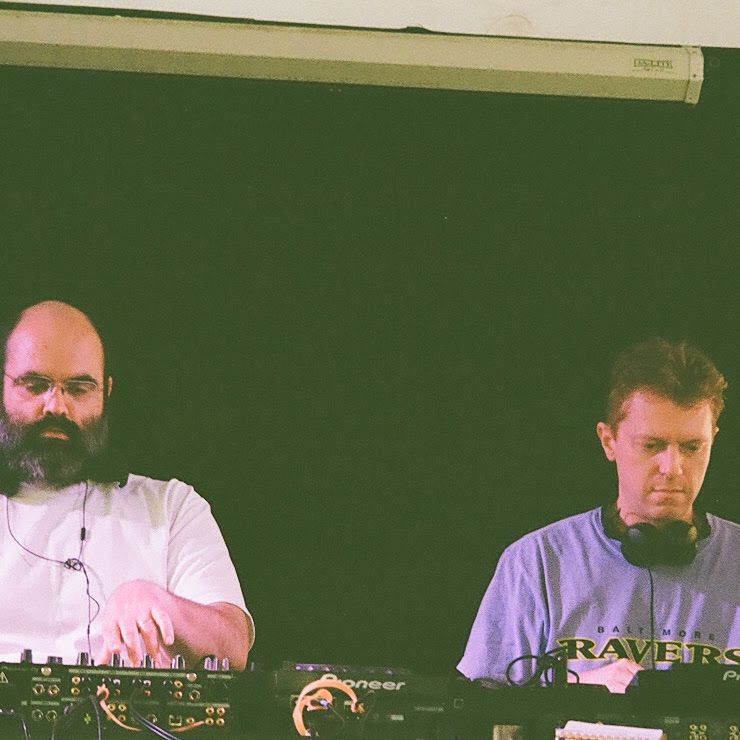 Lifted Interview Image (c) the artists
Matt: "It's always been mostly about chance, surprise, and being able to ask why we wouldn’t like something."
Video