Name: Mary Kouyoumdjian
Nationality: Armenian-American
Occupation: Composer, documentarian
Current release: Mary Kouyoumdjian teams up with the Kronos Quartet for Witness, an album focused entirely on her music. It will be released March 14th 2025 via Phenotypic.
If you enjoyed this Mary Kouyoumdjian interview and would like to know more about her music, visit her official homepage. She is also on Soundcloud.
The borders between producers, sound artists, and even songwriters are becoming increasingly blurry. What does being a composer mean today, would you say?
I absolutely love the idea that being a “composer” means being someone who organizes, or disorganizes, sound with intention –– whether you’re mixing and producing someone’s track, writing an opera, or recording the sounds of your environment as you take your dog for a walk.
As of today, what kind of materials, ideas, and technologies are particularly stimulating for you?
Field recordings are my go-to materials, varying from sounds of place to interviews with extraordinary humans who have gone through extraordinary circumstances. I’ve been exploring displaced communities in my work for the last 20+ years, and this has recently expanded from communities displaced as a consequence of war and genocide to communities displaced by climate change.
As far as technologies, I’m really having a great time with my new Sennheiser MKH 416-P48 shotgun microphone, which allows me to hear my environment in a completely different way –– rather than listening to all of the sounds around me, it allows me to listen to extremely localized sounds and focus on the microscopic.
Recording with the shotgun mic has invited me to focus and really appreciate one sound source at a time.
Music has become a lot more global, and incorporating elements from other parts of the world or the musical spectrum is commonplace. Do you still think there are city scenes with a distinct, unique sound? How does your local scene influence your work?
New York City is incredibly chaotic, noisy, insistent, and overwhelming, but in all of its grit and persistent sonic wall of a soundscape, it’s also incredibly human, community-oriented, and its people show their best in moments of crisis.
I’d like to think that my music walks between these displays of harshities and genuine kindness.
Composing has always had an interesting relationship between honouring its roots and exploring the unknown. What does the balance between these two poles look like in your music?
I find that as an Armenian who comes from a culture that was nearly erased, my work is constantly acknowledging the past (integrating folk music, telling stories from our history), but truly hoping to humbly contribute to a new artistic culture for my community. Creating new work, new artistic languages, and new processes is important for any community to move forward.
I am in a unique position as a member of the Armenian diaspora, in that I have the freedom to express. So my work aims to speak what has been historically unspeakable within my community.
How much potential for something “new” is there still in composition? What could this “new” look like?
The sky’s the limit!
Each composer’s music is inherently unique and new, as their work is a result of who each composer is, their perspectives, identities, environment, access, and beyond.
What role do electronic tools and instruments play for your creative process? What does your creative space / studio look like and what tools does it contain?
My studio space is super minimalist! I really just have my computer, an 88-key MIDI keyboard, a good audio interface and monitors, and my nerdy collection of virtual libraries and audio plugins that I use in Logic, which I’ve been writing in for the last 20 years.
I do have various instruments that I’ll sometimes dig out of the closet for sampling or exploring (everything from my flute, clarinet, accordion, duduks, to a super cheap and questionably-constructed cello I bought on eBay when I was 18), but most of my work is computer-based.
Most importantly, my studio has my two rescue pups / deadline-stress-relief animals: Hooper, a black lab mix named after horror film director Tobe Hooper, and Alfie, a smokey goldendoodle named after the Burt Bacharach song (and more specifically, named after Cher’s version of the Bacharach song).
It is my impression that adding a conceptual, non-musical dimension to one's work is almost a prerequisite for commissions and grants. How do you view this tendency and how “conceptual” is your own approach to writing?
On one hand, I understand that this tendency can often result in artists feeling like they need to force extra-musical ideas into their project proposals in order to receive outside support, when perhaps they are primarily interested in exploring sound for sound itself.
But on the other, I feel this tendency for “non-musical dimensions” is a result of our every increasingly complicated world, and that we look to artists––we need artists––to help us make sense of it.
I’m certainly no exception to being inspired by extra-musical ideas. I find my artistic purpose in sharing stories that are difficult and relevant to our time, and this purpose extends beyond sonic curiosity for me.
To some, the advent of AI and 'intelligent' composing tools offers potential for machines to contribute to the creative process. What are your hopes, fears, expectations and possible concrete plans in this regard?
The more the merrier! I love the idea of utilizing AI to help create projects, but also to help break old creative habits.
Utilizing AI can allow us to approach musical projects from a different angle, and hopefully that means finding new musical languages and processes to create projects that are beyond our immediate and familiar reach.
Are there approaches, artists, festivals, labels, spaces or anyone/-thing else out there who you feel deserve a shout out for taking composition into the future?
I am always most amazed by the artists who create projects that they want to make, rather than the projects they feel they should create. I feel that ultimately these artists are the ones that neglect the borders of genre and propel music forward.
Two artists I’ve been thinking a lot about lately are David T. Little and his project Black Lodge written for Timur and the Dime Museum with producer Beth Morrison Projects and also composer Nicole Lizée and her collection of Hitchcock-inspired works.
Little’s Black Lodge has this amazing ability to bend all the weight and expectations of “opera” towards “metal”, which ultimately reigns in this piece, not to mention its use of film as its primary presenting platform, greatly increasing accessibility for opera audiences.
Lizée’s music often includes found or made toys performed by instrumentalists, whether they be the Kronos Quartet or an orchestra, and she so imaginatively samples and rebuilds eerie and beautiful moments from our pop culture, like old Hitchock films.
Lizée’s music reminds me that composition can be whimsical, playful, and can embrace the bizarre in beautiful ways.
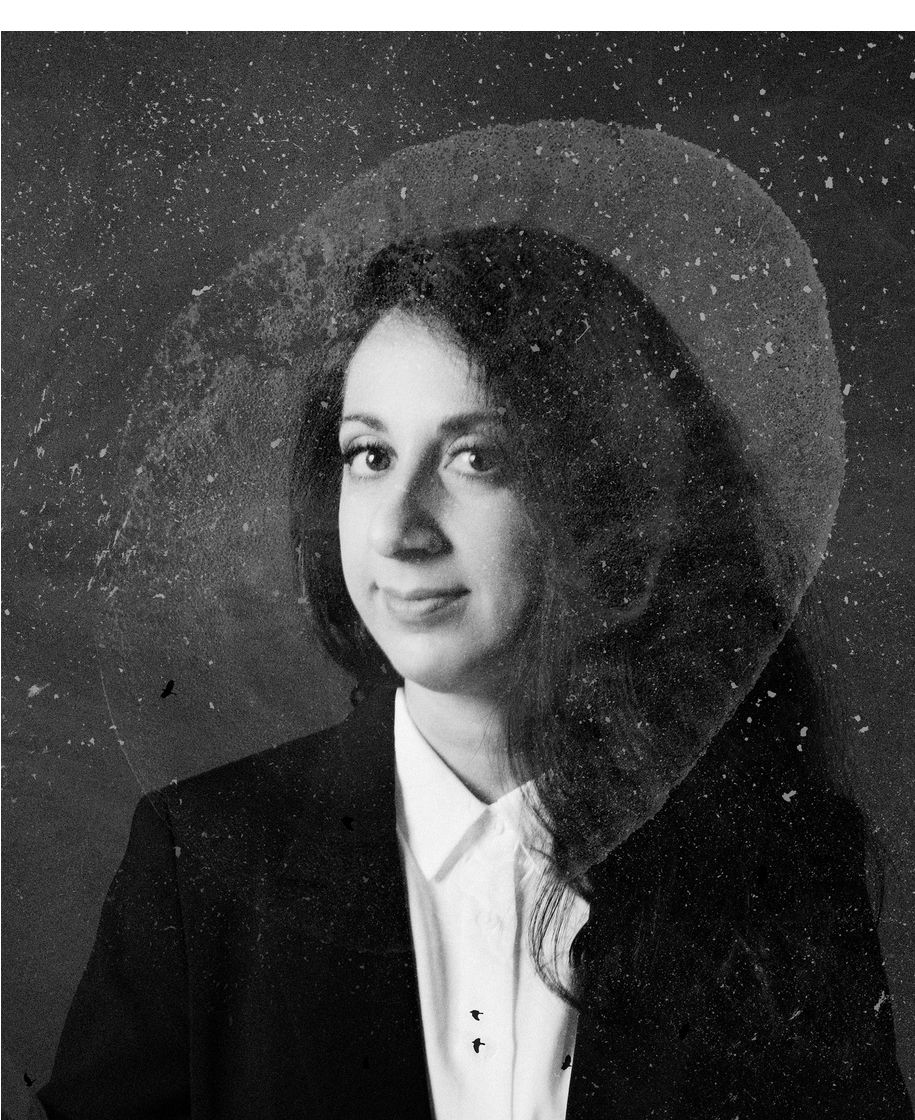 Mary Kouyoumdjian Interview Image by Osheen Harruthoonyan
“Being a composer means being someone who organizes, or disorganizes, sound with intention.“
Video