

Part 1
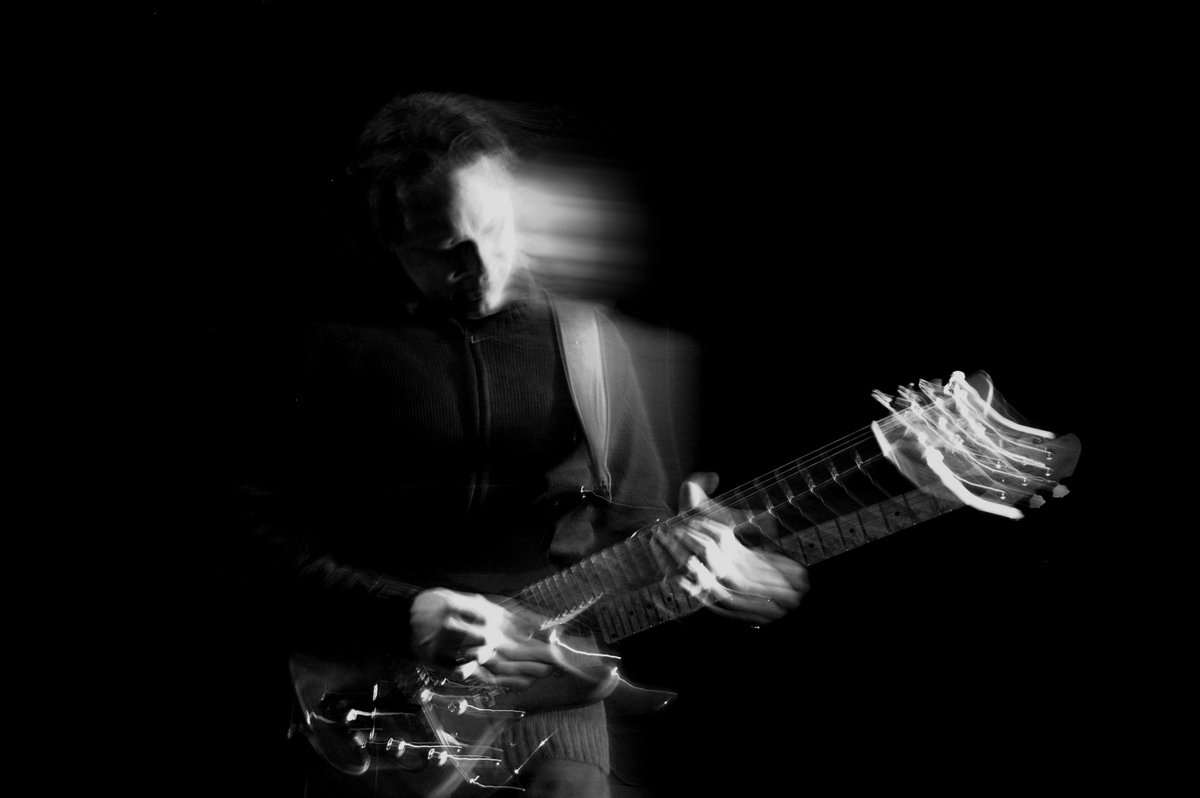
Name: Mark Wingfield
Nationality: British
Occupation: Guitarist composer, improviser
Current release: Mark Wingfield's new album The Gathering is out via Moonjune. The line-up for the release features Tony Levin, Gary Husband, Percy Jones and Asaf Sirkis.
If you enjoyed this Mark Wingfield interview and would like to know more about his work and music, visit his official homepage. He is also on Facebook, and bandcamp.
What were some of the musical experiences which planted a seed for your interest in jazz?
As a teenager I discovered Jimi Hendrix and was bowled over. It was his innovative creativity and out of the box thinking that really captivated me. His Woodstock rendition of the "Star Spangled Banner," I think still stands as one of the greatest pieces of electric guitar playing and sonic art ever performed. I heard that and I knew the guitar could do something completely amazing.
A while after that I got hold of Miles Davis' Bitches Brew and that was another revelation, particularly the title track and particularly what Miles is playing on that. The mood he creates with just a handful of notes is otherworldly and full of potent musical magic.
Those two influences have informed everything I've done in some ways. Hendrix's sonic innovations and gutsy expression and Miles' harmonic innovations and subtle tonal expression. From there I discovered Coltrane who was another revelation and this lead on to finding the whole ECM catalog which became a major influence.
What does the term jazz mean today, would you say?
To me jazz means improvised music based on a harmonic or melodic structure. Almost anything else you can say about it will be overturned by one or another great player.
What interests me in the history of jazz are the innovations, and emotional expression. Each great innovation in jazz has overturned what came before and each great innovation has been criticised by some as "not jazz" and yet each time history has proven that this was wrong. I think that will continue.
Jazz has also always been a fusion. B-bop was a fusion of jazz with show tunes and the pop music of the day. In the 1960s Miles fused jazz with latin and classical influences and then later with rock. In the 70s artists like Jan Garbarek and Keith Jarrett fused jazz with classical, folk, gospel, Indian music and much more.
Jazz has always been a fusion, for me that's integral to the core of what jazz is.
Jazz was about a lot more than just music in the 60s and 70s, from politics to fashion. For you personally, is jazz still a way of life – and if so, in which way?
For me it does represent a way of life. It represents rebelliousness, the commitment to risk taking, innovation, and the courage and generosity to share your feelings without reservation.
It also represents total commitment to your craft, and a lifestyle that allows time for the level of practice necessary, even if that means financial instability. A commitment to being true to your art, to playing the music you really feel, even it doesn't lead to commercial success.
And finally an affirmation of humanity, justice, connection and global community through the universal language of music and emotion.
Many people perceive jazz as a genre with high barriers of entrance, both for listeners and musicians. What have your own experiences been in this regard?
Jazz does require a lot of dedication for a musician to play well and yes that can be a barrier. But you could say the same thing about being a Shakespearean actor or any acting at a high level and the same is true of many other art forms.
What many of these different art forms and music have in common, is they are about the language of emotion. There is an almost infinite world of emotion and mood, from very subtle to extremely deep (and sometimes both at the same time).
But from a listener's point of view there isn't necessarily a high barrier. I think it really depends on various factors. Some people hear jazz for the first time and they just instantly get it. Some people will never really get it. Any many other people need some gradual exposure to it before the light bulb goes on.
Anyone who thinks jazz is "intellectual music" or "nervous music" isn't getting it. Most Jazz is all about different moods and emotions, that's the whole point (Certainly any jazz I'm interested in listening to or playing).
Derek Bailey defined improvising as the search for material which is endlessly transformable. As of 2024, what kind of materials are particularly stimulating for you?
When I improvise, I'm usually telling a story about the composition, the chords and melody of the song. The larger the musical vocabulary I have, the better I can tell the story. One key for me is to only learn ideas that really affect me in terms of mood or emotion. I find these ideas from lots of sources. Jazz of course, but just as much from folk music from different parts of the world. Classical music is another rich treasure trove of ideas.
Also for me tone, inflection and articulation are just as important a part of improvising as the actual musical phrases I play. There's no greater instrument of subtlety and inflection than the human voice, so many of my influences have been singers. Similarly in terms of tone and inflection I've also been influenced by a lot of sax players. All of these different elements form part of a musical language which I use to improvise. This language allows me to tell musical stories about the song I'm playing.
But this isn't something I think about while I'm playing. The magic of improvising (at least for me) is that these influences come together intuitively in the moment, seemingly out of the aether as you play. It's definitely not a thinking process, it's absolutely not intellectual. It's reacting in the moment to the music, getting yourself and your thinking mind out of the way, so that the feeling of the music flow through you.
What, would you say, are the key ideas behind your approach to improvisation?
Being in the moment is one of the key things for me. This requires putting yourself, your thinking mind and your ego aside, and just letting the emotion of the music flow through you. I find that if I don't get myself out of the way, if I start thinking about what I'm playing rather than feeling it, if I start assessing it, or thinking about myself, it means I'm out of the zone and real improvising won't happen.
Generosity is another element. I think you need to be generous with what you are willing to express, you can’t hold anything back. You have to go where the music takes you, however joyful, tragic, subtle or intense that might be. Doing this comes back to moving myself out of the way. It’s not about me, it’s about the music, I’m a conduit for the feeling in the music to channel through.
Finding potent new sounds along the boundaries of tonality is another important aspect of improvisation for me as it is for composing. I'm not talking about the usual "out playing" you traditionally hear in some jazz.
I'm talking about making something that could sound "atonal" or "out of key" if played in one way, actually sound melodic if played in another way. These areas on the boundaries of tonality, which have their own unique melodic or thematic meaning, can create potent musical magic. When you play something like this, the listener might not even realise you are playing outside of the normal musical rules, it may just sound "striking" or "interesting" or "mysterious" yet still perceived as melodic. These magical areas on the boundaries are not easy to find, it's taken me many years of searching to uncover them.
I like telling stories when I improvise. Writing my own music is a big part of that for me. If there is a real story in a composition, it opens the door for me to tell another story when improvising within that. For me that's where improvising really takes off, playing over a chord progression where there's a harmonic and melodic story I can say things about when I play.
The stories that inspire my improvising and composing come to me out of the blue, often when I’m away from the guitar. They are very intense inner experiences. In my mind, I suddenly see a person's life in front of me as if I was seeing through their eyes. I feel all the emotions and atmospheres they experience at that time in their life, as if they were real.
These are imaginations of course, but I don't have any say over them, they just arrive fully formed, and can be so strong that I have to do something with them or I'd probably loose my sanity. Rendering them into musical form or using them as inspiration is a way I can channel them into something more universal, something hopefully everyone can relate to in some way.
It feels like a necessary thing for me, it's built into my brain to take these experiences and make music from them.