

Name: Harry Ling aka Mackwood
Occupation: Drummer, percussionist, composer, producer
Nationality: British-Lithuanian-South-African
Current release: Mackwood's new single "Habits", featuring anaiis and Quinn Oulton, is out via 5dB.
Pure Drumming Recommendations: Art Blakey – Holiday For Skins; Milford Graves – Grand Unification; Los Muñequitos de Matanzas – Cuban Classics, Vol. IV
If you enjoyed this Mackwood interview and would like to know more about his work, visit him on Instagram, and Facebook.
What was your first drum set like and what are you using today? What, to you personally, are factors in terms of build and design that you appreciate in drums and percussion instruments?
My first set was a Session Pro kit I kept at my grandparents’ place. They’re farmers so pretty much the only place I could avoid complaints.
The whole idea with percussion is to get maximum resonance. So whether it’s a short dampened vintage vibe or full decay, I love hearing the full frequency response of a drum.
Late Rush-drummer Neil Peart said: “The equipment is not an influence. It doesn't affect the way I play. It's an expression of the way I play.” What's your take on that?
Yeah I definitely hear that. There’s a million ways to set up a kit but it’s ultimately what you can do with the sounds at your disposal.
Love hearing Billy Cobham or Jack DeJohnette on a huge setup just as much as I love hearing them on a classic 3 piece. Loved playing a large kit on "Premeditatio Malorum" by Levitation Orchestra.
Drumming is an integral part of many cultures, and traditions. Which of these do you draw from in your playing – and why?
I started out playing rock and making dance music, and from there found my way to jazz, which I studied at Tomorrow’s Warriors and the Guildhall School in London, so plenty of Coltrane, Art Blakey as well as modern players like Robert Glasper and Kenny Garret, especially their drummers like Chris Dave and Justin Tyson.
The dots started joining quickly to things like hip hop, club culture and other drumming scenes like I’ve listened to their catalog.
What were some of the main challenges in your development as a drummer / percussionist? Which practices, exercises, or experiences were most helpful in reaching your goals?
To be honest the main obstacle has always been time – that is, to juggle all the different styles I like and maintain the relevant skills. A massive game changer for me was using the same materials for multiple different playing styles.
I had a really great lesson with one of my favourite players, who got me to play the same sequence over a bunch of tracks – DnB, bebop, Senegalese Djembe music – and look at what volume / timbre / timing differences emerged.
Charly Wilcoxon’s rudimental etudes can be hugely beneficial for building long form phrasing. But you can also isolate individual bits and use them to develop other things like trap hihat rolls.
What do you think you're doing different than other drummers?
I think that cross-platform approach has led me down some territory that is less traditionally drum-kit based. On the other hand I’ve put quite a lot of time into developing fluency and vocab from all kinds of drummers.
The common thread is maintaining stylistic and sonic detail – playing the differences between drummers like Bill Stewart and Jeff Watts, but also producers like Sam Gellaitry and Kaytranada.
How do you experience the concepts of "groove," "swing," and "rhythmic feel" in music?
“Feel” is definitely the key word in my opinion – each style of music has its own emotional quality and rhythmic flow and momentum are huge contributors to that.
Theorising has helped with familiarising myself with different feels, and DAWs like Ableton let you input and space notes by exact degrees – e.g. 50% swing is exactly straight or 66% is 1 triplet away from the next note. Did lots of playing round with grooves on Yella!
Ultimately there’s so much music that doesn’t work that way though – the challenge is catching the feel you want on the fly and I’d rather be able to play something to you than explain it.
How do time signatures and tempo affect our perception of rhythm?
Tempo is just the speed you’re playing, but it’s definitely has an informational effect on what you hear. UK Garage initially came from just speeding up house tracks in South London, which I think speaks for itself.
It’s a fairly different game playing in other time signatures because all your ideas literally land on different beats. It’s way less common in hip hop and dance music but there’s loads of countries where it’s standard.
If their aunty can dance to it on a table at a wedding, you can probably learn it too. 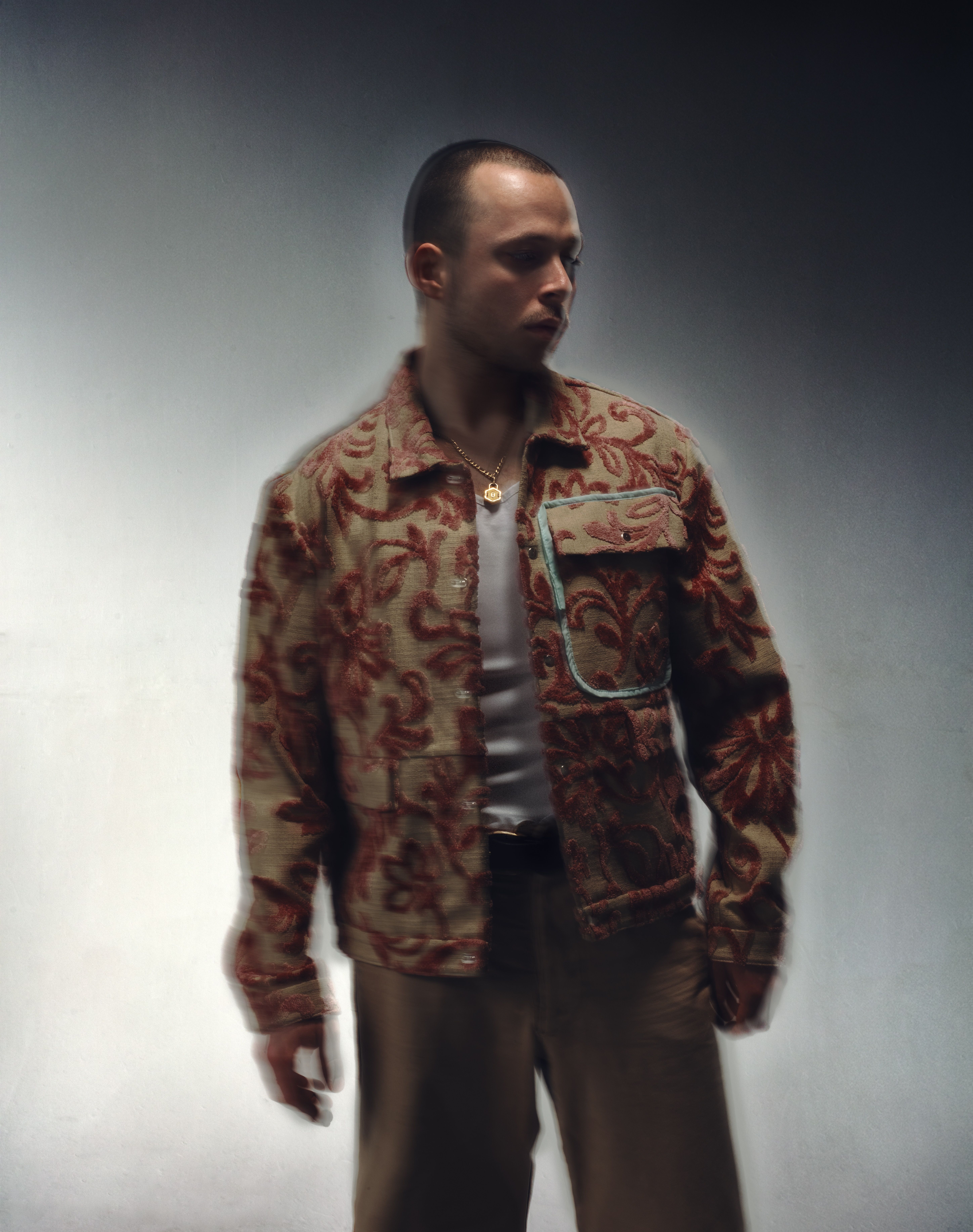
Mackwood Interview Image by Michelle Janssen
What is the relationship between harmony, rhythm and melody? How do non-percussion instruments contribute to the overall rhythmic texture of a piece?
I used to think melody was story, harmony was emotion and rhythm was pacing, but they get more entangled the more I probe that.
For example, chordal players like pianists often talk about “voice leading” – giving each stack in a harmony it’s own convincing melodic line.
In relation to drumming, Stewart Copeland said: “Listening is where the cool stuff comes from. And that listening thing, magically, turns all of your chops into gold.” What do you listen for?
Absolutely, although I think it changes depending on context because the answer could be anything at all. But rather than being overwhelmed by choice paralysis, you can be guided by the relationships between parts to get some sense of informational priority.
For example, if there’s an underlying loop, the topline will sometimes rhythmically line up and sometimes not. I can then make a choice as to whether I reinforce that loop and riff on it, or leave it alone, or play something that contradicts it, each of which have their own effect on momentum / intensity.
Loads of that in Duke Ellington, James Brown, George Clinton, all kinds of good rap and hip hop.
Do you feel that honing your compositional / songwriting skills has an effect on your drumming skills?
No doubt.
The more you know what actually goes into the song you’re playing, the more detail you can draw from and the more music you can bring out of the song itself.
Physical strain is a particularly serious issue for many drummers. How does it manifest itself, how do you deal with it and in how far does it affect your creativity?
I’m incredibly lucky to never have had any serious run ins with injury or strain. I’ve always been taught to absolutely prioritise relaxation in everything I play, and as long as I tailor my work around that, over-exertion is rarely a problem.
Lots of great writing on this, like Effortless Mastery by Kenny Werner.
Many recording engineers have remarked that the drums can be particularly hard to capture. What, from your perspective, makes drums sound great on record and in a live setting?
There’s usually a funny divide between what you hear when you play, and what you hear back on the mics. Trying to reconcile those is a case of preserving the low-end body of each drum, then also the mid/high-end that details your articulation.
I used to think that super dead booths were the one, but actually getting some bounceback from the room can help with achieving a fuller stereo image. Saturation was a game changer for me – especially multi-band plug-ins like Fabfilter Saturn.
This means you can tone-shape to taste, especially if I want a kick drum to really knock like on my track "Fuzzz."
Drums and percussion are remarkably often used for physical therapy / healing. What, from your point of view, makes them particularly suitable tools for this?
Non-tuned percussion is really cool because the whole harmonic spectrum is up for grabs.
For example, you can hear a gong ring out in all these beautiful overtones, but there’s no key or chord quality for it to agree/disagree with. That kinda negates any associative emotional sequencing related to songs and their respective chords, basically levelling the emotional playing field.
That totally makes sense if you’re trying to reform and reprogram, because it’s a direct kinda tonal analog.