Name: Lawrence Hart
Nationality: British
Occupation: Producer, composer, vocalist, multi-instrumentalist
Current Release: Lawrence Hart's new single “NoMoreLove4u” is out via Domino's Double Six.
Recommendations: Mona Lisa’s Moustache: Making Sense of a Dissolving World by Mary Settegast, I read this when I was 18 or 19 and it had a profound impact on the way I think about art and what it means to be an artist.
Keith Jarrett - Vienna Concert. This was a foundational record for how I think about improvisation.
If you enjoyed this Lawrence Hart interview and would like to know more about his work and music, visit him on Instagram, Facebook, and Soundcloud.
Tell me about one or two of your early pieces that you're still proud of (or satisfied with) in terms of production – and why you're content with them.
‘Innocent’, my track with Casually Here on Hotflush is one I still feel stands up if I play it alongside my current work.
When I listen to it now there’s nothing I would change about it, whereas with other pieces I can hear where I might make improvements on the mix/production. I love the sonics in it and texturally I find it draws me in straight away.
Another one is my remix of Model Man’s ‘Ketones’. I feel happy listening to this now because it still feels fresh and honest to me.
I made it in a cafe in Brooklyn in a couple hours using just plugins and felt like it was the first thing I had made on plugins that sounded analog.
Do you keep up with recent developments in terms of gear and software? If not, why not? If so, what are you looking for?
Yes, anything that offers a new approach to making music and sounds will pique my interest.
But I do find that with Max MSP and Ableton the possibilities are endless, so it’s harder and harder for companies to come up with something that you can’t just program yourself. A lot of new gear and software these days just does what you can already do in a simpler plugin with less control and I don’t really have any time for that kind of thing.
At the moment I’m obsessed with using AI for sound generation, I find that ‘Uncanny Valley’ thing really interesting.
How and for what reasons has your music set-up evolved over the years and what are currently some of the most important pieces of gear and software for you?
I’ve bought synths and outboard gear over the years as I’ve chased certain sounds whilst keeping an eye on any old hardware going cheap on Ebay.
I started off when I was 12 with a cracked copy of Steinberg Nuendo, a simple audio/midi interface and a digital piano. Then, as I got into jazz, I was writing music for ensembles and orchestras using Sibelius for the scoring. As I got into electronic music I was writing on samplers and using guitar pedals for manipulation, then when I was 21 a friend of mine showed me Ableton and at that point I moved all my composing into the DAW.
Throughout my early to mid twenties I started producing for other artists and was picking up old analog synths to fit the sonics of the projects I was working on. First was the Juno 60, then the SH 101, Prophet 08, ARP Solina and some bucket brigade delays. This was the set up I had for years as I had either bedroom studios or shared studios with not a lot of space.
In my late 20s I moved into my first studio that had some space to expand and added more synths to the arsenal. In my early thirties I started working as mix engineer alongside producing and bought some 500 series analog EQs, a little SSL mixer and the Overstayer Modular Channel. The Overstayer has been my favourite bit of outboard processing by far!
These days the core of my setup is the Moog One, Instruo Arbhar into the Hologram Electronics Microcosm, Omnisphere, NI Massive and the Ableton Push. These are the bits that make it on every track more often than not. The other synths I’ll use regularly are the Polivoks, Deckards Dream, SH 101, Cyclone 303, Juno 60, Casio CZ 5000, Alpha Juno 2, ARP Solina and once in a while the Prophet 08.
Jean-Michel Jarre maintained that, despite the advances in virtual technology, we are still "analogue animals made out of blood and bones who need buttons and knobs to touch.” In how far is this statement true or false for your own music?
This is very much the case for my own music, without that physical interaction my music feels too sanitised. I came up through playing instruments so that physical interaction is vitally important to me.
I like to make the distinction between when something needs to be performed and when it needs to be drawn in. There’s always a place for both styles of production.
What are examples of production tools/instruments that you bought for a specific purpose?
I bought the Casio CZ5000 to get the original Reese Bass sound, although I was also very interested in its phase-distortion synthesis and the ‘glassy’ high end it generates.
Late producer SOPHIE said: “You have the possibility with electronic music to generate any texture, and any sound. So why would any musician want to limit themselves?” What's your take on that?
I agree with that sentiment in regards to my own music, although I understand why someone would want to limit themselves. Some people rely on certain limitations to give their music a sonic identity.
What does your own way of working with sound look like? Do you find using presets lazy?
I used to think using presets was cheating, but now I think it really doesn’t matter. Does the listener know you’re using a preset? I think you should remember you’re writing music and whatever can help that process is a benefit to you.
I use a mixture of presets and sounds and patches I’ve programmed and made myself. Although when I do use a preset I will generally edit the patch to work in the track.
What were some of your most positive collaboration experiences? How did this "human element" enhance your solo approach? Did you record via filesharing or in the same room and if so, what did the recording process look like?
My collaboration with Giulia Tess was a really positive experience. Giulia gets elements to sound chaotic whilst still working in the track. That’s something I used to put a real focus on but lost as I was focusing more on mixing. Since working with Giulia I’ve managed to get that back into my process.
Working with Mera Bhai has been great as we focus on completely different aspects of the production. I’ll focus on the bigger picture and emotion, whereas he focuses on bringing energy in the track and transitional details. Again, I’ve been bringing those elements into my own productions since working alongside him.
Otus and I have both been delving into Massive and chopping breaks over the last few years and we keep showing each other new tricks we learn and have been discovering new techniques together.
What is a production related question that you would like to ask yourself – and what's your answer to it?
How do you get around writer’s block?
I’ll find some vocal chops I find inspiring and will try to write a track around those elements.

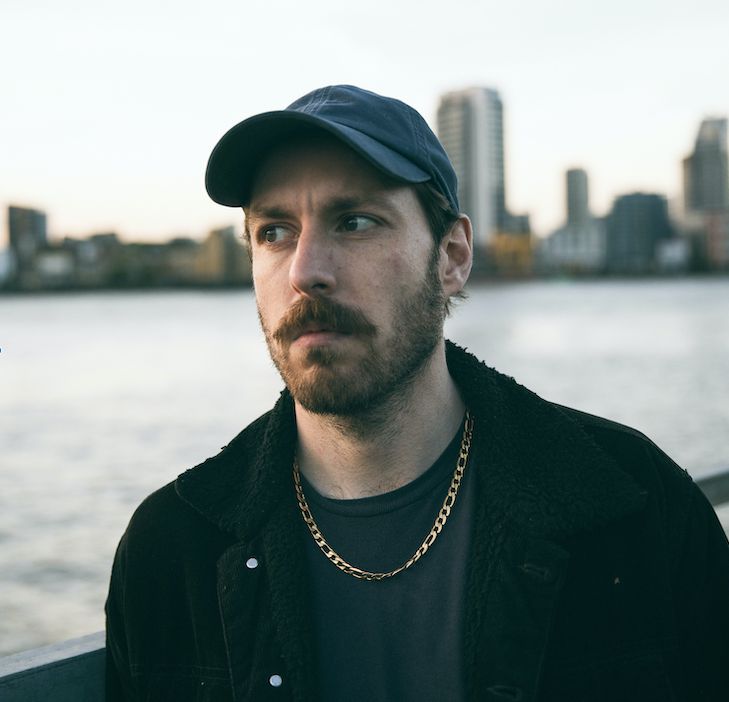 Lawrence Hart Interview Image by Dave East
"Anything that offers a new approach to making music and sounds will pique my interest."
Video