

Part 1
Name: Laura Strickling
Nationality: American
Occupation: Singer
Recent release: Laura Strickling's new album Legends: Rebellion is out via Sono Luminus.
Hometown Recommendation: We recently moved to Racine, Wisconsin, from the U.S. Virgin Islands — a fact that tends to elicit incredulity from most people — and it truly is the most wonderful place. When visitors come, I take them to the Racine Zoo, the Wind Point Lighthouse, North Beach on Lake Michigan, the Racine Art Museum for its annual Peeps™ art exhibition (I even submitted a Peeps™-based sculpture myself this year!), the maze of treasures at the School Days Antique Mall, and dinner at the HobNob, a classic Wisconsin supper club. And one must never pass up a kringle from O&H.
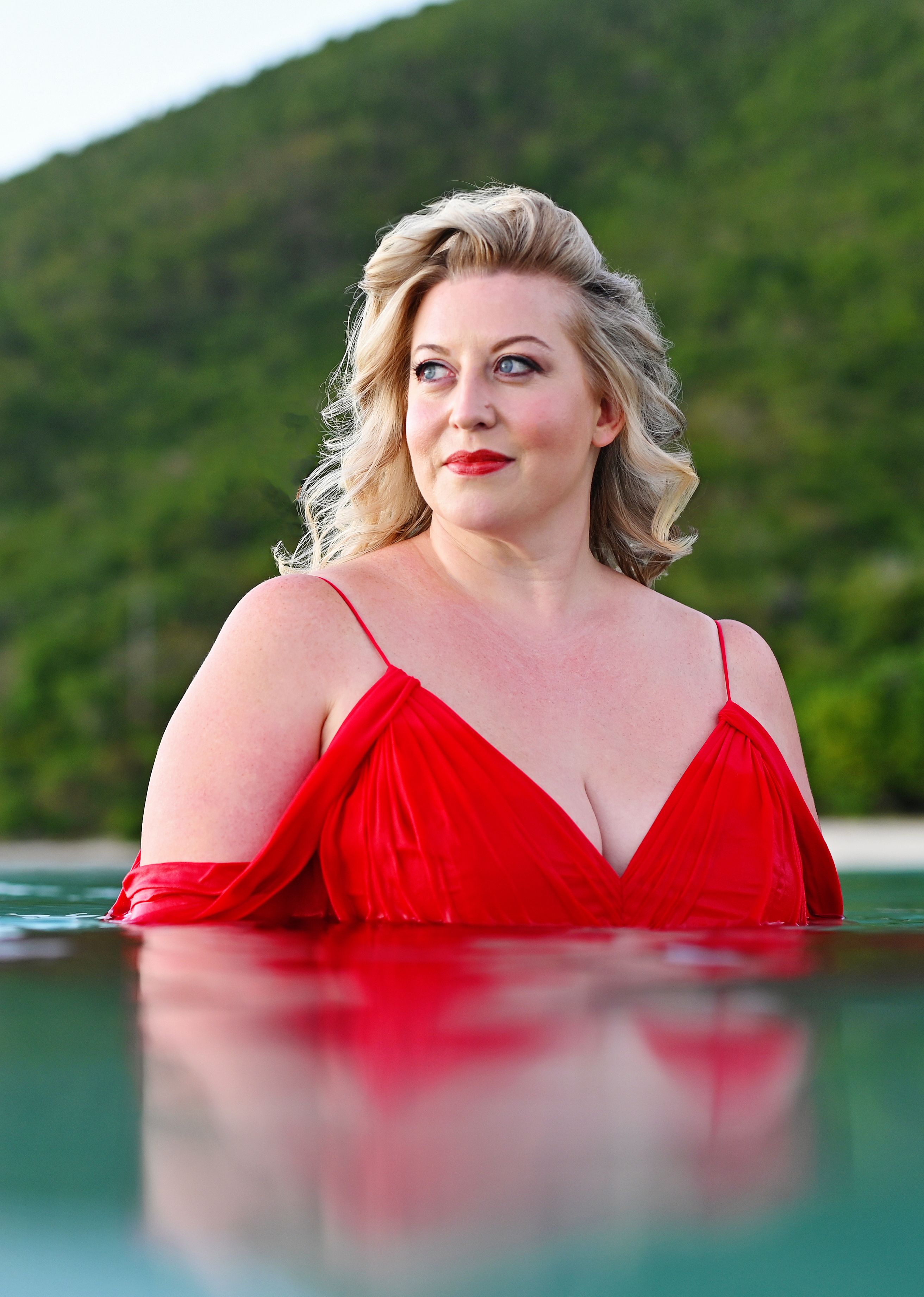
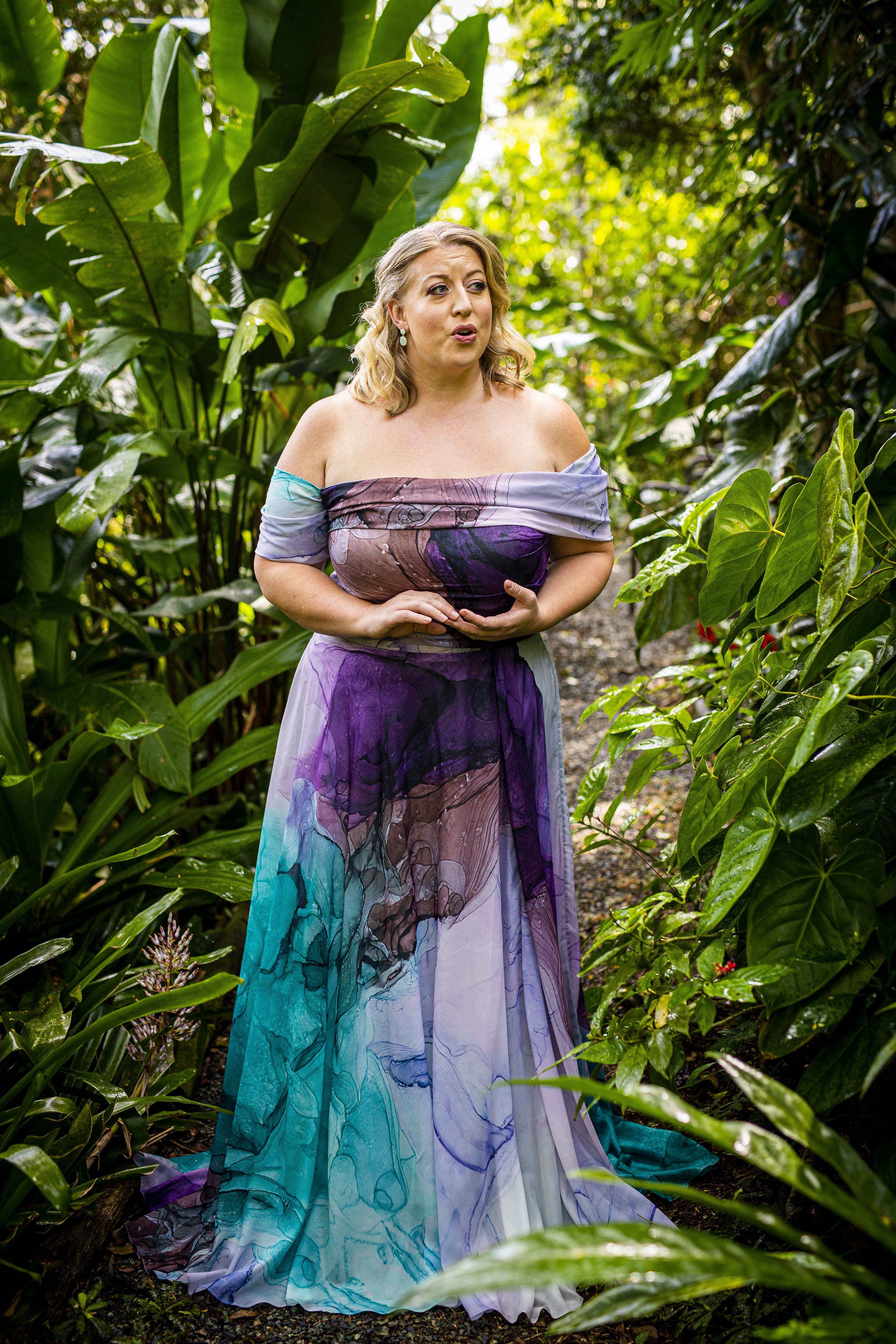
My second GRAMMY® gown was made by sewist Kitty Knapp, who creates costumes for the Metropolitan Opera, Lyric Opera of Chicago, and Disney theme parks, among many others. Her magical shop of fabric wonders occupies part of the original Hamilton Beach factory in Racine. One of my neighbors hosts a raucous monthly Ukulele club and another hosts a regular ladies crafting night that should not be missed! We are often found at the Racine Symphony concerts. My daughter takes horse riding lessons at the Stepping Stone Farm, which also rehabilitates rescue horses and runs programs for at-risk youth and adults with disabilities, and others. There are little miracles of culture, care, and community to be found around every corner of this wonderful city we now call home.
If you enjoyed this Laura Strickling interview and would like to stay up to date with her music and upcoming live dates, visit her on Instagram, tiktok, and Facebook.
When did you first consciously start getting interested in singing? What was your first performance as a singer on stage or in the studio and what was the experience like?
My father was a minister, and I have a visceral memory of being dressed as an angel in our church nativity play at 5 years-old, singing “Away in a Manger” by candlelight. I always joke that I’ve been chasing the high of making an audience cry ever since.
When I was eight, I borrowed my mom’s fanciest dress - a drop-waist, blue-striped polyester stretch-satin number - and carried a microphone I’d made from cardboard so I could be a “singer” for Halloween. My sister won the costume contest for her “Peanut Butter and Jelly Sandwich” costume, and I was flabbergasted by my loss. Obviously, “singer” was the coolest thing anyone could possibly be.
Between singing at church and singing at school, I somehow always self-identified as a “singer,” even though I didn’t have my first formal voice lesson until my freshman year of college.
Singing is an integral part of all cultures, and traditions. Which of these do you draw from – and why?
I’ve primarily trained in the Western Classical tradition of singing.
If someone asks me what I do for a living I usually respond with “opera singer” because the more accurate, “recital, concert, and chamber music-focused Western Classical Singer” doesn’t quite roll off the tongue or prompt immediate understanding from the average listener. But, in short, I want to build my vocal conditioning and expressive skills to access all communicative capabilities possible.
My husband was the founding director of the law school at the American University of Afghanistan, and we lived in Kabul from 2011 to 2014. I spent time in his classes, sitting alongside brilliant young women who were determined to be part of building a free Afghanistan. I became friends with women in positions of leadership whose voices have now been silenced by the Taliban’s return to power. I remain committed to supporting them and amplifying their voices as they continue their struggle to be seen, heard, and treated as human beings of equal value in their own society.
Juhi Bansal also sought a way to amplify the voices of Afghan women through her music, and came across internet groups where Afghan women share their landays, an Afghan poetic tradition built upon two lines: a nine-syllable phrase followed by another of thirteen, created and transmitted primarily orally by women. The anonymous nature of these poems allows them to serve as a quiet protest - unfiltered and unchecked by the men’s voices that surround them.
Bansal’s "Love, Loss, and Exile" – asks the singer to vocally explore the space between western classical singing technique and eastern classical singing technique. This is most instantly apparent in her song “Exile“ but is felt throughout the cycle.
I went to California to spend three days with Juhi before recording to make sure that I was realizing her vision for the vocal approach. Having lived in Morocco and Afghanistan, I had a head start for some of these non-Western approaches but bringing them into my own body required practice and thoughtfulness.
I am drawn to composers who demonstrate fascination with the exploring the endless possibilities of expression with the human voice. It’s the only instrument we are all born with. Learning to employ it in myriad ways - adding to my expressive toolbox – allows me to communicate more deeply with audiences.
I also feature the music of Jodi Goble & Caitlin Vincent on this album. The score for "Night-time in the Fourth Trimester" – a humorous/heart-breaking exploration of post-partum depression – sets the tone with the first composer’s tempo/expression marking: “World-Weary, Brechtian.”
I leaned into the jazz/cabaret ,”Weill-esque” nature of the music with my vocal approach to the work. For me, singing always starts with asking myself: “How can I best help the audience viscerally understand this text?”
As a student, you are training and conditioning for years within an art form that requires striving for beauty, consistency, and perfection. But “perfect” is rarely compelling. You arrive at a solid, healthy, working vocal technique to earn the ability to step outside of the box you spent 10-15-20 years building.
Once I gave myself the permission to go against what I had been taught “perfect” was, the real fun began.
What were some of the main challenges in your development as a singer/vocalist? Which practices, exercises, or teachers were most helpful in reaching your goals – were there also “harmful” ones?
I feel very fortunate to have been guided by masterful voice teachers – from my high school choir director, the legendary Chicago educator George Rico, to my first voice teacher in college, Susan Clark Manns, to William Sharp (who demonstrated that a career in chamber music and song was possible) and Phyllis Bryn-Julson (who instilled a great passion for new music) in graduate school, and finally my teacher since 2009, Elizabeth Daniels of Silver Spring, MD. My technique reached a truly solid footing in her care.
I also credit a great many collaborative pianist/coaches in the development of my musicality and artistic point-of-view: Mona Coalter, Ruth Locker, Liza Stepanova, Daniel Schlosberg - my primary touring partner, and collaborator on my 40@40 album and commissioning project and of course, Joy Schreier, with whom I collaborated on my first solo album, Confessions, and now on Legends: Rebellion.
The list of people who have contributed to who I am today as an artist could fill a book. I’m grateful for the wisdom, time, and care that has been invested in me.
There was a recent article in the New York Times by Jonathan Biss imploring the classical music field to eschew the “god” status of the abusive teacher pantheon. I am fortunate to have avoided abusive teachers, but I certainly participated in masterclasses as a student under what I experienced as “abusive” master-teachers, and what those touchpoint events taught me was:
(1) I want to be the reason someone is inspired to continue studying music; never the one who discouraged them into stopping
(2) It is very awkward to work as a colleague with someone who was once abusive to you. Every student with whom I come into contact is hopefully a future colleague.
I travelled a winding path to a career in singing. While I completed bachelors and masters degrees in voice in the usual manner, I could not figure out how to “become a singer” after graduate school at Peabody. I did some auditions, nothing came of them, so I stopped. I got a job as the Accreditation Specialist for the National Office for Arts Accreditation.
My husband, who was studying at Georgetown Law, won a Boren Fellowship to study Arabic in Morocco and that sounded like a life experience I should not pass up, so we moved to Fez and I also studied at the Arabic Language Institute of Fez. It is the one year of my life I would re-live, if I could. It stretched my boundaries, honed my worldview, enriched and expanded my palate for all things from food to art, and laid the foundation for my belief in the importance of community.
After we returned to the DC-area, I decided to start taking voice lessons again, at the age of 29. I’m not sure what I thought would happen, but it reignited my passion for the “singer” part of my identity. Through competitions and summer art song programs, including SongFest, Ravinia, and Tanglewood, I built a facility for learning “new” music, lasting collaborative relationships, and a professional network.
Composers like Libby Larsen and Tom Cipullo recommended me for my first “real” singing engagements, and the rest is … history. My history, “becoming a singer” the hard way (is there an easy one?).
The question I am most frequently asked is: “Why aren’t you singing opera?!” I love opera, and I have done some work in recent years in world premiere opera productions, but since I didn’t follow the traditional graduate school-to-YAP pathway, I never built a hiring network in the mainstream opera scene. I do feel incredibly fortunate that I get to sing as a profession. And that I get to do a little bit of everything – recital, chamber music, concert, oratorio, and yes, occasionally opera.
I describe my career to people who aren’t as familiar with the classical music industry as, "more gown and instruments than costume and instruments”. In fact, I have tracked my career journey, in part, through my #GowningAround hashtag on social media. It started because my husband left for a job at the American University of Afghanistan the same weekend that I had my first performance at Carnegie Hall and I wanted to send him a picture of me in my gown, which I also posted on social media. It became a habit that has continued to this day.
I travelled back and forth between my singing work in the US and our home in Kabul for 3 years. His next job was in the US Virgin Islands – a one-year appointment that turned into 9 years of our lives that included having a baby in the middle of the Zika pandemic, two category-5 hurricanes in two weeks that upended everything that could possibly be upended, and the Covid shutdown/performance exile.
Somehow, here I am – still identifying as a “singer.” I deeply believe that a life in the arts should be heavy on the “life”. You need to have something to sing about. We recently moved to Wisconsin, where I joke that I am learning to appreciate cheese, beer, and being cold. And the flights to gigs are MUCH shorter.
What are the things you hear in a voice when listening to a vocalist? What moves you in the voices of other singers?
I take notice when someone has a natural vocal attribute that is unique to them – an ineffable quality that is not within their control, but that they use skilfully to their advantage.
I am moved by singers who truly bring a text to life.
We have a speaking voice and a singing voice. Do these feel like they are natural extensions of each other, ends on a spectrum or different in kind?
I always joke that my job is, “controlled screaming in 20 different languages.” And there is some truth to it.
How we sing something matters; Worlds exist within color, pacing, phrase, vibrato, emphasis, pitch, enunciation. Both singing and speaking work towards the common goal of communication. I want others to understand me specifically. Every time I record a song that has spoken text, I end up spending an inordinate amount of time getting those sections just right. I think I did 34 takes of “uh huh” in "Thanks a Latte" by Lori Laitman and Caitlin Vincent, …
… and at least 15 takes of, “Yeah!” in Libby Larsen’s "Righty."
On the current album (LEGENDS: Rebellion), Jens Ibsen’s "Why Won’t You Let Me Look Right At You?" features a spoken repetition of, “why won’t you let me?” for which I needed four characterizations of the phrase. There was one that made everyone in the engineering booth visibly shudder in fear, so we made sure to include that one.
We study the mechanics of singing and condition our bodies to do our bidding towards that end. My friends who focus on musical theatre spend no less time agonizing over these minutia and are equally served by understanding the apparatus of the breath.
We who work primarily within the field of opera-style singing have the added complication of doing it un-amplified, to be heard in a large theatre, sometimes over full orchestra, which requires more “weight” behind the application of the voice.
How do you see the relationship between harmony, rhythm and melody? Do you feel that honing your sense of rhythm and groove has an effect on your singing skills?
I was a percussionist in middle-school band, and then the Lane Technical High School marching band and the Chicago City-Wide Symphony Orchestra. My high school choir teacher, who consistently implored me to “stop banging on things,” was triumphant when I gave up percussion to focus on voice when I entered college.
Surely this early foundation in rhythm led the way towards my career focus in new music. I won’t say I am the world’s best sight-reader, but I do have a strong inner metronome, the ability to decode difficult scores, solid relative pitch, and a brain that absorbs complicated melodic patterns quickly.
I was recently laughing with one of my coaches because after months of quickly preparing recently composed music for consecutive engagements, I was working on something standard-repertoire German romantic, and I kept singing errors. My brain refused to cooperate towards uncomplicated eighth and quarter notes composed in a melody that remained perfectly within one key.
Obviously, I eventually pulled things around to a successful performance, but overthinking is a particular complication to the specific kind of singing career that I have built that I’m not sure every singer experiences.