Name: Julien F
Nationality: French
Occupation: Drummer, songwriter
Current release: The new Chevreuil album Stadium is out via Computer Students™.
Pure drum recording recommendation: Easy! Perez Prado “Concierto Para Bongó.” It is pretty incredible and was recorded in the 50s to then appear on an album in the 60s.
If you enjoyed this Julien F of Chevreuili interview and would like to know more about the band and their music, visit their page on Murailles Music as well as on the Computer Students website.
It seems as though most aspiring artists are drawn to the drums and percussion for one of two reasons: Creating sound/noise and creating rhythm. What captivated you?
My first encounter with drums was through sight rather than sound.
As a child, I stumbled upon a simple set of white drums opening a door in a theater. I became fascinated by their appearance and kept wondering what they sounded like. Although I never got the chance to hear them, that image stayed with me for years.
My journey with drums really began later, while I was in art school. I started teaching myself to play as we were forming Chevreuil with Tony. What captivated me wasn't only the sound, but also the physical presence of the instrument—the shape, the mechanics, and the way it interacts with the body.
I love that there is something almost mechanical about drumming; the instrument becomes an extension of your movements and your physical expression.
When I listen to music, I see shapes, objects and colours. Others experience emotions. Everything around drums, on the other hand, is based on touch, vibration, and movement. Does this mean that your own perception as a listener is also more connected to touch, vibration, and movement? What happens in your body when you're listening?
When I listen to music, I don't primarily connect to it through emotion. I'm more aware of its physical qualities—its movement, texture, rhythm, and vibration. Certain sounds create a strong sense of space in my mind, while unusual drum patterns can make me feel a physical tension or momentum in my body.
At the same time, listening is deeply connected to memory for me. Music often returns as images and sensations rather than feelings. Sound is invisible, yet it can completely shape how I experience the world around me.
What was your first drum set like and what are you using today? What, to you personally, are factors in terms of build and design that you appreciate in drums and percussion instruments?
My first drum set was incredibly simple, and it’s actually very close to what I use today.
Over the years, I’ve become increasingly interested in minimalism and efficiency. I spent a long time exploring complexity, and while I learned a lot from it, I eventually felt limited by it. Today I’m more interested in reduction—how much can be achieved with the fewest possible elements.
That also shapes what I appreciate in drum design. I value instruments that are functional, direct, and physically engaging. The best drums feel like an extension of the body, where the design serves the interaction rather than drawing attention to itself.
Late Rush-drummer Neil Peart said: “The equipment is not an influence. It doesn't affect the way I play. It's an expression of the way I play.” What's your take on that?
I think the opposite. Equipment absolutely influences the way I play. Every setup encourages certain possibilities and discourages others.
Personally, I’m interested in limitation rather than abundance. The less you have, the more creative you have to be. Constraints push you to invent new approaches, so for me the instrument and the setup are active collaborators in the creative process.
The drums and percussive instruments are an integral part of many cultures, and traditions. Which of these do you draw from in your playing – and why?
In the beginning, I was heavily influenced by Western music and culture from the 1960s and 1970s. Compared to many other musical traditions, the rhythmic language was relatively simple, but it gave me a strong foundation.
As I grew older, I became more open to different kinds of music, and Latin American percussion became a major influence, alongside minimalist rock. What attracted me was the richness of the rhythms and the way repetition could create both structure and surprise.
More broadly, I’ve always been drawn to music that exists at the edges—music that feels raw, unconventional, or overlooked. I became fascinated by the way dissonance and harmony can coexist and even strengthen one another.
That tension between order and disorder, simplicity and complexity, continues to influence the way I think about rhythm and sound.
What were some of the main challenges in your development as a drummer / percussionist? Which practices, exercises, or experiences were most helpful in reaching your goals?
I’ve always relied heavily on mental practice. I tend to work through rhythms and structures in my head, while the actual physical playing happens mainly in rehearsal or performance.
The main challenge has been translating those internal ideas into precise physical execution. That gap between imagination and action is something I’ve had to continually work on.
What has helped me most is using live performance as a form of practice. I often experiment on stage, which keeps the process open and allows me to develop ideas in real time rather than finalizing everything in advance.
How would you describe the physical sensation of playing the drums? [Where do you feel the resonances/pulse/groove, what are emotional sensations, is there a sense of release or tension etc …]
It feels physical, mechanical, almost like a sport. I experience it through repetition, pulse, and vibration, where sound and movement constantly feed into each other.
One of the challenges is how easily drumming becomes shaped by habit, and how difficult it is to break those patterns. I actually stopped playing for many years and had to relearn the instrument from a different perspective.
Today I’m less focused on influence or imitation. I tend to play more intuitively, and that has given me a stronger sense of freedom and confidence.
What is the relationship between harmony, rhythm and melody? How do non-percussion instruments contribute to the overall rhythmic texture of a piece?
I think of music as layered, where harmony, melody, and rhythm are different but interconnected forces. Harmony creates a field, melody moves through it, and rhythm organizes it in time.
I’m especially interested in situations where all elements remain equally present, rather than one dominating. In that context, non-percussion instruments also become rhythmic through repetition, phrasing, and texture.
What may sound simple on the surface is often highly structured underneath, and I’m drawn to that hidden complexity—especially when dissonance and unpredictability are part of the system.
Do you feel that honing your compositional / songwriting skills has an effect on your drumming skills?
For me, it actually goes the other way around—my drumming influences my compositional thinking more than the reverse.
When the drummer is the leader or main composer, I think the emphasis often shifts toward rhythm, texture, and structure, but the core roles of the musicians remain equal.
I see each musician as contributing to the composition of the whole. When individual display becomes more important than the collective structure, the music can lose focus. The most interesting situations are those where everyone is effectively composing together.
How are you making use of the timbral and textural potentials/possibilities of your drums and percussion instruments when making music?
For me, drumming is about resonance, tension, space, and silence—the timbral and textural qualities are inseparable from rhythm itself.
I used to play in a very fast and energetic way, but I’ve moved away from that. Now I’m more interested in a minimal approach: a steady pulse with subtle changes in dynamics and articulation over time.
Rather than decorating the rhythm, I try to let timbre and space define its texture. That feels more direct and meaningful to me at this stage.
How has technology, such as drum machines and sequencers, impacted the way rhythm is created and perceived? Has it been a concrete influence on your own approach?
For me, it’s a different story. I find it hard to really enjoy electronic drums because they often feel flat and lifeless. That said, some recordings of acoustic drums can sound flat and lifeless too.
Still, I can’t help wondering: why use electronic drums when real drums can bring so much more character and depth to your music.
Many recording engineers have remarked that the drums can be particularly hard to capture. What makes drums sound great on record and in a live setting?
To capture drums with a rich, natural sound, it’s important to mic not only the kit itself but also the room it’s in. The room plays a crucial role because it shapes and carries the resonance of the drums.
Of course, the approach ultimately depends on the sound you’re aiming for. Some drummers will like overproduced sounds. It’s a bit like movies. Hollywood or Straub-Huillet?

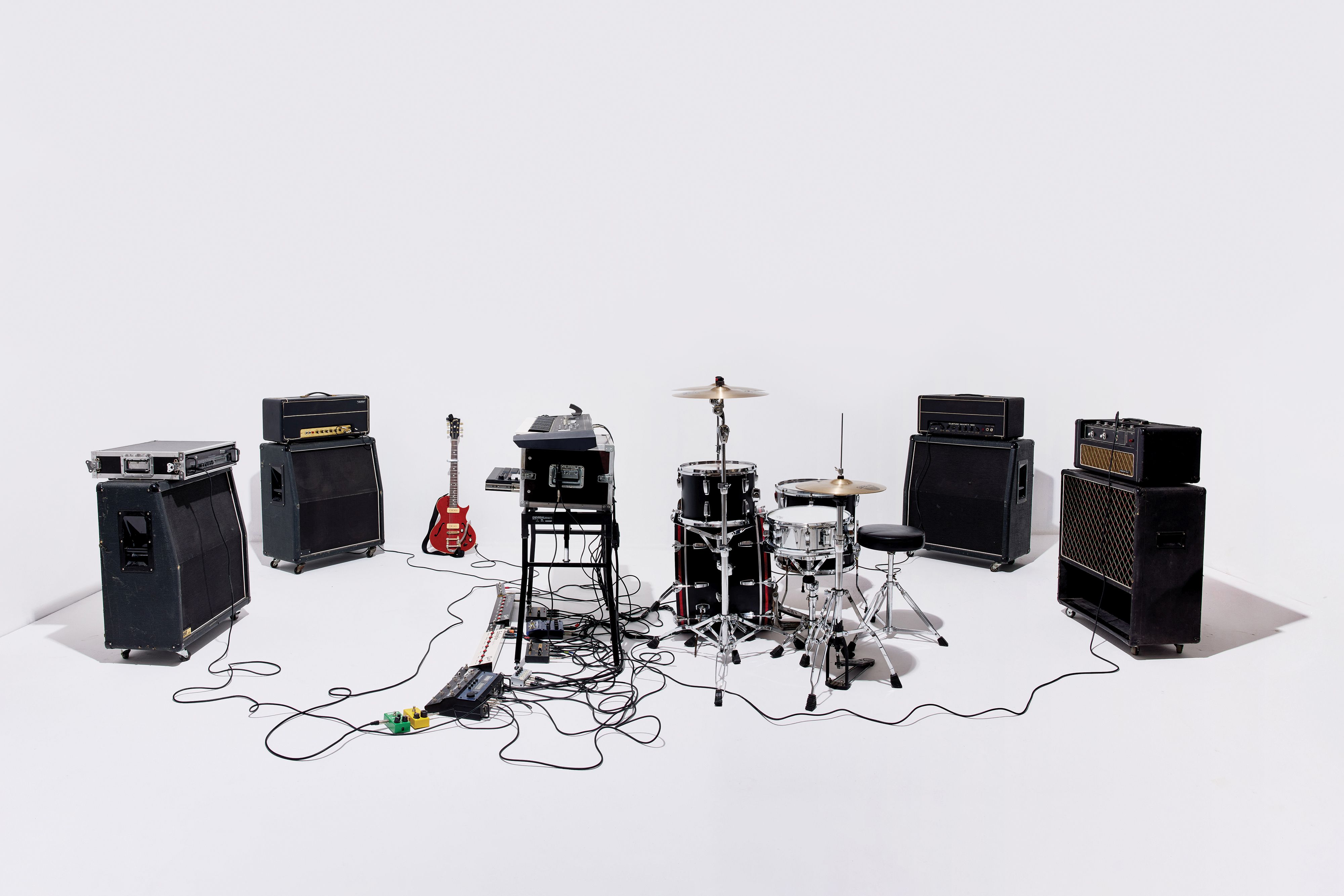 Chevreuil Interview Image by Alessio Federico
"One of the challenges is how easily drumming becomes shaped by habit, and how difficult it is to break those patterns."
Video