Name: Jon Onabowu
Nationality: Nigerian-British
Occupation: Drummer, composer, improviser, bandleader
Current Release: Jon Onabowu's new album Now's the Time is out via Finished Work.
Current Event: Jon Onabowu will perform with Cosmic Fusion, a group of young musicians inspired by fusion legends like Herbie Hancock and Miles Davis, at Ronnie Scott's. Catch the band play live Thursday 18th June 2026 or Thursday 25th June 2026. For more information and tickets, head over to the Ronnie Scott's website.
If you enjoyed this Jon Onabowu interview and would like to know more about his music and upcoming live dates, visit his official homepage. He is also on Instagram, bandcamp, and tiktok.
There can be many different kinds of energy in art — soft, harsh, healing, aggressive, uplifting and many more. Which do you tend to feel drawn to most?
That honestly depends on the mood I'm in.
If I'm in the gym, I'll want something more aggressive. If I'm pensive, I'll want something more ambient. Sometimes I'm in the mood for something uplifting, other times I'm in the mood for something nostalgic.
I wouldn't say there's one I'm particularly drawn to more than others.
I have had a hard time explaining that listening to death metal calms me down. When you listen to a song with a particular energy, does it tend to fill you with the same energy — or are there "paradoxical" effects?
I'd say so.
I don't find myself being worked up listening to ambient music and if I'm lifting a heavy weight I need heavy bass/a strong groove to give me a boost.
When it comes to experiencing the sensation of "energy" as a creator, how would you describe the physical sensation of experiencing this energy?
It comes in the form of some sort of bodily movement.
For some, it's a head nod, others, a foot tap. It can be a full-on two-step, depending on the environment. Whatever that movement is, that's the music doing its job.
When it comes to composing / songwriting, are you finding that spontaneity and just a few takes tend to capture energy best? Or does honing a piece bring you closer to that goal?
I'll typically sing an idea in the room, we'll find it together, and then the work is about stripping everything back to what actually needs to be there.
The spontaneity captures the feeling. The honing protects it.
With the songs on my album Now’s The Time, we mostly captured everything on demos, then we refined for the actual recordings.
How much of the energy of your own music, would you say, is already part of the composition, how much of it is the result of the recording process?
The composition sets the emotional direction: the groove, the texture, the world I want to build. But the energy itself lives in the players. You can write a feel but you can't manufacture it.
The recording process is where the musicians bring something you didn't plan for, and that's usually the best thing on the track.
For Now’s The Time what kind of energy were you looking for?
Something that feels as good as it is complex.
I wanted people to be inside the music before they realised how much was happening. The groove had to be the entry point; everything else could move around that.
How do you capture the energy you want in the studio?
I sing or beatbox ideas. Not formally, just to get them out of my head and into the room as quickly as possible.
From there it becomes a conversation. I know the sonic world I'm after and I work with the people around me to find it; people who understand the feel intuitively and can run with it.
What role do factors like volume, effects like distortion, amplification, and production in general play in terms of creating the energy you want?
Production plays a huge role. Musicians often struggle with "demo-itis" where the mixed version of a song struggles to replicate the feel/energy of a demo. A lot of that is down to how things are produced.
I think working with mixing engineers who are also musicians, or at least who understand the kind of sonic landscape you're going for, can make this a lot easier.
In terms of energy, what changes when you're performing live on stage, with an audience present, compared to the recording stage?
Live is all about exploration and innovation. How can we keep the song familiar but take it somewhere new?
Things open up in ways they can't on a record because there's a risk present. Someone might take it somewhere unexpected and you have to respond. That's where the best moments happen.
How does the presence of the audience and your interaction with it change the energy of the music, and how would you describe the creative interaction with listeners during a gig?
I describe the audience as a crowd on the other side of a window at a shop, peering in. They're spectating what's happening on stage, but to me the best gigs are where the band play like there's nobody in the room; fully inside the music.
I do believe a responsive audience does something to you, whether you're conscious of it or not.
What kind of feedback have you received from listeners or concert audiences in terms of the experience that your music and/or performances have had on them?
The thing that stays with me most is when people say they didn't expect to feel what they felt. That they came in curious and left moved.
I've had people tell me they don't usually listen to jazz but something about the music got them — and that's exactly what I'm going for.
Would you say that you prefer to stay in control to be able to shape the energy or do you surrender to it and allow the music to take over? Who, ultimately, has control during a live performance?
Neither … and both. You have to be in control enough to hold the structure, but surrendered enough to let the music breathe. The moment you're gripping too tightly, the energy dies.
I think the best performances happen when everyone on stage has quietly agreed to follow wherever it goes. Nobody's in control, but nobody's lost either.
The energy that music is able to generate can be extremely powerful. How do you think can artists make use of this energy to bring about change in the world?
By being honest. The music that changes something in people isn't the music that's trying to… it's the music that's so true to itself that it can't help but affect the room.
I think artists create change by refusing to make music that explains itself, that justifies itself, that apologises for itself. You build the world you want people to inhabit and you trust them to step inside.

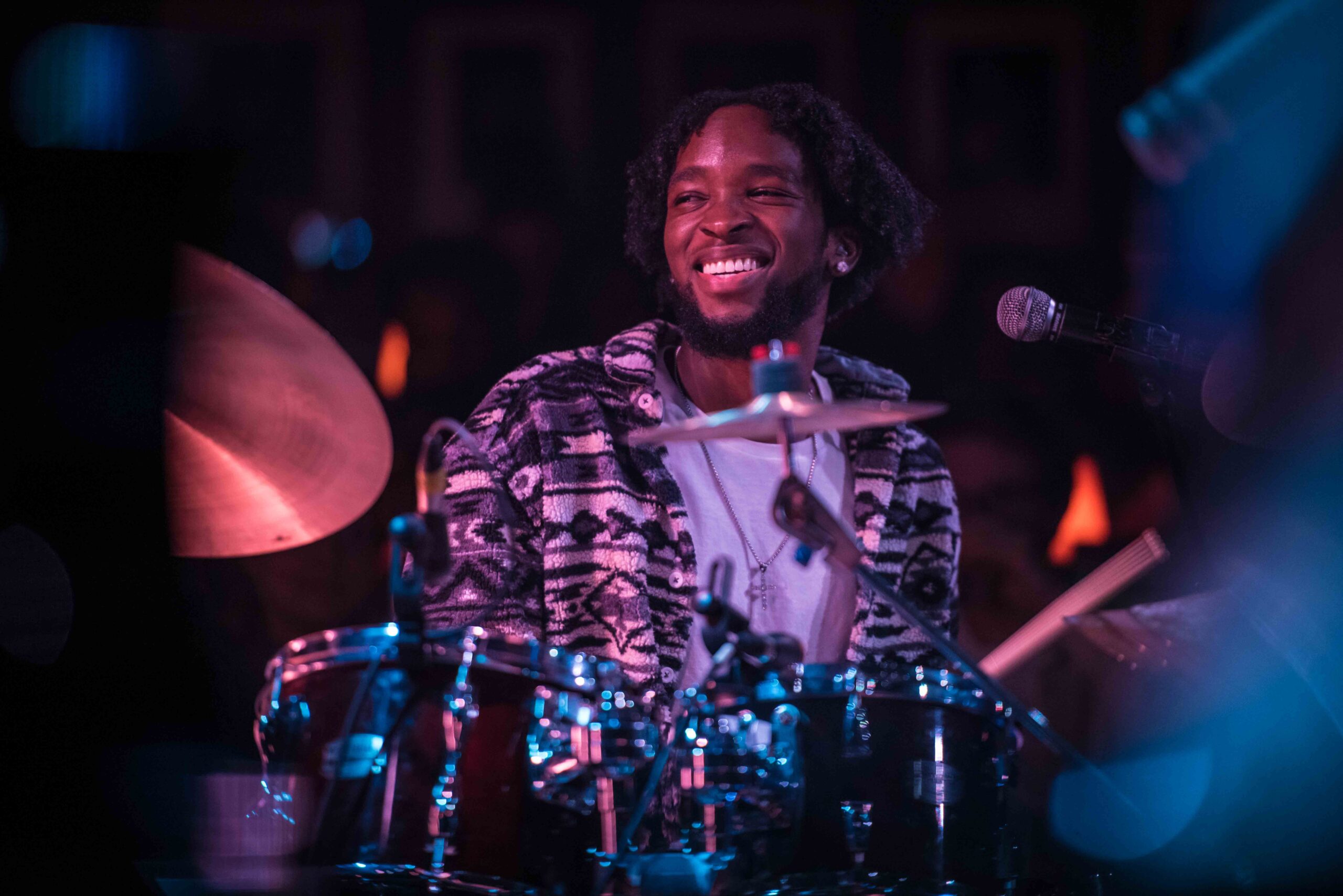 Jon Onabowu Interview Image (c) the artist
“You can write a feel but you can't manufacture it.“
Video