Name: Afro Celt Sound System
Permanent members: N'Faly Kouyate, Johnny Kalsi
Interviewee: Johnny Kalsi
Nationality: British-Indian
Occupation: Drummer, percussionist, composer, singer, songwriter
Current Event: Afro Celt Sound System are one one of the acts performing at the Musicport Festival 2024. Under the headline of “A Magnet for World-Class Musical Diversity,” the festival will take place at Whitby’s landmark Pavilion - Friday October 25 – Sunday October 27 2024. Get tickets here. Other acts at the event include Divanhana, Chahat Mahmood Ali Qawwal Group, Rokia Koné, Karolina Wegrzyn, Fulu Miziki as well as Jah Wobble and The Invaders of the Heart.
Recommendations: I would recommend a book called The Secret by Abraham Hicks.
Music: I still listen to Mezzanine by Massive Attack. I think this is/was ahead of its time. But then again - so was the album Big Drum Small World, also ahead of its time.
[Read our N'Faly Kouyate interview]
[Read our Divanhana interview]
[Read our Rokia Koné interview]
[Read our Karolina Wegrzyn interview]
If you enjoyed this Afro Celt Sound System interview and would like to know more about the band and their music, visit their official homepage. They are also on Instagram, Facebook, and Soundcloud.
Where does the impulse to create something come from for you?
The Impulse to create something can come from anywhere at anytime. I have found myself going into my studio with an idea at 3am or while walking around an electronic store once I “LaLaLa” a tune into a voice memo while walking around.
Sometimes it could be a guitar or kora lick or a nass line. Many things might turn into a piece of music even a Talking Drum or Djembe Rhythm.
What role do often-quoted sources of inspiration like dreams, other forms of art, personal relationships, politics etc play?
Yes absolutely, personal experiences, relationships or a situation can also induce a song. I remember speaking to Steve Knightley at a Shrewsbury Folk Festival in Shropshire, and asking him to work with me on a track. Eventually It happened but that idea was because of the amount of people moving away from their Country of Birth.
Also in the UK Brexit was also a big deal at the time. Migration is something that not all of us wish for, but sometimes this is forced depending on the circumstance.
For you to get started, do there need to be concrete ideas – or what some have called a 'visualisation' of the finished work? What does the balance between planning and chance look like for you?
I think this was answered in the previous. To be able to visualise the end result of what a track should sound like is also an art. There IS such thing as “Overproduction”. This is where you need adding more to a track when it doesn’t need it.
So to have an “End Game” for each production, is always a good thing. Inspiration comes from layering up adding effects and using the vast array of production technology available nowadays.
Is there a preparation phase for your process? Do you require your tools to be laid out in a particular way, for example, do you need to do 'research' or create 'early versions’?
We would usually only do some research if perhaps we may not have heard someone’s playing and we are interested in a collaboration.
One thing our late commander and chief Mr Simon Emmerson did was, get people together and also to bring the right colours and collaborations. This gave Afro Celts that unique sound. It stamped our music with that Afro Celt Brand.
With Simon Massey (Mass) in the production cockpit, it gave that electronic and Daft Punk sort of twist.
Do you have certain rituals to get you into the right mindset for creating? What role do certain foods or stimulants like coffee, lighting, scents, exercise or reading poetry play?
Stimulants? Coffee for me, of course. N’fally I don’t know. Rituals? A small thanks for being where we are to the Universe as an acknowledgement and name check before I would start any project.
Always Give Thanks. We are all where we are because we manifested it at some point. We made our lives what they are. We should give thanks for that, shouldn’t we?
What do you start with? And, to quote a question by the great Bruce Duffie: When you come up with a musical idea, have you created the idea or have you discovered the idea?
Sometimes this can be a musical idea that blossoms into something that is crafted and created with the end creation in mind. This can be anything from a glimmer of a tune that goes around or a bass line that has good movement and bounce.
They are enough to develop into something that can become a best hit.
When do the lyrics enter the picture? Where do they come from? Do lyrics need to grow together with the music or can they emerge from a place of their own?
Sometimes a song might start from vocals. The lyrics might be already written. They could even be partially written. As soon as this turns into something in the shape of a song, this can inspire the rest of the lyrics to be written.
Other times a tune has been the inspiration for lyrics. A song is not always conformed to a fixed structure. It can be open and not always symmetrical. In the past the AfroCelt signature were songs that did not have a fixed structure.
Often, while writing, new ideas and alternative roads will open themselves up, pulling and pushing the creator in a different direction. Does this happen to you, too, and how do you deal with it? What do you do with these ideas?
Like a game of tennis we record a bit and then pass it back to the other person. This is a great way to get a good sense of direction. This also helps to create boundaries of what can or can not be possible.
It is the creative ear and to know where the creator is taking the piece of music. For example, a quiet song that is gentle would not necessarily require a Drum and Bass beat over it (unless it was a remix).
There are many descriptions of the creative state. How would you describe it for you personally? Is there an element of spirituality to what you do?
As sense of spirituality is ALWAYS present in an Afro Celt Recording. It is the essence and within the tapestry of what becomes the song or piece of music.
The ancestors from N’fally’s Village to the Spiritual and musical guidance of Raag can show the way. Once the creative music shows the direction and colours it needs, then the pallet changes accordingly. Sounds become colours and the nature of what the song/music is about will show itself in the frequencies and form.
The development is created from layers and what we bring to the table. What brings us the end result is crafted from what is within and what has been installed through emotion and feeling.
When you're in the studio to record a piece, how important is the actual performance and the moment of performing the song still in an age where so much can be “done and fixed in post?“
Sometimes during the creation of a track, you get to see the performance as it will be on the stage. Other times you even know what colours the lights are and how dynamics will work with depth and with continuity for the flow of the stage performance. This is key to being able to display what the original creation was.
In essence, you bring the sound to the stage and animate this through talent and demonstrate through our instruments.
Once a piece is finished, how important is it for you to let it lie and evaluate it later on? How much improvement and refinement do you personally allow until you're satisfied with a piece? What does this process look like in practise?
Over-production is a thing. Keeping everything you have added into a pot for the mix becomes messy and the frequencies end up fighting for space. This causes distorted images and sounds. We would leave it and hear it on a variety of speakers.
I still remember working with Simon, we would burn of mixes onto CDs and then sit in his car to have a listen, then move it to the living room and have a listen. Then we would adjust the mix and do it all again. As pointless as this was at the time, we thought it was great to have that facility. Especially back in the days of Whirl-Y-Gig when we would play fresh new mixes fro the studio to try them out.
Even recording a solo song is usually a collaborative process. Tell me about the importance of trust between the participants, personal relationships between musicians and engineers and the freedom to perform and try things – rather than gear, technique or “chops” - for creating a great song.
It’s always best NOT to be too protective when there is more than one person involved in a recording process. This results in less tension to how one person hears something in their mind. The creativity flows better when you see what happens and let it go.
The only thing N’fally has to do is to make sure that the track makes sense lyrically.
What's your take on the role and importance of production, including mixing and mastering for you personally? In terms of what they contribute to a song, what is the balance between the composition and the arrangement (performance)?
Fortunately we do not need to worry about the mixing or mastering. This is done by 2 different people. Our job was made easy when Simon appointed Mass to Mix the Album and then to pass it to Simon from Superaudio for Mastering.
This made our job easier and to only concentrate on the creative element and adding the parts into the pot. This did not have a change in direction and Mass would always ensure the direction of the track remains as the producers wish for it to be.
After finishing a piece or album and releasing something into the world, there can be a sense of emptiness. Can you relate to this – and how do you return to the state of creativity after experiencing it?
In the past we have been together in a club and heard the DJ play some music. I remember looking at Simon who was looking amazed at the sound and said "this is great who is it?" I have then laughed and said “It’s us, Simon!” Sometimes, after so many creations, we forget that we had made pieces of music that we have not heard in a while. It’s always nice to hear it again after a while.
But there has never been an emptiness after making an album. There has always been the aftermath of things like artwork, release label, publishing etc to deal with. When we have the choice to do this on our own the doors for choices are many and wide to chose from.
Creativity can reach many different corners of our lives. Do you personally feel as though writing a piece of music is inherently different from something like making a great cup of coffee? What do you express through music that you couldn't or wouldn't in more 'mundane' tasks?
Creativity comes from inside us all. This is something that is intentional if we desire it. Manifesting is a big part of all this creation and will ultimately bring us what we want.
To be able to to manifest takes an understanding.

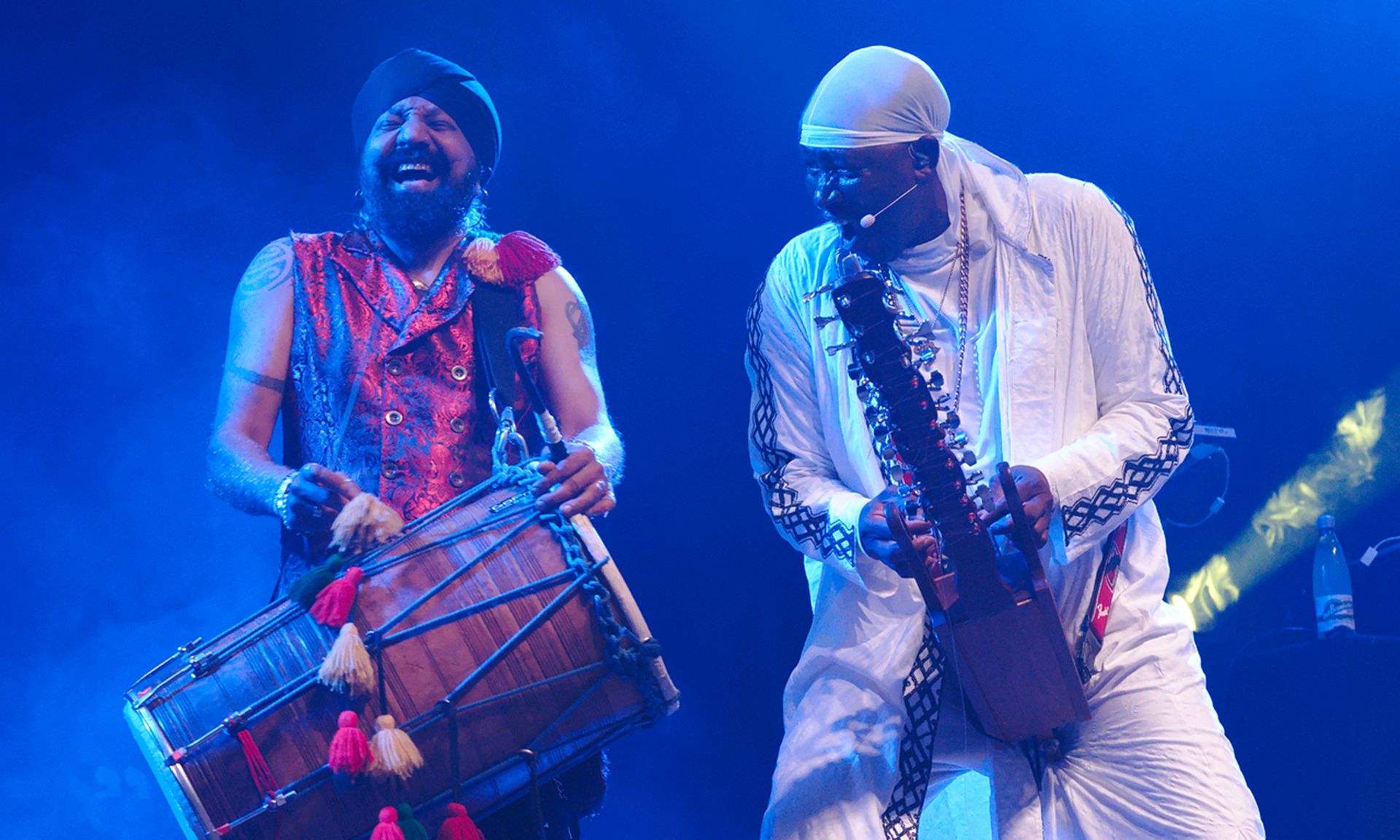 Afro Celt Sound System Interview Image (c) the artists
"It’s best NOT to be too protective when there is more than one person involved in a recording process."
Video