Name: Jessica Ackerley
Occupation: Guitarist, improviser, composer, visual artist
Nationality: American
Current release: Jessica Ackerley's new album All Of the Colours Are Singing is out via AKP. The album features Walter Stinson (upright bass), Aaron Edgcomb (drums), and Concetta Abbate (violin, viola)
If you enjoyed reading these thoughts by Jessica Ackerley, visit their personal website for more information. They are also on Instagram.
For a deeper dive, read our earlier Jessica Ackerley interview.
Over the course of their career, Jessica has performed with a wide range of artists, including Chaz Prymek, Patrick Shiroishi, and Jason Nazary.
[Read our Chaz Prymek interview]
[Read our Patrick Shiroishi interview]
[Read our Jason Nazary interview]
You moved to Hawaii in 2021 for a doctoral program in composition. What did you take from it so far?
My program focuses on intercultural composition, so the past two years have exposed me to a lot of incredible traditional music from Oceania and Asian regions. I am currently playing in a Javanese gamelan group and had the opportunity to work with musicians in South Korea.
It continually decenters western ways of thinking and approaching music that I have been taught in my previous musical education.
Hawaii is known as a remarkably beautiful island. But with its wide landscapes, it surely must also have a striking acoustic landscape. What are some of the sonically most striking places on the island for you personally?
The islands are iconic globally, and the pictures do not do it justice. It is also complex in its history with the occupation and overthrow of the Hawai’ian Kingdom by the United States.
I cannot say which exact spot is the most special because there is so much diversity amongst micro ecosystems across the island of O’ahu where I am located. You can find desert foliage and brown arid hills in one part, then drive 45 minutes into stunning lush greenery in another part. The ocean is a constant soundscape that I spend a lot of time and attention listening to.
My friend Gahlord Dewald, who plays bass on our record “Submerging Silently,” has been documenting and creating interesting work with sounds and location specific places on the island linked here:
Are you finding that your new environment is leading you to new shores – or is it showing you more clearly how you've always been in the first place?
With my move to this new location I am beginning to realize that I will always feel a sense of rootlessness and of a lack of “home’ within myself.
I see it more as an ever evolving growth rather than a return to who I am, it always feels like a continuous motion to me.
The press release for All Of the Colours Are Singing speaks about the benefits of quietude and solitude for your writing. But then there is also the inspiration that comes from being surrounded by incredible culture all the time in a big city. How do these two poles balance out do you feel?
Growing up in a rural small town for the first 18 years of my life and then spending the better part of my young adulthood in larger cities has made me pretty adaptable to both living situations.
I feel connected to both lifestyles and the energy that they bring in the day to day, and because of that it probably trickles down into my creative pursuits as well.
How would you describe the process that led up to All Of the Colours Are Singing?
Difficult and trying at times, with a lot of coordination with balancing my schedule and making this music.
Once I got to the other side of it I was amazed with my ability to finish this record despite the obstacles and challenges.
Parts of the music were written under very difficult circumstances for you personally. I was wondering whether you find that art becomes painful or helpful under such circumstances – or even impossible sometimes, as it has been for me?
Art can be an extremely important source for processing difficult life events that we might not be able to verbally convey or fully understand why they happen. It can provide paths towards healing and ways to reflect and I do think it can be helpful both for the artist and audience.
It seems to me that, musically, there are different stylistic strands woven through the pieces. Is it fair to say that you will sometimes use style as a compositional tool? Or did the pieces just very naturally move through these different segments, from gorgeous string quartet sections to fully-fledged jazz and rock explosions to introspective, pastoral fantasies?
I have a lot of musical interests and lately I have been curious about creating forms that juxtapose ideas with the goal of a unified flow.
I like the challenge of taking two ideas that seemingly might not “fit” together and piecing them together in a way that can make sense despite their stylistic differences.
What role did improvisation play for All Of the Colours Are Singing? There seem to be many instances where you're improvising on top of a given structure, but the “solo” is so perfectly in tune with the band that it could just as well be written out in full.
The improvised sections for most of the songs on this record are free form in terms of the written direction I am giving the band. We are not sticking to any specific form once we break free from the melodic written structures. Maybe the occasional mode or tonality is indicated on the sheet music but it is never strict in terms of bar length etc … like, say, a jazz standard.
I think it also speaks to the band’s ability to listen and make musical decisions in the moment.
There is an interesting aspect to the album of the visual arts feeding into the music. When I listen to music, I see shapes, objects and colours. What happens in your body when you're listening? Do you listen with your eyes open or closed?
I have been listening to a lot of music with my eyes closed recently and have definitely noticed how it changes the listening experience.
I am also pretty stoic when I perform because I continuously strive for focused listening when playing. My body does not move much because of that.
You told me in our last interview that, when you were younger, “sound and visual concepts [...] felt like they were interchangeable as a form of expression.” This begs the question, what do you want, and need to express and what can you express through them?
My hope is that one day they can be fluid in their transaction with how they inform each other’s creative ideas. It is a continual practice that I am working on and discovering new ways in which they can work together.
I think the expression I am seeking is the ability to transition from music to visual art and vice versa without pause or need to recalibrate, having it be a free flow process between both disciplines.
In her insightful article on the album, Stephanie Manning wrote about you: “After a career as a performer, Ackerley now puts their energy toward writing music.” Do you think that one aspect of this is that by writing more and performing less, your music is approximating the condition of drawing and painting more?
I write more because I have less opportunities to perform these days. I spend more time making music by myself and because of that and am glad that I have dedicated creative energy towards pre-composed music.
It has helped fill in a slice of that void for me that has been lacking from my former busy performance schedule.
The article shows one of the drawings you made which then turned into a piece of music. Were these drawings always intended as triggers for music? Do you see them as “scores”?
The past several pieces I composed started as drawings and used as a map to clearly lay out structures in arch, density, dynamics and phrasing. Having done this a few times now I am always surprised as to how these visual roads help guide the music in the notation stages.
Is there a difference between using one of your own drawings as a starting point or someone else's painting?
Yes, my drawings are rough images of the synesthesia that I experience from music in my head. It is unique to my own experience.
If I were a performer seeking inspiration from another visual artist I would prefer to take it from the approach of responding to the image rather than reinterpreting it.
Can you describe how the translation process from image to composition works? Does the reverse also occur – that a piece of music leads to a visual artwork?
For my own process, I haven’t created any visual art inspired by my music yet, it has always been the other way. But one day I would definitely be interested in exploring that process.
Do you feel as though writing or performing a piece of music is inherently different from something like making a great cup of coffee? What do you express through music that you couldn't or wouldn't in more 'mundane' tasks?
Music takes a tremendous amount of focus for me. When I am going through my routine day to day with tasks and upkeep it is easier to dream and wander in my mind.
But when I am making music or performing, it is always my sole meaning in the moment.

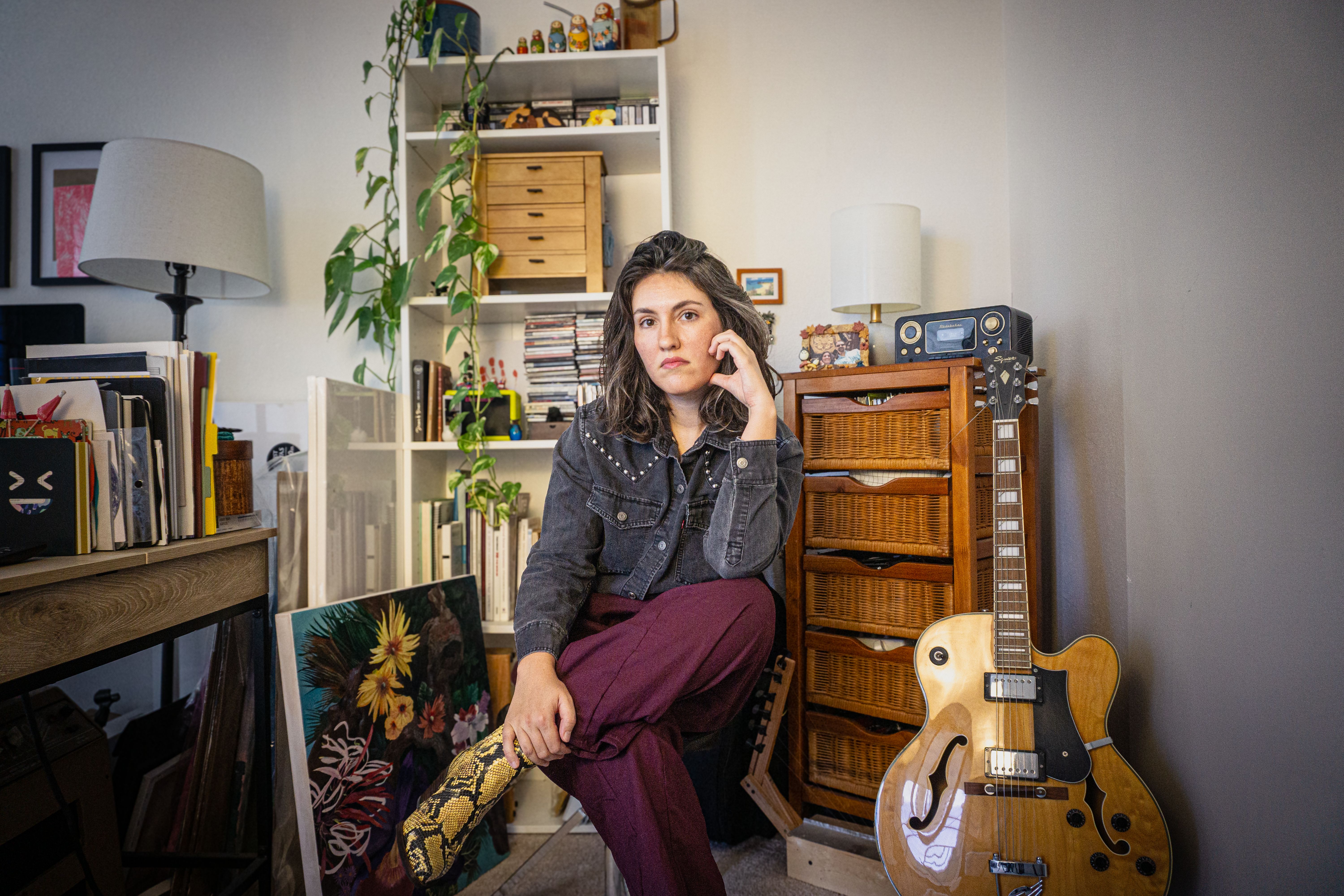 Jessica Ackerley Interview Image by Michael Kochman & Jessica Ackerley
"I like the challenge of taking two ideas that seemingly might not “fit” together and piecing them together in a way that can make sense."
Video