Name: Patrones
Members: Carlos Icaza, Mike Sandoval, Humberto Polar, Yudith Rojas
Interviewee: Humberto Polar
Nationality: Peruvian
Occupation: Composer, guitarist, improviser, DJ, producer
Current release: The self-titled debut album by Patrones is out via Tenorio Cotobade & Sometimes Music.
Shoutouts: There are many artists and approaches I listen to with true admiration. I will choose a Peruvian cello player, Fil Uno, whom I admire a lot. He developed a cello improv concept that is nurtured by music from the Andes, Italian baroque and noise. I’ve recorded with him and I think his music is as jazz as it gets, even though he never labels it that way.
Hometown Recommendation: I live in the countryside now, but lived in Mexico City for 20 years. You have to go to Salon Los Angeles on a Tuesday afternoon, to see senior people dancing in fancy outfits to big bands playing danzón and Cuban music from the 50s. Quite an experience.
Things that I am passionate about but rarely get to talk about: I write and publish poetry as well, and read lots of poetry. I adore it. It’s one of the very few things capitalism cannot abduct. There are no Netflix series out of a poetry book. Nolan’s Odyssey is not based on the poetic side of the original.
If you enjoyed this Humberto Polar interview and would like to know more about his music and upcoming concerts, visit his official homepage. He is also on Instagram, and Facebook.
What were some of the musical experiences which planted a seed for your interest in jazz?
I was born and raised in Lima, Perú. Not a jazz spot at all, but my dad had a small, interesting record collection, mostly classical and Latin American pop from the 50s-60s.
Among those records there were 2 weird jewels, local albums both by Jaime Delgado Aparicio, who was a young Peruvian jazz pianist and composer who just graduated from Berklee and happened to be my dad’s friend. One was a trio session, the other was a test pressing with big band arrangements for the soundtrack of a Peruvian film.
For all my childhood and teen years that was the only definition of jazz I had access to.
Then, when I joined the university, I started to know the jazz universe from the roots and became quite a fan and listened to all the founders, the great black masters.
But the seed in me came from music very isolated from the canon. I still have those two albums and listen to them frequently.
What does the term jazz mean today, would you say?
It means two things to me: a powerful culture defined by a very concrete, Afro-American tradition, and a state of mind for musicians to expand the very idea of improvisation in music.
In my opinion, if you label your music as jazz today, you have to respect and understand both principles.
As of today, what kind of materials, ideas, and technologies are particularly stimulating for you?
I work a lot with machines and software designed for producing electronic music, so all my work is crossed by the idea of blending skillful instrument playing and technological means for composing and producing.
The aesthetics and formal territories from that blend are huge and still underdeveloped in my opinion. So that’s stimulating.
Where do most of your inspirations to create come from – rather from internal impulses or external ones? Which current social / political / ecological or other developments make you feel like you need to respond as an artist?
As I said, I’m from Peru and have been living in Mexico for more than two decades. So my work is focused on understanding and deconstructing all the colonial paradigms that we Latin artists are forced to follow, even in an extremely subtle way.
I aim to fight the need for validation from the Eurocentric ways of qualifying art, or the way US-western capitalism imposes a definition of what is good art in our countries. So everything I do in music comes from there, it’s political at the core.
Tell me a bit about the sounds & creative directions, artists & communities, as well as the colleagues & creative hotspots of your current hometown, please. How do they influence your music?
In Patrones, my new album, I worked with three amazing artists from the Afro-Peruvian community, and made a connection between them and some Mexican musicians I work closely with, Carlos Icaza and Mike Sandoval. We invited a Cuban trombonist living in Mexico, Judith Rojas.
So I managed to build a really interesting network of creative people just based on their quality as musicians and human beings. It’s really as simple as that. Great artists around you are the greatest influence for your art and your life.
What role do electronic tools and instruments play for your creative process?
As I said, my whole work is based on how to develop an aesthetic in that intersection.
I don’t see myself as a jazz musician in the sense that, as a guitar player, I’m way behind the technical skills of a proper guitarist. I wish I were John Scofield, but I’m not and will never be.
But I consider myself a composer with enough knowledge of some instruments -electronic and acoustic- to perform jazz-infused music and explore improvisation from my native traditions.
Thanks to technological advances, collaboration has become a lot easier. What have been some of the most fruitful collaborations for you recently and what approaches to and modes of collaboration currently seem best to you?
Actually, Patrones is the result of recordings made in different places and moments. My editing capabilities -coming from 20 years of producing electronic music- made it possible.
I used to think that jazz was only possible if the musicians played live, all together. But then there is the Miles Davis-Teo Macero reference on editing sessions.
Ultimately, I believe every musician should be able to build the way that works better for their projects, as long as they’re honest and creative.
Jazz has always had an interesting relationship between honouring its roots and exploring the unknown. What does the balance between these two poles look like in your music?
Well, it’s very difficult to plan that outcome. It’s a matter of having a conceptual framework and then playing and listening to what happened.
Honouring the roots is something you bring yourself in your playing, your grammar. Exploring the unknown is what you do when you’re invited to, by the compositions or by your bandleader.
How much potential for something “new” is there still in jazz? What could this “new” look like?
Jazz is a pretty new musical path, with many developments along the 20th century that are clear and easy to describe.
The introduction of electronic strategies in jazz, starting with the use of electronic instruments or hip-hop/sampling language is super new. As I said before, there’s an aesthetic fertile ground there that should bring very creative developments.
We musicians have to free ourselves from prejudices and constructions. A lot of those constructions are ideological blockades disguised as principles.
For many artists, life-changing musical experiences take place live. How do you see that yourself?
Absolutely.
That’s because music is first and foremost a collective experience. You can listen alone at home and have an experience, but the one you have performing for others, or as part of an audience is way more emotional.
How would you say your live performances and your recording projects are connected at the moment? How do they mutually influence and feed off each other?
Since my music is mostly improvisational (even my DJ sets, since I don't plan the records I will play) the connection between playing live and recording is very tight.
The way I see it, you have to be ready to play what is in your mind in any setting. So you gotta practice and be close to your tools.
Improvisation is obviously an essential element of jazz, but I would assume that just like composition, it is transforming. How do you feel the role of improvisation changed in jazz?
Maybe the most interesting change on improvisation in the jazz context comes from the openness to other improvisational traditions.
We all know that western scales, chromatism, modes, changes and swing/speed shaped the Afro-American jazz improvisational vocabulary, but there are many other ways. Pentatonic Andean music, flamenco music, jarocho music from Mexico, Afro-Colombian music …
Jazz tends to demand that only virtuosos have a place in its canon, but virtuosity means different things in other improvisational traditions. Playing that in a respectful, educated way is expanding what jazz is, conceptually.
What, would you say, are the key ideas behind your approach to improvisation?
Be convincing in my instrument. Saying what I really think.
Be a part of something bigger, meaning the band I play with or the concept I want to embrace.
The Montreux Festival intends to preserve its archive of recordings for future generations. Do you personally feel it's important that everything should remain available forever - or is there something to be said for letting beautiful moments pass and linger in the memories of those that experienced them?
I believe in archives. I learned most of what I know from listening to recordings and understanding the ideas of the masters.
On the other hand, I distrust digital archives. Having everything in bits means giving the control to others, the ones who build the storage systems and can decide that you cannot reach to your files anymore.
In many ways. I believe in physical support. The problem is the storage space. But in that sense, I join Borges in imagining the world as an immeasurable library, where you can get lost and forget about everything else.

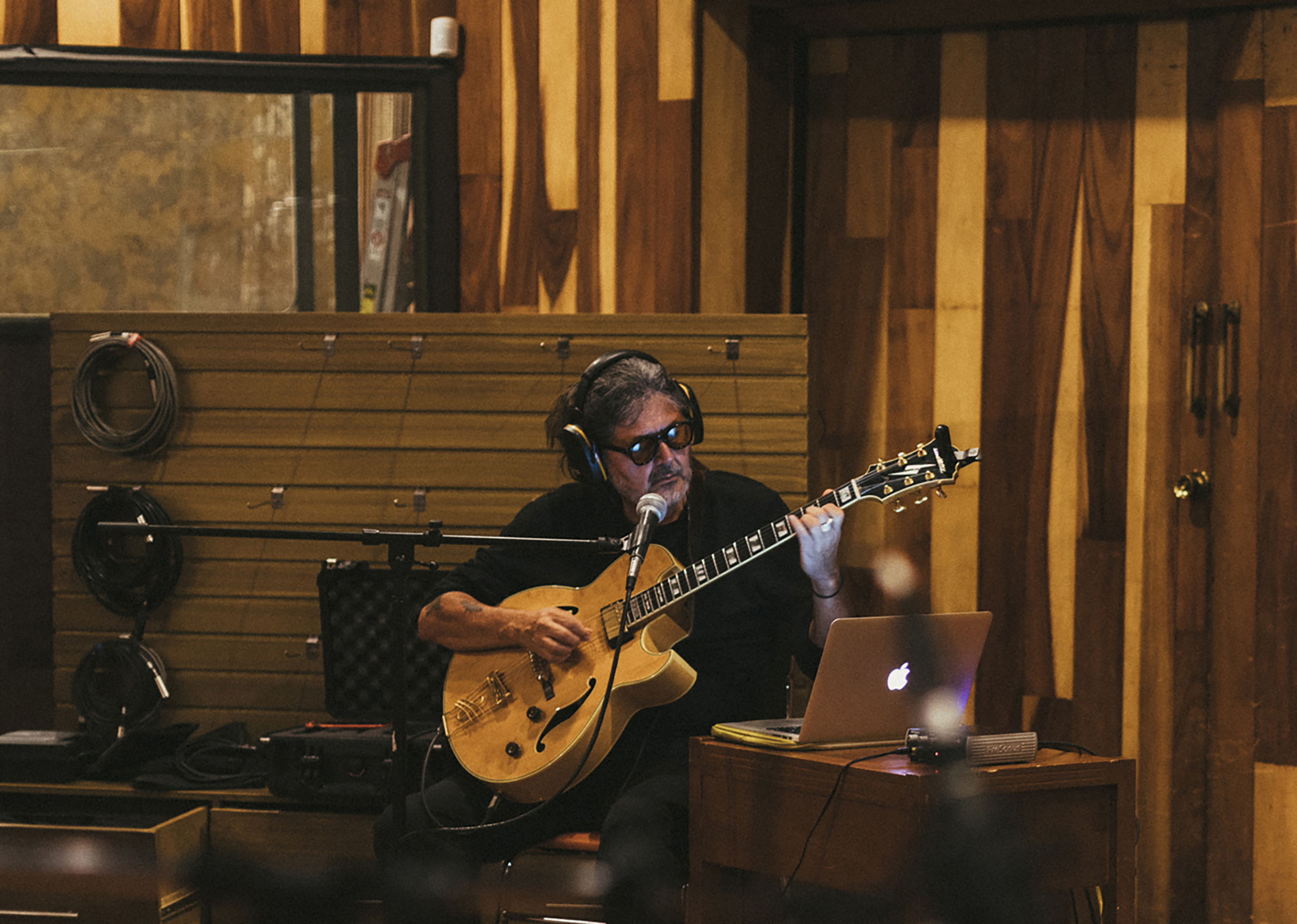 Humberto Polar Interview Image (c) the artist
"Great artists around you are the greatest influence for your art and your life."
Video