

Part 1
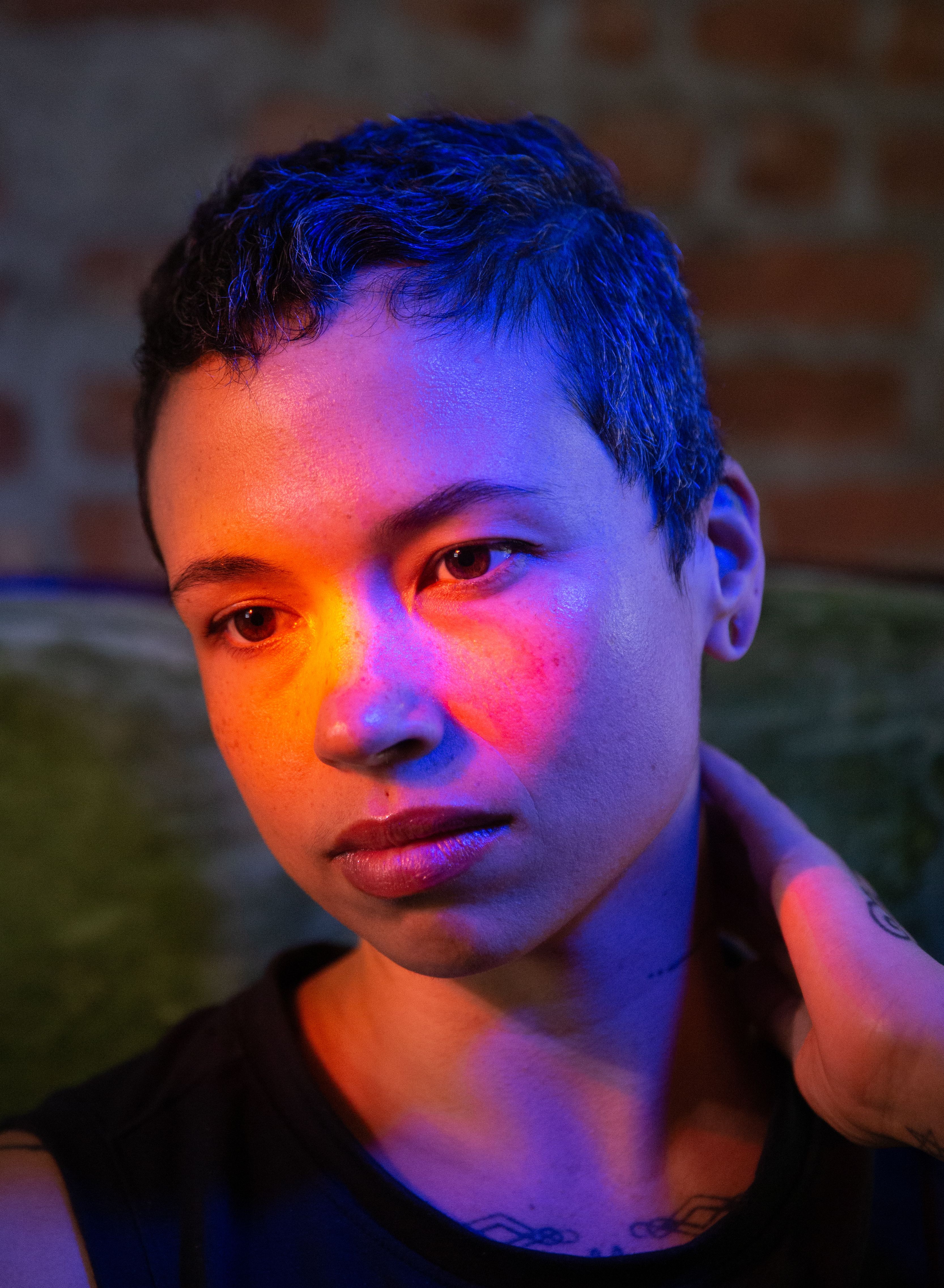
Name: Holland Andrews
Occupation: Singer, composer, performance artist, and clarinetist
Nationality: American
Current release: Holland Andrews's Answers EP is out via Nils Frahm’s LEITER.
Recommendations: Sand Talk by Tyson Yunkaporta
If you enjoyed this Holland Andrews interview and would like to stay up to date on their music, visit their official homepage. They are also on Instagram, Facebook, and Soundcloud.
To keep reading, we recommend our selection of interviews with other LEITER artists:
[Read our Nils Frahm interview]
[Read our Alexandra Hamilton-Ayres interview]
[Read our Fabian Willmann interview]
[Read our Minua's Luka Aron interview]
[Read our Minua's Kristinn Smári Kristinsson interview]
Do you think that some of your earliest musical experiences planted a seed for your interest in sound?
Yes, absolutely. Music has been around me since the day I was born having been a part of a musical family on my mother’s side.
My mother and my aunts were singers who used to tour in a singing group together in the 70s. During Christmas we would have mini talent shows where one of the kids got to perform a song or dance, so there was always a lot of encouragement for performing growing up, especially from my mom’s side of the family. My father was always someone who appreciates music and the arts even though he is a very technically minded civil engineer who wanted me to go to college and get a degree (and I never did either. Sorry, Dad!)
As a child I remember music being first thing to make me feel euphoria. We had an old organ in our house that no one ever played, except I remember sitting at the organ and playing three notes over and over and over again: A, C, B. C, A, B, in that order. (I didn’t know the names of the notes at the time, and actually didn’t know until I checked just now. Ha!)
As a child, maybe 3 or 4, I’d play this pattern slowly, holding each note out long and not changing until it felt right. It’s was a bit dark in tone, but it gave me such an exciting feeling of wonder. I suppose nothing felt resolved about these notes altogether and I suppose liberating.
Do you experience strong emotional responses towards certain sounds? If so, what kind of sounds are these and do you have an explanation about the reasons for these responses?
I have deep visceral responses to certain kinds of sounds, some blissful, emotional experiences, and some that fill me with rage, which is often called as misophonia. In terms of the misophonia, I think it helps me calculate what sounds align with the intended feeling of a piece, and if a sound is texturally out of place, or going on for too long, then I feel quite a bit of irritability. Some of my favorite sounds are tight tonal clusters that seem to have at least 3 different emotions inside of them.
I tend to respond very deeply to music that tells a whole story of being incomplete and perpetually changing. I always come back to the idea of what feels like truth to me. My explanation of that is that perhaps my introduction to the world came with a lot of not understanding why things were so painful potential to be like heaven.
So the clarity of truth brings me peace, even if it’s hard to accept or complex.
Are there places, spaces, or everyday devices which intrigue you by the way they sound? Which are these?
I am intrigued by sounds that are created in specific circumstances. For example:
Hearing someone wearing an abundance of metal bracelets fanning themself with a piece of paper. A naturally harmonic mechanical drone. I love hearing the wind blow so fast that it whistles while trees rustle and then the rain comes. In the refrigerated section at Kam Yeun Supermarket in Brussels, there is an incredible humming sound. I love the sounds of a megaphone in the distance and people cheering demanding the liberation of an oppressed people.
I love how things sound when they are so far away you don’t know what it is but it’s beautiful.
For some, music equals sound, to others they are two distinct things. What is the relation between music and sound for you? Are there rules to working with sound, similar to working with harmony, for example?
The relation between music and sound to me is determined by the context in which I’m experiencing them or how I choose to use them.
For example, I have a personal listening practice of sitting somewhere outside, or going on a walk, and imagining that everything I hear is part of an improvised music score written, so I get to listen to sounds that become musical works with intention and spontaneity. In that context, the sounds are the music. The line between the two for me is very subjective and really depends on my intention.
And as far as music rules, objective rules for all music do not exist. For myself, I have preferences of the places I like to be emotionally for what I am composing and can use rules to play improvisation games.
What were your very first active steps in terms of working with sound and how would you rate the gains made through experience?
My first active steps began with recording my voice, clarinet, and tenor saxophone into GarageBand when I was 18 and making my first attempts at writing music. Since I don’t play piano or guitar, I needed to first write music by recording and layering chords together note by note with the only instruments I knew, voice and woodwinds.
I now get to live my life making music, which at the time wasn’t something I knew would be possible for me when I was 18.
For your own creativity, what were some of the most important things you learned from teachers/tutorials, other sound artists, or personal experience?
First and foremost I think just playing music and improvising with friends on a regular basis is a really great way I got to grow creatively, especially because I have always had a diverse friend group where everyone has unique approaches to musical creativitly.
I didn’t go to school for music, or to university in general, so I got to learned so much in being in bands with friends, playing shows together, and going on tour and seeing all different kinds of artists perform. Being inspired by the community I was in also opened door for new things to try.
For example, I ended up writing music for dance because I knew dancers and we began to improvise together, and that opened up my entryway into scoring film, and playing with sound design for theater. Over time, I developed a unique set of skills which I continue to grow upon, and so much of it got to flourish because of my community.
How and for what reasons has your music set-up evolved over the years and what are currently some of the most important pieces of gear and software for you?
My live set up began with pedals back in 2010, which is primarily what I still use today, with some additions of using samples I trigger either from an iPad or my phone. I still have not performed live with Ableton.
Before I ever played a live solo show, I was in a friend group of people who were mostly guitar players in math rock and punk bands. I had been writing music just on GarageBand and someone heard my music on MySpace and reached out to me to see if I wanted to open for them, not knowing I had never played a solo set before.
I said yes and then I asked my friends what gear I should get to perform live, and they all suggested to start with pedals. So I got a loop pedal, reverb, and a delay pedal and I was writing songs with voice, clarinet, and a toy glockenspiel. As time went on, I wanted more low end, so I got an octave pedal that serendipidously also had distortion, and the more comfortable I got with pedals, the more I got to try adding and taking them away from my setup.
I’d say for live, my most important piece of gear is my over a decade old and trusty Boss RC 20 xl. Nowadays, I am writing music on Ableton and blending what I write with my pedals with other elements I compose on Ableton.
Already as a little kid, I was drawn to all aspects of electronic/electric music but I've never quite been able to put a finger on why this is. What's your own relationship to electronic sounds, rhythms, productions like – what, if any, are fundamental differences with “acoustic“ music and tools?
It is hard to put a finger on isn’t? My relationship with electronic music began with playing video games on gaming systems from the 90s like Super Nintendo and Gameboy Color.
I remember having a Gameboy Color and playing my first games, which I think was Super Mario Bros and Pokémon Blue Version, and feeling like all of the sounds that were coming from the game were symbols working under extremely restricted conditions to evoke a feeling of a universe or another dimension. My child brain was able to together what the symbolic beep boops meant and I felt moved by the complexity of the 8 bit sound.
I think because of video games, I saw all electronic music as symbols that I was able to decode the meaning and feeling of. Electronic music is just sound world building with technology that requires electricity, whereas acoustic composition is sound world building with technology can emit vibration without electricity.
To me, electronic music can possess a specific kind of nostalgia that feels like an open door for a starting place to write something new.