

Published
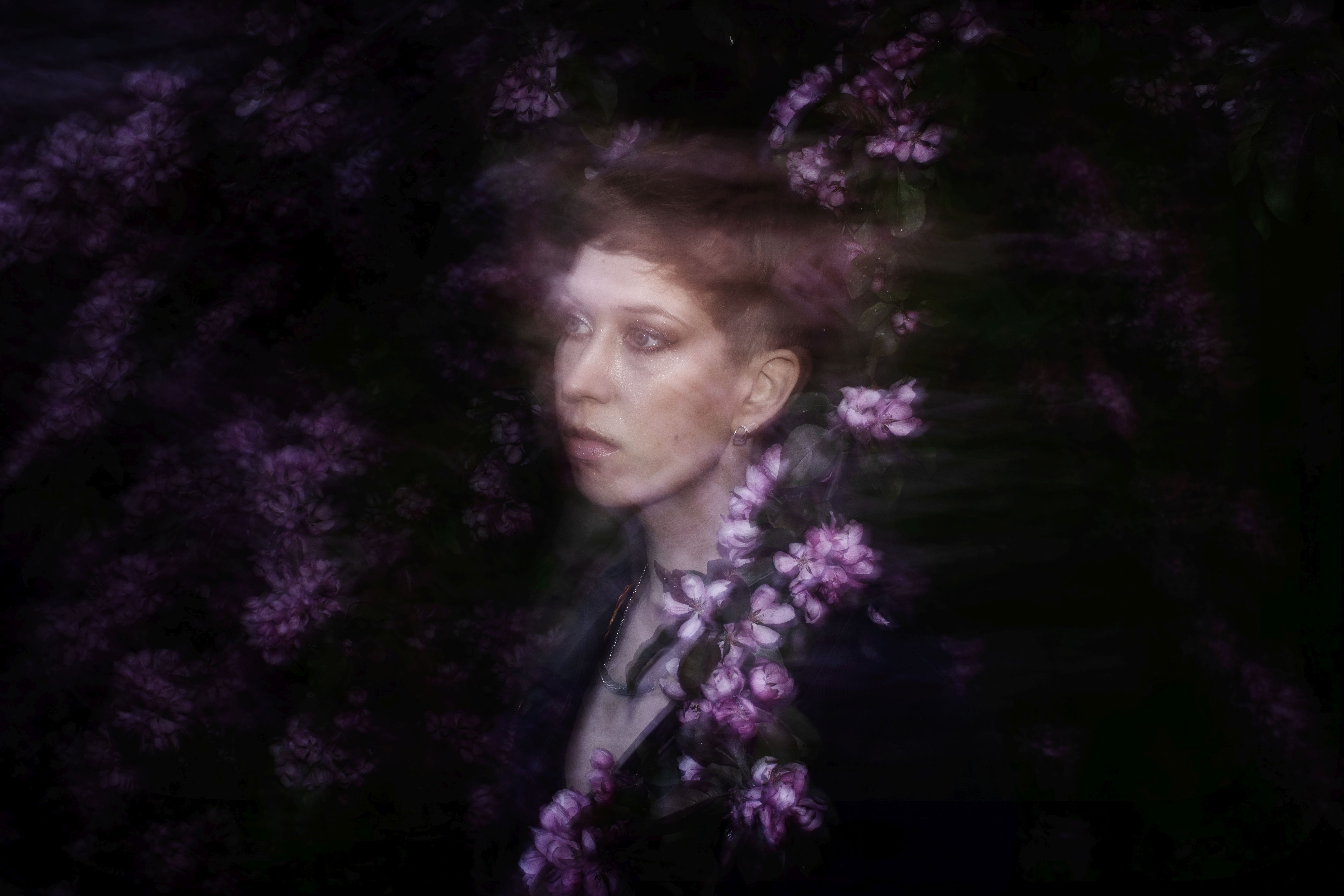
Name: Heli Hartikainen
Nationality: Finnish
Occupation: Saxophonist, clarinetist, composer, improviser, sound artist
Current Release: Heli Hartikainen's CHRONOVARIATIONS, featuring Esther Calderón Morales on live electronics and programming, is out via Multiphonic Works.
If you enjoyed this Heli Hartikainen interview and would like to know more about their music, visit their official website. They are also on Instagram.
For a deeper dive, we recommend our earlier interview with them about Instruments as an Extension of the Body.
Derek Bailey defined improvising as the search for material which is endlessly transformable. What kind of materials have turned out to be particularly transformable and stimulating for you?
Lately, I’ve been really into studying overtones—the physical phenomenon of frequencies caused by resonance. Amplifying, emphasizing, and making these harmonics more audible has been a huge inspiration for my new album CHRONOVARIATIONS, where this tactile quality of sound manifests in resonating metal objects where my saxophone sound is sent through electromagnetic actuators. I also use saxophone overtones as a special technique to bring new colors and textures to my melodic material.
Another big theme in CHRONOVARIATIONS is unfolding, where a constant chain of variations builds an immersive stream of sound. During my studies at Sibelius Academy, I really dived into the methods of improvising and variating in archaic Finnish folk music. The way ideas are patiently developed and themes are highlighted from all angles has been super significant to me.
When you're improvising, does it actually feel like you're inventing something on the spot – or are you inventively re-arranging patterns from preparations, practice, or previous performances?
It’s really important for me to challenge myself as an improviser. That’s why I’ve created this rule for myself: when performing, I always give myself a task to lead myself into “trouble” at least once during the gig, and often this means pushing my physical strength and technical abilities, like speed and dynamics, to the absolute maximum, so that I definitely need to get out of my comfort zone and come up with something completely new and creative.
When I’m listening to a music performance or watching a theater play etc., what captures me the most is when something unexpected happens—when the performer steps out of their comfort zone. That’s where the magic happens, and the atmosphere becomes truly interesting and exciting. Seeing someone conquer what initially seemed impossible is incredibly rewarding.
That’s why I want to challenge myself while improvising too. It’s like abstract problem-solving in real time, following the logic of the ongoing music – or completely breaking it, if needed.
Are you acting out parts of your personality in your improvisations which you couldn't or wouldn't through other musical approaches? If so, which are these? What, would you say, are the key ideas behind your approach to improvisation?
Improvisation definitely brings out parts of me that might not come through playing thoroughly composed music. When I'm improvising, I feel like I’m tapping into a more instinctual, raw part of myself. Sometimes I’m surprised by where the music takes me, and when I’m in a good flow, I can’t even remember what I just played. It’s like I’m accessing something deeper, subconscious, that I don’t usually reach in more structured compositions.
This process is quite interesting, since while improvising I think that I'm 100% focused on the music, and it follows a certain kind of logic (a logic can be that it has no logic). I still think I'm consciously fully responsible for my decisions while playing. But afterwards, I don’t always know what the impulse was that guided me. That’s one of the things I love most about improvisation: it allows me to explore and express parts of something subconscious, to get surprised by my own mind.
A key idea in my approach is to stay open to all the impulses around me. I’m inspired by the concept of “ekphrasis,” which is about translating one form of art into another. For me, it’s about making music from anything that catches my attention, whether it’s visual art, a spatial installation, photography, or just the atmosphere around me.
In terms of your personal expression and the experience of performance, how does playing solo compare to group improvisations?
In improvisation, for me, textures, dramaturgy, timbres, directions and forms play a big role. When I’m improvising solo, I find inspiration within myself and my surroundings, creating this inner logic for whatever kind of web of sounds I’m creating.
In a group improvisation, though, communication with the other artists is key. No matter how great an instrumentalist you are, in group improvisation, the ability and willingness to listen is more important. In group improvisation, in my opinion, you have to be willing to lift others, make them sound good, and push them to shine. It will then work the other way round too.
In your best improvisations, do you feel a strong sense of personal presence or do you (or your ego) “disappear”?
I think this is really connected to the flow state: when I’m not fully in that state, there’s an inner monologue where I might be considering for example the harmony I want to explore or other aspects of music I could bring into the play, the mood, the occasion – basically having this constant analysis and process of intellectual decision-making.
But in flow, when everything is working—my body, breathing, fingers, and the instrument—I can let my guard down and fully immerse myself in the music. The inner monologue falls silent and is replaced by a stream of “thinking in music,” where reaction time is non-existent.
In that flow state, all of that conscious thinking disappears, or if it’s there, I don’t remember it later. It’s instinctual, a state where I’m physically and mentally one with my instrument. That’s when I know it went well, or that I’ll be happy with it when I listen back. It means I was fully immersed in the music, not concerned whether it’s “good”, interesting to the audience, how I look, what people will think, or if the harmony or melody is sophisticated—just creating from my artistic subconscious.
In a live situation, decisions between creatives often work without words. From your experience and current projects, what does this process feel like and how does it work?
For me, one of the most crucial aspects of group improvisation is the “yes, and” mindset—the idea of building on each other’s contributions to keep the music evolving. This doesn’t mean we’re always in harmonious unison; sometimes the best way to push the music forward is by introducing contrasting ideas, like a “counter melody” of sorts, that expands the overall expression.
In cases like CHRONOVARIATIONS then – it is what I call a ‘scored improvisation.’ It’s basically a timeline of tasks, missions, and directions, notated only in graphic cues without any traditional notational systems. The long arc/structure/dramaturgy is about the same every time, but within the sections, the execution is always different and fully improvised.
This, again, reflects my musical aesthetics; it’s not about the notes, it’s about the dramaturgy, the soundscapes, the immersion, the intensity, the textures, and the direction.
I’ve worked closely with sound artist Esther Calderón Morales, who plays the live electronics on the album, for three years now, developing the piece and its musical aesthetics and inner logic. We’ve learned to communicate through sound, sculpting the piece out of the endless possibilities electronics provide.
With Esther, I feel supported artistically and musically; she knows how to push me to excel every time. It’s about sharing the aesthetics, motives, and having this common “language”, communication and trust, which makes it safe for both to experiment, try out completely new and crazy things, knowing you are supported and encouraged.
Stewart Copeland said: “Listening is where the cool stuff comes from. And that listening thing, magically, turns all of your chops into gold.” What do you listen for?
I’m listening for empty territories to concur, a way to make the “composition” richer and fuller, to enhance the dramaturgy, and to bring movement.
I love it when a sound has a strong quality, whether it’s a mushy bass, screeching electric noise, or an acoustic instrument with rich, ringing overtones. I’m drawn to different textures—huge masses of very quiet sounds, immersive, evolving, and bubbling streams and soundscapes. These are the things that I am drawn to and that work as a constant source of inspiration for me.
When improvising, I listen with all my instincts, being in the moment, inhaling the atmosphere, and exhaling sound.